
Published on Sep 28th, 2026
1985: Premiere performance of a Shulamit Ran commission
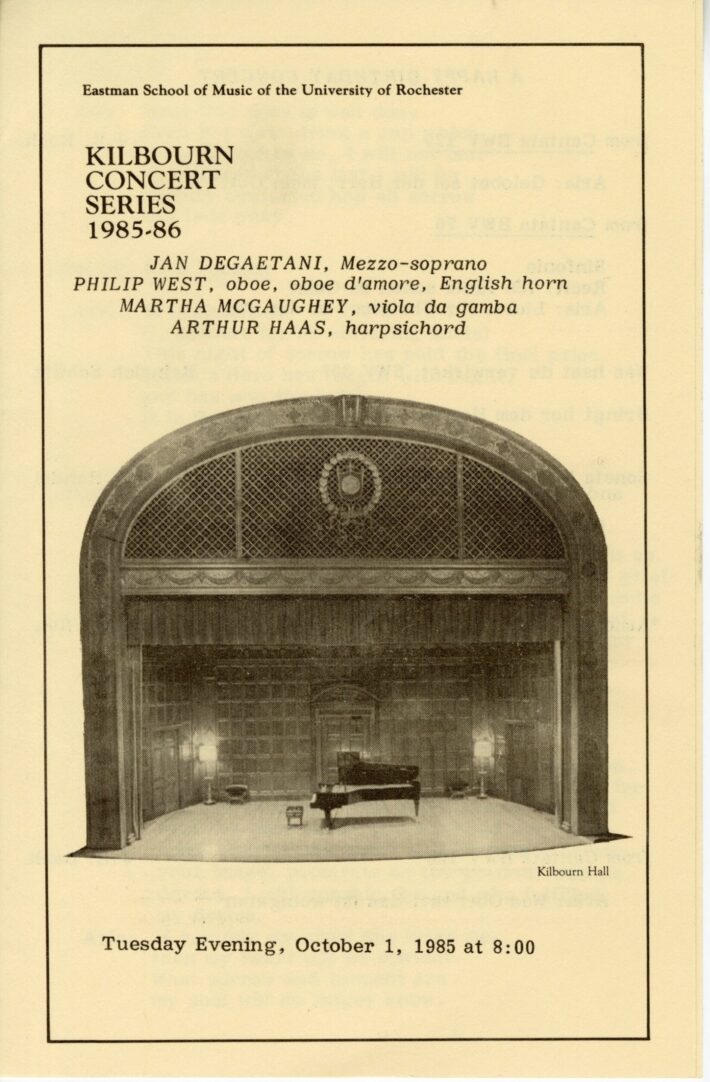
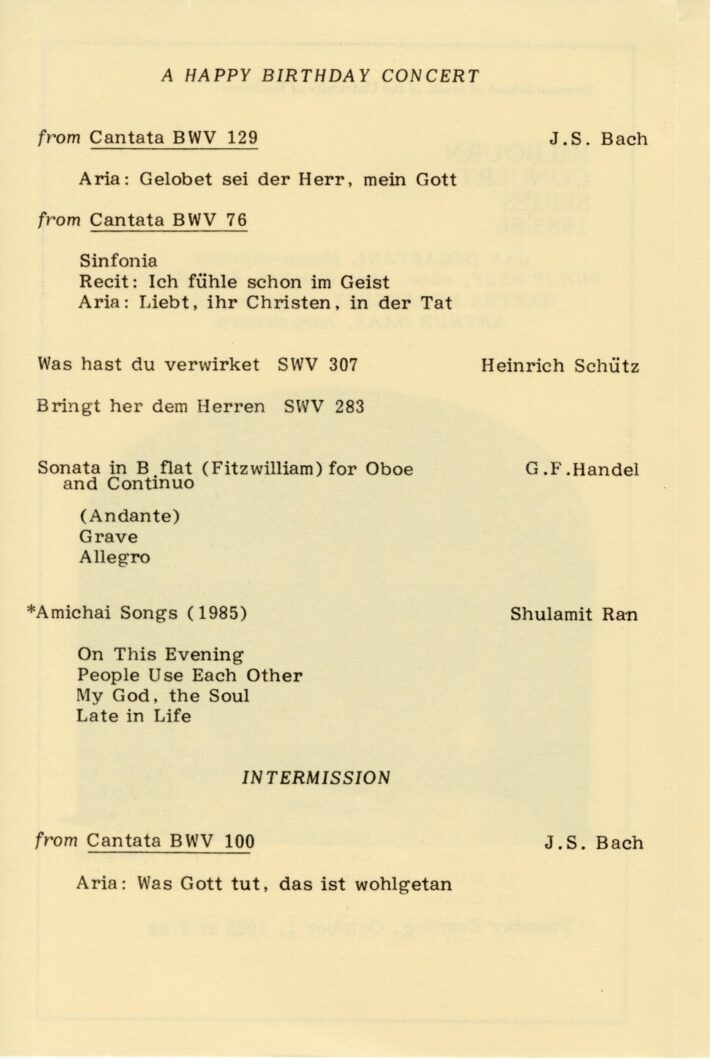
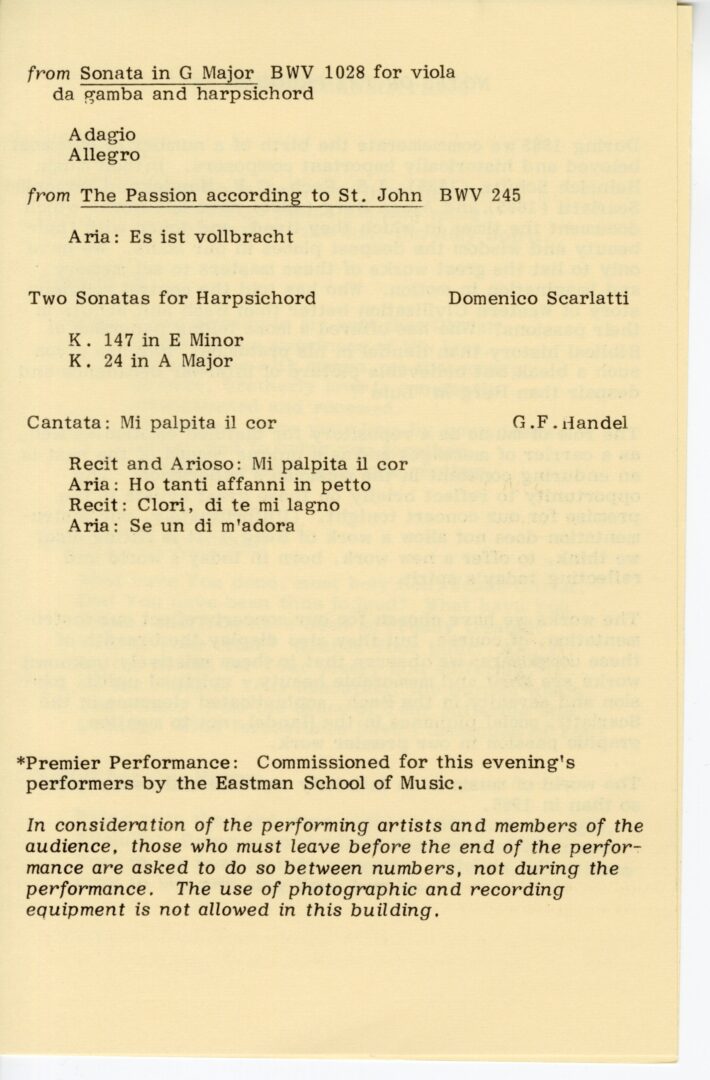
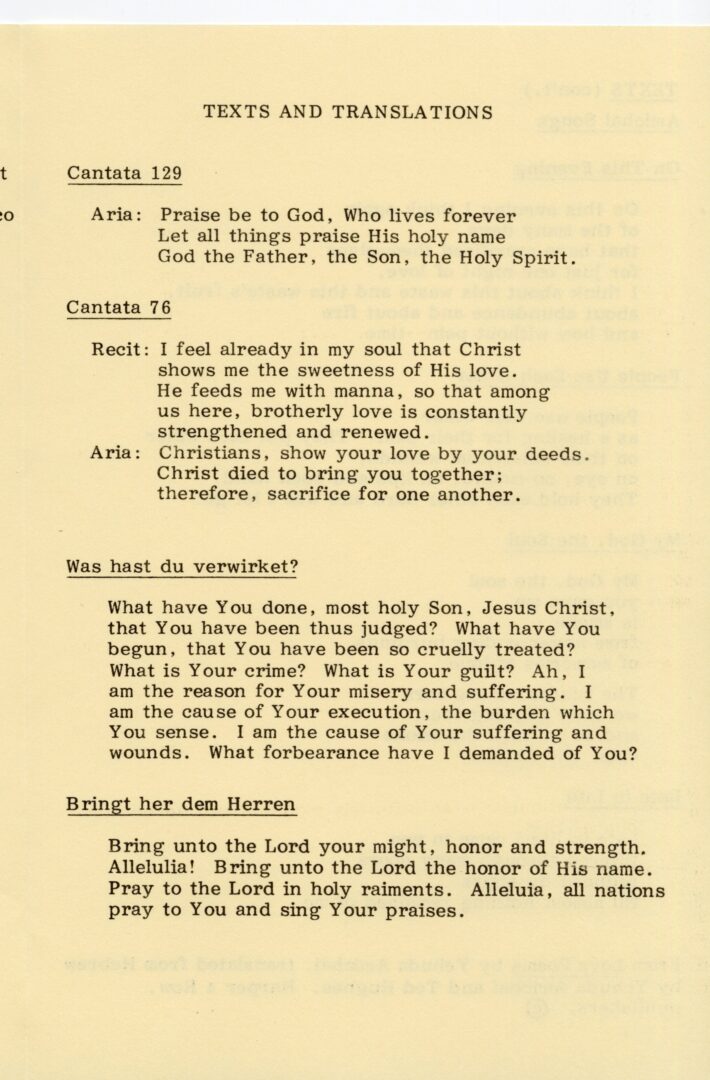
The frequency of premiere performances is one of the exciting hallmarks of the Eastman School’s concert calendar; the introduction of new works by living composers always commands attention and interest. The composers receiving that recognition might fall anywhere on the professional spectrum—whether already enjoying the height of professional renown, or still on their professional ascent; or for us at Eastman, they may be student composers who have amply demonstrated technical mastery and elevated musical expression; still others are composers-in-residence, as during the Eastman School’s past Women in Music Festivals (2005-2015). Forty-one years ago this week, on Tuesday, October 1st, 1985, a newly composed vocal chamber work by Shulamit Ran (b. 1949) was premiered in Kilbourn Hall, when the Amichai Songs were performed by Jan DeGaetani, Philip West, Arthur Haas, and Martha McGaughey. The Eastman School of Music had commissioned the work expressly for these four artists. The concert was promoted as “A Happy Birthday Concert” featuring lesser-known works by four composers whose birth milestones were observed in 1985: Henrich Schütz, J. S. Bach, G. F. Handel, and Domenico Scarlatti. Their music was complemented by the work newly composed in 1985.
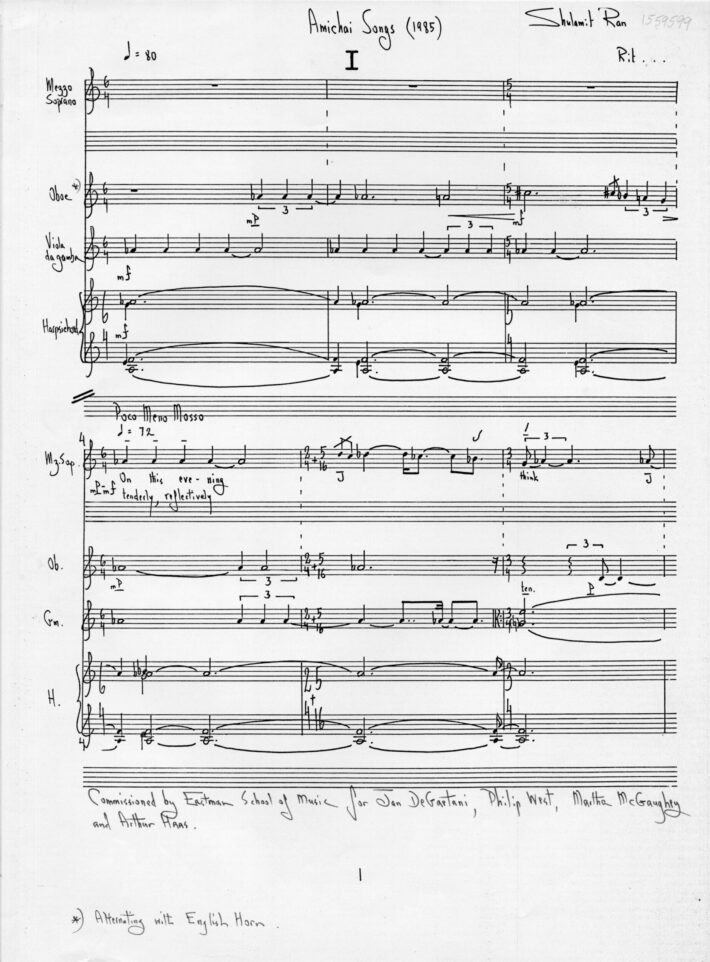
First page of a facsimile of the composer’s manuscript of the Amichai Songs. The facsimile is a holding of the Sibley Music Library.
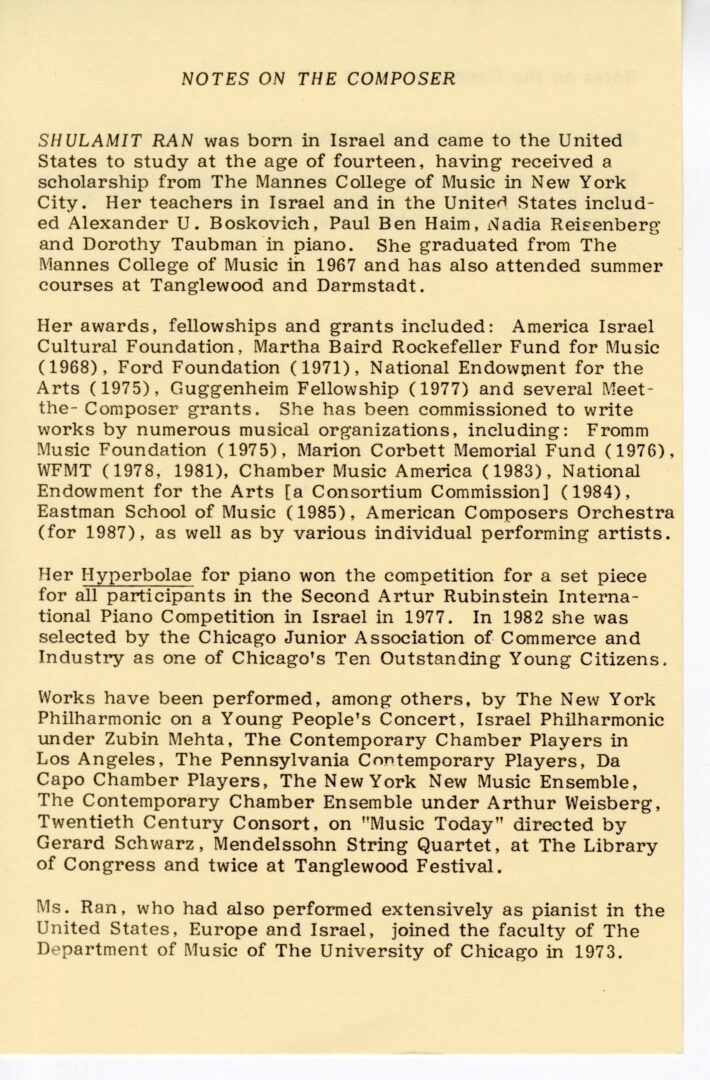
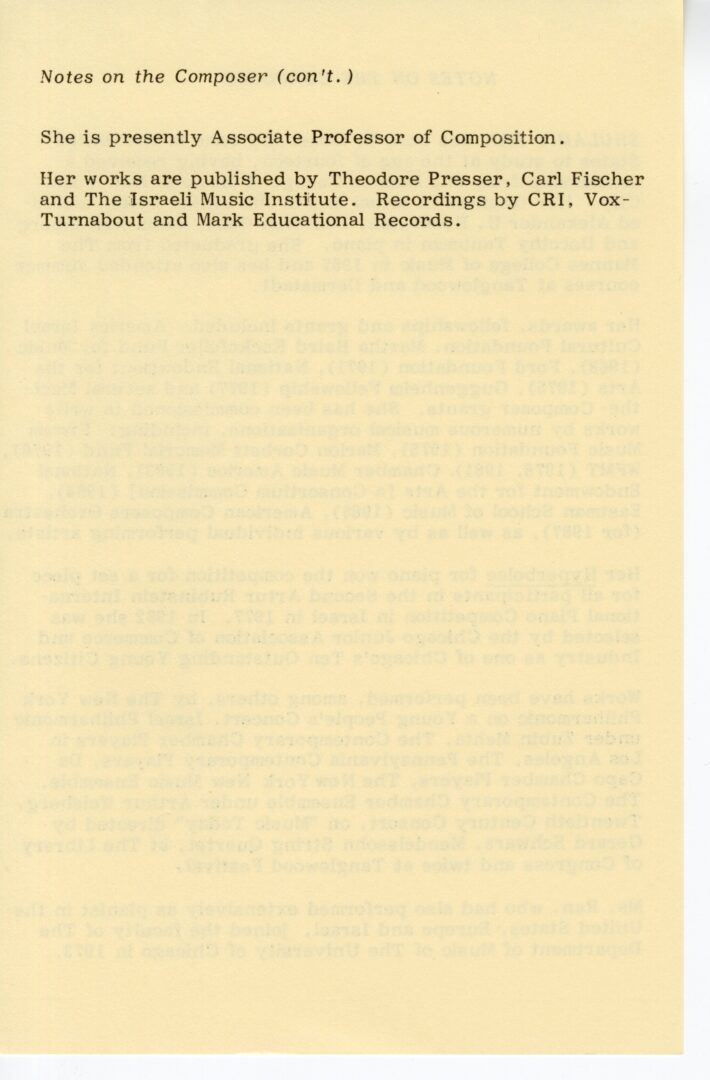
Composer Shulamit Ran was born in Tel Aviv in 1949 and was educated in Israel and in the United States, her adopted country. She studied at the Mannes College of Music (BM 1976) with additional studies under Dorothy Taubman (1970-76) and Ralph Shapey (1976). At the time of the Amichai Songs commission, Shulamit Ran had served for twelve years on the faculty of the University of Chicago, where she would continue to serve until her retirement in 2015, since which time she has been the Andrew MacLeish Distinguished Service Professor Emerita in the Department of Music. In 1985, most of her larger works, and her Pulitzer Prize (1991), were still in the future. Nevertheless, she had compiled a substantial catalogue of works in various genres and for diverse performing forces. Of particular note, she had completed numerous vocal and chamber works, including Seven Japanese Love Poems (1968) for mezzo-soprano and piano; Hatzvi Israel Eulogy (1969) for mezzo-soprano, string quartet, and harp; O the Chimneys (1969), a setting of verses by Nelly Sachs, for mezzo-soprano, ensemble, and tape; Apprehensions (1979), a setting of verses by Sylvia Plath, for soprano, clarinet, and piano. Ran’s proven affinity for vocal chamber music was recognized by the artists who in 1985 commissioned a new work, the result being the Amichai Songs. Several years later, the composer briefly spoke of the commission and the challenge of writing for the viola da gamba for the first time.[1] Shulamit Ran would again be recognized at the Eastman School twenty-five years after this commission, when she was in residence at the Eastman School of Music as the 2010 Howard Hanson Visiting Professor of Composition. The press release announcing her appointment remains on the ESM website. Her principal publisher is Theodore Presser Company, at whose website is a professional profile with lists of publications and recordings, and also extensive excerpts from reviews.
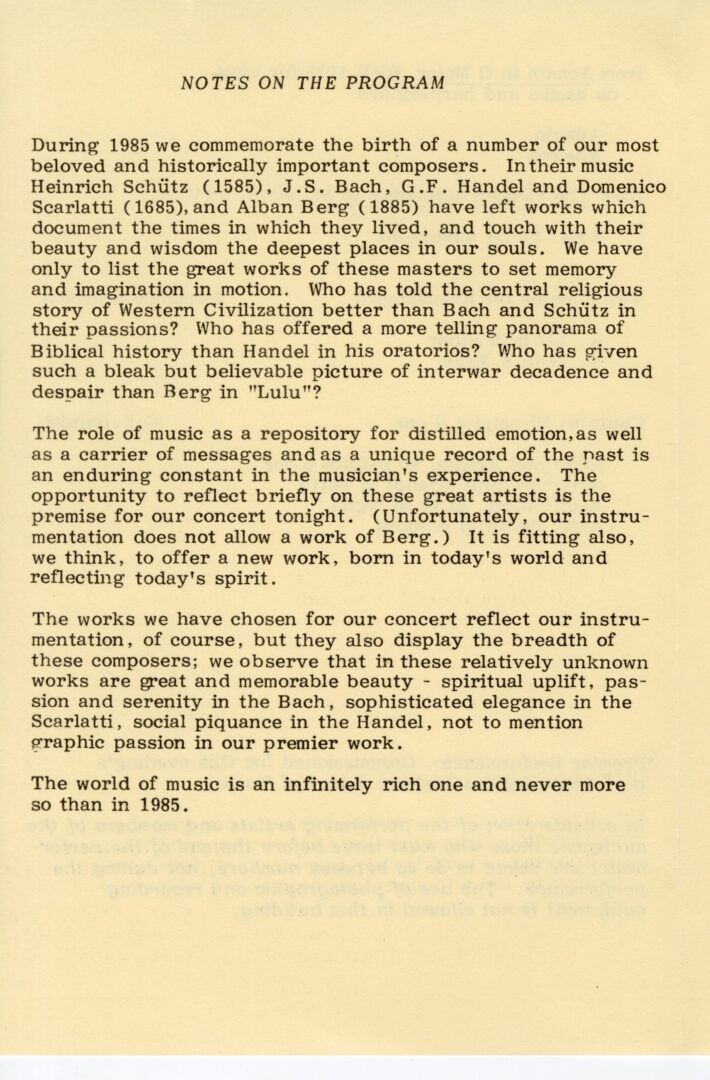
Interestingly, the Amichai Songs were programmed in a recital that was otherwise promoted as a celebration of four of the year’s milestone birth anniversaries: those of Heinrich Schütz (1585), Johann Sebastian Bach (1685), George Frideric Handel (1685), and Domenico Scarlatti (1685).[2] The juxtaposition of the newly composed Amichai Songs (1985) with the works of those venerable composers of yesteryear was not as unseemly as might have appeared at first glance. The printed program carried an eloquent note by the performers that offered reflection on the meanings of the year’s anniversaries, noting the particular qualitative contribution of each of the composers concerned. In particular, these words speak a universal truth:
The role of music as a repository for distilled emotion, as well as a carrier of messages and as a unique record of the past is an enduring constant in the musician’s experience.
—Inherent in that notion was the appropriateness of including a contemporary work, “born in today’s world and reflecting today’s spirit.” Thus, the newly composed work was offered as sharing something vital with the music of the other composers. The program note further cited the “graphic passion” in the Ran work, no doubt referring to both the texts and the instrumental-musical treatment.
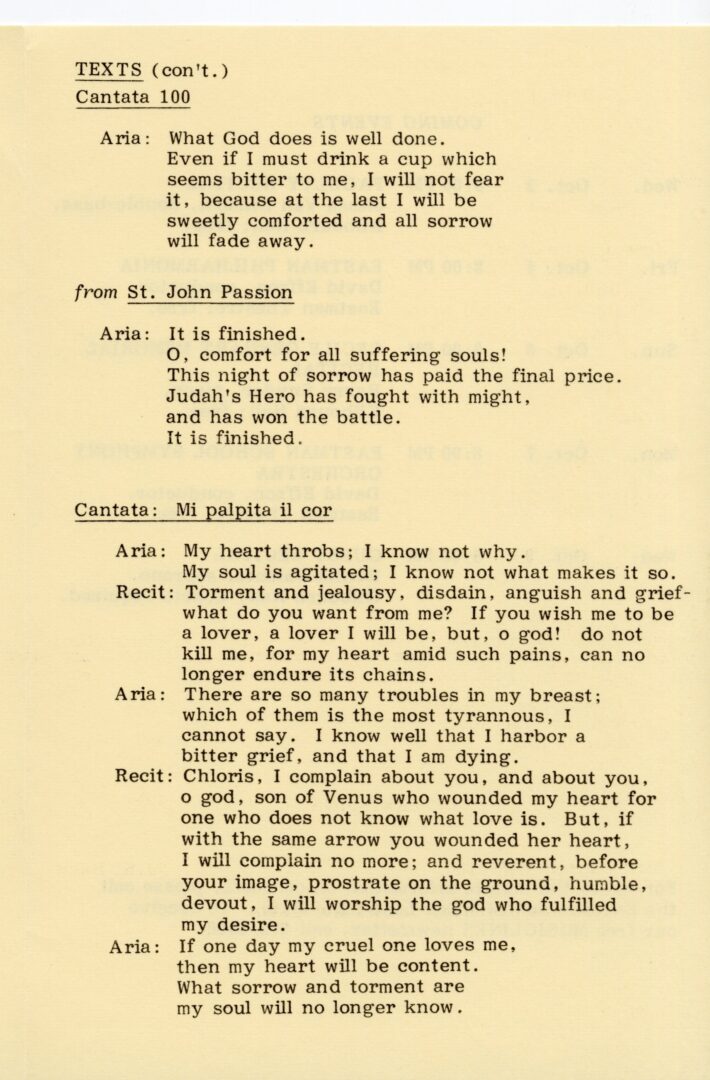
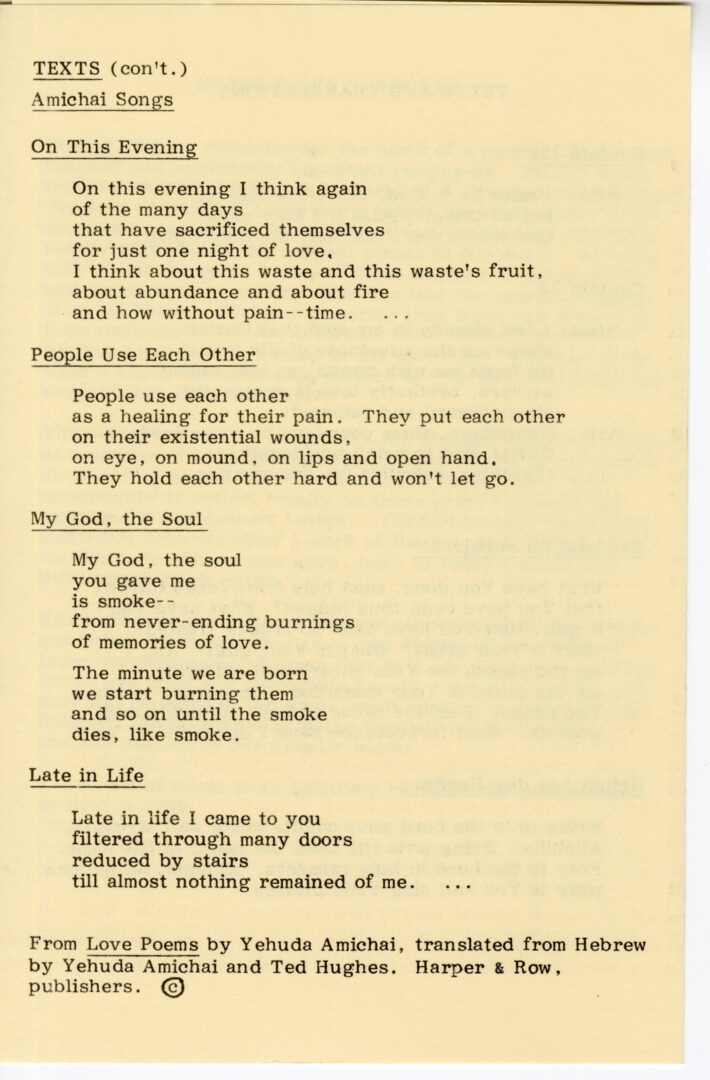
The four poems that comprise the Amichai Songs — “On this evening”, “People use each other”, “My God, the soul”, and “Late in life” — were selected from the Love Poems by Israeli writer and poet Yehuda Amichai (1924-2000). Mr. Amichai is recognized as one of Israel’s greatest writers; his poetry has been translated into more than 40 languages.[3] The volume of Love Poems was pubished in a dual-language edition (Hebrew and English) in 1981, but most of the poems therein had previously appeared in either English or Hebrew in other collections. The Eastman printed program of October 1, 1985 offered representation of the texts variously in in their English translations: the first stanza (of two) of “On this evening”; “People use each other” in its entirety; “My God, the soul” in its entirety; and, the first stanza (of four) of “Late in life”. The translations of the four poems as set in Love Poems were by Yehuda Amichai and Ted Hughes.[4]
Not knowing Hebrew, I regret that I cannot read the original texts, for to encounter verse solely in translation is to miss an essential part of the experience. Reading them in translation, the four poems of the Amichai Songs present a somewhat hard-edged perspective on the human experience. In the poem “On this evening” the speaker reflects, for not the first time, on “the many days / that have sacrificed themselves / for just one night of love” and eventually calling it “this waste . . . .” In “Late in life” the speaker describes having found his other, “reduced” (or exhausted) by experience “til almost nothing remained of me” and at the conclusion, apparently for naught when in a hard finality, “And then you went.” In the last poem, the speaker directly addresses God — “My God, the soul / you gave me / is smoke –” the smoke that results from the burning that had begun “the minute we are born . . . / until the smoke / dies, like smoke.” The poem ______ “People use each other / as a healing for their pain. / They put each other / on their existential wounds.” —Which seems an almost desperate act in search of healing, for, as in the last line, “they hold each other hard and won’t let go.” No rose-colred view of the human experience is to be found in these verses; perhaps it’s their very realism that resonates most deeply. It’s pertinent to know that Shulamit Ran began to set Hebrew verses at any early age.[5] Numerous of her instrumental works and larger works have either been inspired by literature or else constitute settings of written texts.[6]
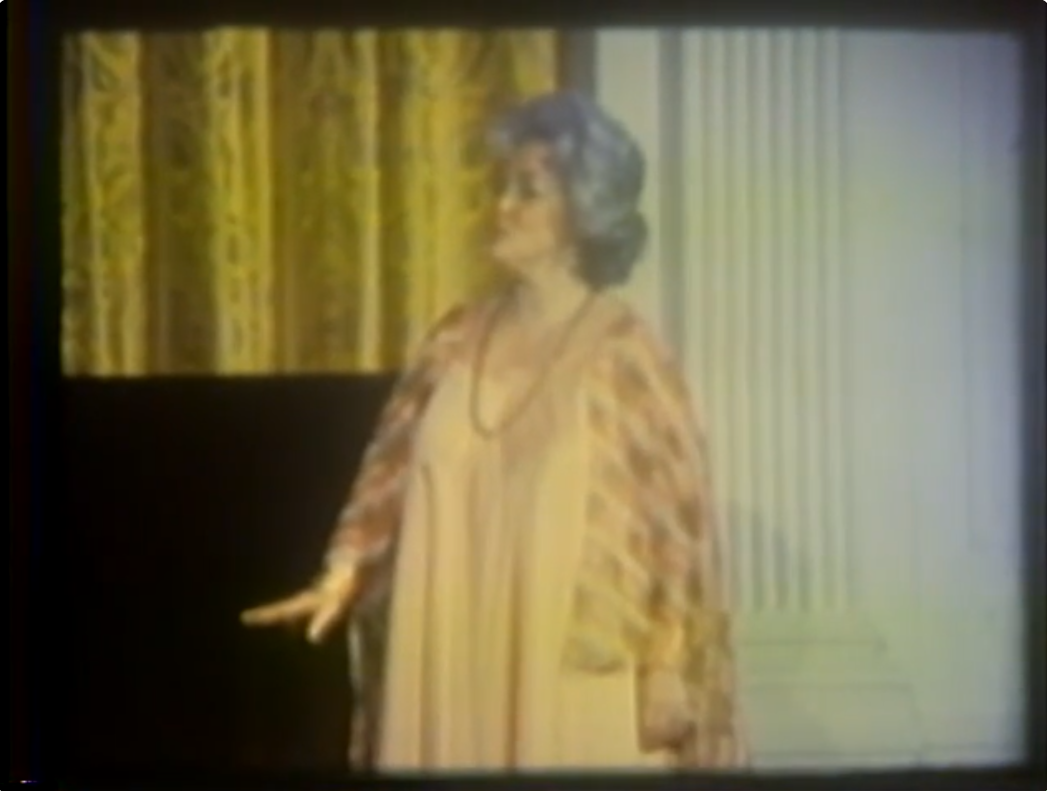
Altogether, the Kilbourn Hall program of October 1, 1985 was a mixed bill of chamber music featuring the various performers in turn, but as the artist delivering and interpreting the texts, Ms. DeGaetani could arguably be regarded as the evening’s principal performer. Jan DeGaetani was a noted interpreter of contemporary music, and in particular, her association with George Crumb’s Ancient Voices of Children, has received much attention.[7] She had served on the ESM faculty since 1973, and had also been Artist-in-Residence at the Aspen Festival annually since that same year. In contrast with other singers of her caliber and renown, she appeared in opera only rarely, preferring to specialize as a song recitalist and also appearing with orchestras and other ensembles. Ms. DeGaetani’s public performances had included a 1977 guest appearance at the White House before then-President Jimmy Carter and visiting Prime Minister of the United Kingdom James Callaghan. A video excerpt of that appearance, in which tenor Robert White also performed and pianist Gilbert Kalish assisted, is accessible on YouTube.
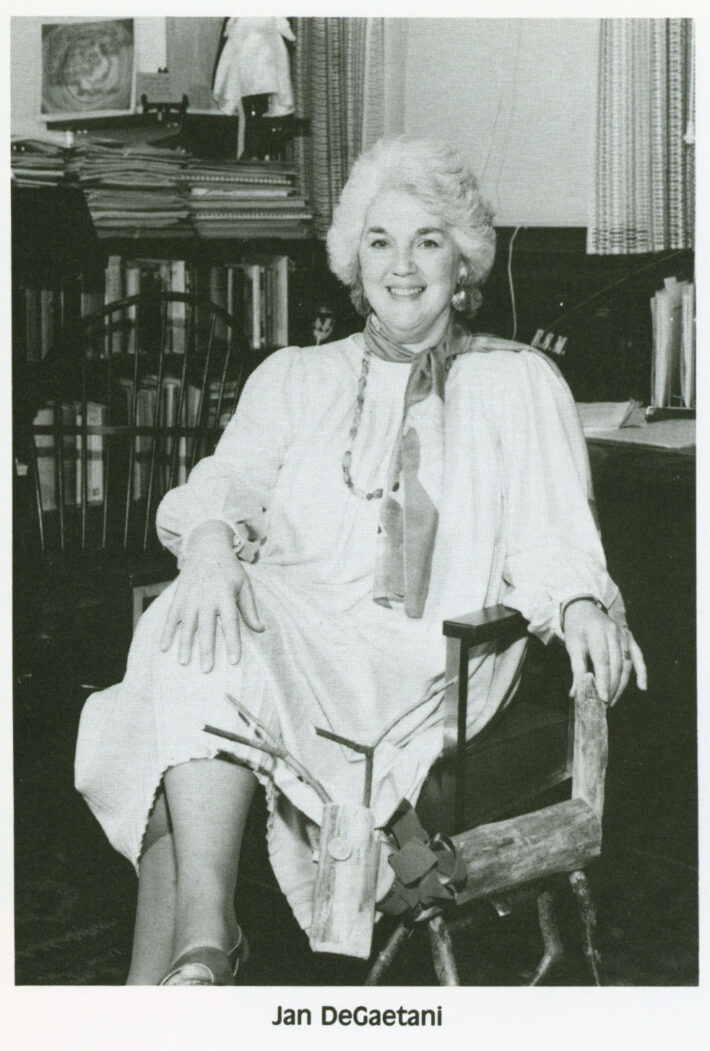
Jan DeGaetani photographed in her studio; the photo published in the Eastman School’s 1986 yearbook.
In addition to performing the solo vocal liberature, Ms. DeGaetani performed regularly with instrumental ensembles of various sizes and formations, whether symphonic or chamber. Her versatility lent itself to chamber works of different eras and instrumentations. For the Shulamit Ran commission, her collaborators were similarly renowned artists in their own right. Philip West, serving on the Eastman School faculty since 1973, was an American oboist and English hornist whose years on the Eastman faculty were noteworthy for his direction of inter-departmental chamber music recitals. Harpsichordist Arthur Haas had won the first prize in the 1975 Paris International Harpsichord Competition and had won a robust reputation for his performing and commercial recordings as an artist of early music. He was a visiting faculty member at the Eastman School in 1983-85. Martha McGaughey was by this time an internationally recognized viola da gamba artist, having been a member of the Paris-based Five Centuries Ensemble (1971-84).
With respect to the Kilbourn Hall performance on October 1st, 1985, the view from the archive is at this time, alas, sparse. No photographer was present in Kilbourn Hall that evening—that is, no photographs are known to be extant, and so we have no representation of the four performers together. Ms. DeGaetani’s own papers yield no reference to the songs apart from a few printed programs, and no copy of the score is extant in her performing library. What remains to document the premiere performance are the printed program, the master audio reels (recently digitized for streaming), and a facsimile of the composer’s manuscript, which was the gift of Dr. Robert Freeman, then-Director of the Eastman School, from whose office the commission was most likely executed.[8] . Printed programs in the Jan DeGaetani Collection indicate that the four artists DeGaetani, West, Haas, and McGaughey gave at least three performances of the Amichai Songs during the 1985-86 season: in Kilbourn Hall (October 1), in the Mohawk Trail Concerts in Western Massachusetts (October 11-12), and at Swarthmore College (November 10). While the four did not make a commercial recording of the work, the live concert recording in Kilbourn Hall is preserved for posterity. The Amichai Songs were later published by the Theodore Presser Company in 1995.[9]
The Shulamit Ran commission of 1985 deserves renewed attention at the Eastman School of Music. With the recent publication of the first biography of Jan DeGaetani,[10] renewed attention to Ms. DeGaetani’s career and legacy may well engender greater interest in the numerous works either that she premiered or with which she was associated.
[1] Music commentator Bruce McDuffie interviewed Shulamit Ran in 1994 and in 1997; portions of both interviews were broadcast on WNIB, Classical 97, and on WNUR, Contemporary Classical Internet Radio. The entire transcripts are now published online. Accessed on October 21, 2026.
[2] The performers’ note in the printed program acknowledged that their particular instrumentation did not allow for the performance of a work by Alban Berg, the centenary of whose birth was acknowledged in 1985.
[3] Altogether, he wrote eleven volumes of poery in Hebrew, two novels, and a volume of short stories. Among his numerous professional recognitions was his being named a foreign honorary member of the American Academy of Arts and Letters (1986). His papers are archived at Yale University.
[4] Ted Hughes (1930-1998) was a British writer and poet who served as Poet Laureate of the United Kingdom from 1984 until his death. As the ex-husband and literary executor of American poet Sylvia Plath (1932-1963), he gained a certain notoriety among Plath’s admirers.
[5] So indicates the biography on the composer’s professional website . Accessed on October 21, 2026.
[6] Probably one of the most compelling is her full-length opera Anne Frank, based on the famous diary, written with librettist Charles Kondek. The opera was commissioned by Indiana University’s Jacobs School of Music and was premiered at IU in 2023.
[7] Ms. DeGaetani was one of the participant performers in the premiere performance at the Library of Congress in November, 1970.
[8] The copy bears call number M1613.3 .R185 A51 1985 Folio, and is shelved in the vault of the Ruth T. Watanabe Special Collections.
[9] Note that Theodore Presser also published, in 2014, a vocal chamber work by American composer Daniel Asia (b. 1953), also under the title Amichai Songs, commissioned by SOLI and the Network for New Music, and scored for flute, clarinet in B-flat, violin, cello, voice, and piano. For his own work Amichai Songs, Mr. Asia set six poems other than the four which Shulamit Ran had set.
[10] The book Jan DeGaetani, Mezzo-Soprano: Her Life, Art, and Teaching by Ann Marie Wilcox-Daehn, DMA has just been published by the University of Rochester Press.