
Published on Aug 31st, 2026
1924: Howard Hanson has a close call at sea
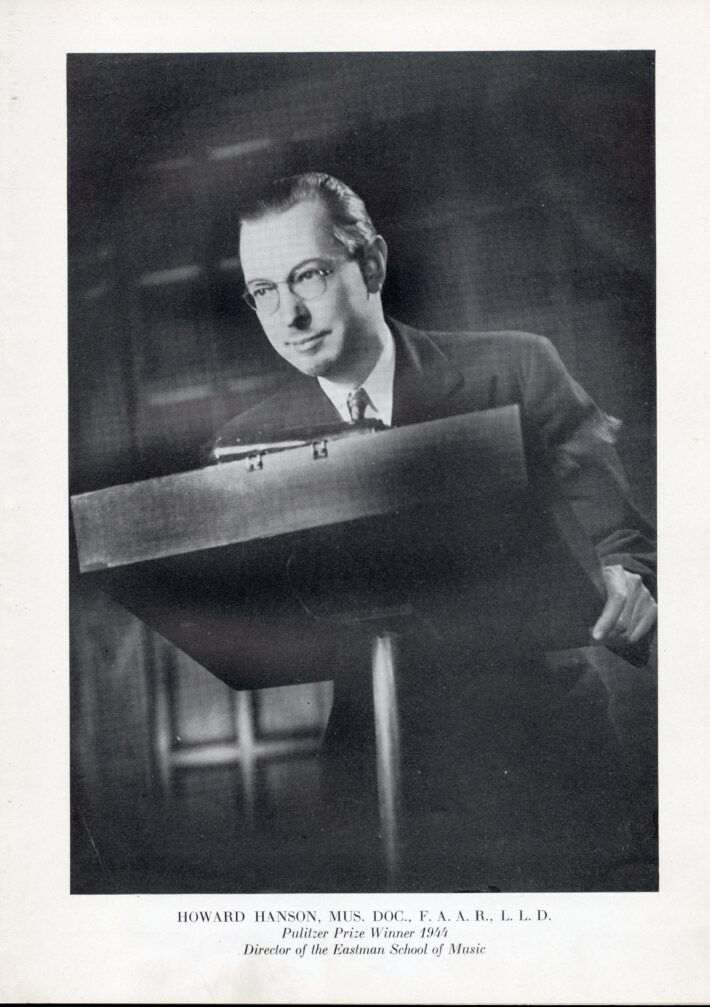
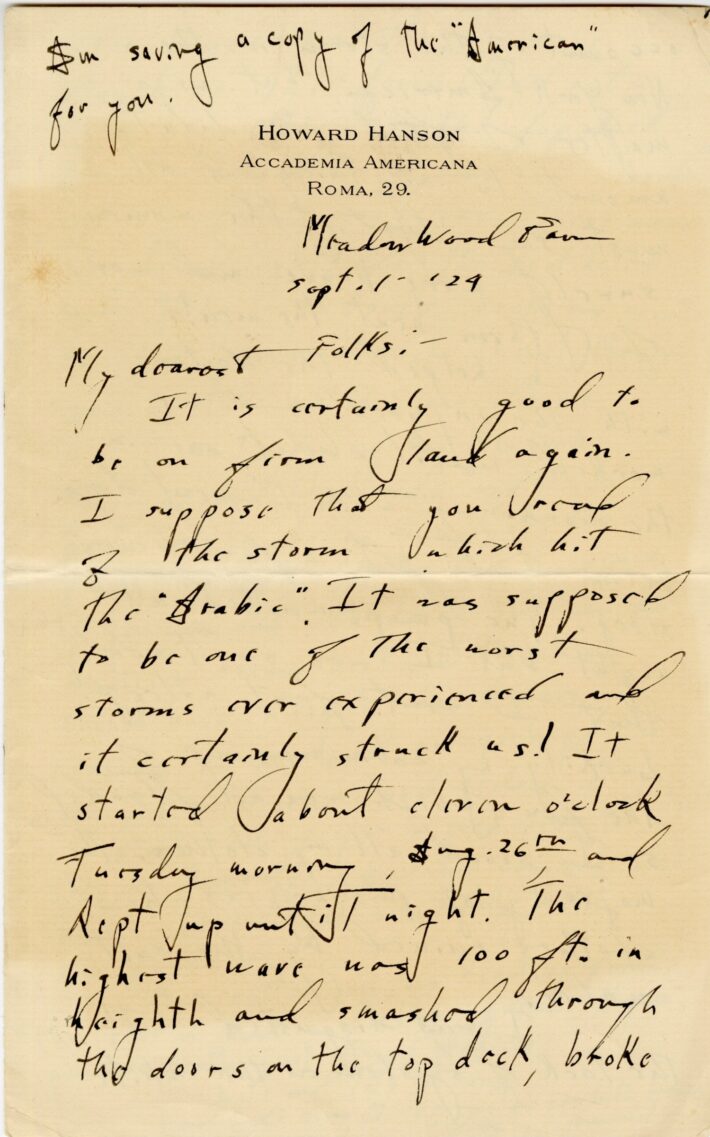
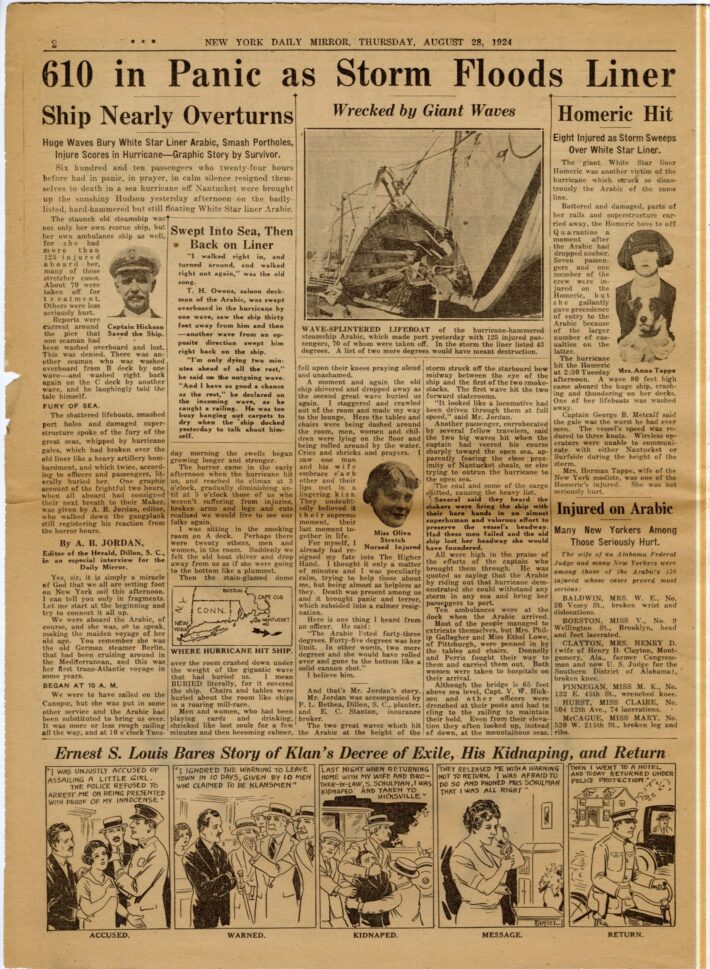
One hundred and two years ago this week, while in transit to Rochester to assume his position at the Eastman School of Music, Howard Hanson had a close call at sea on board the White Star liner S. S. Arabic.[1] Two archival sources paint a vivid picture of the occurrence—a handwritten letter that Hanson wrote to his parents on September 1st, 1924, and a press account published in the (New York) Daily Mirror on August 26th, 1924 (one of several press accounts known to have been printed). For my money, Hanson’s eyewitness account is the more compelling and the more human of the two, given that it was a spontaneous, personal emanation to loved ones with the intention of providing reassurance. Moreover, Hanson always had an eye for detail, and so we can be certain of his telling.
Eastman’s Howard Hanson was a well-travelled man. As a college student he travelled hither and yon by train between his native Wahoo, Nebraska and Chicago (Northwestern University) and New York City (Institute of Musical Art), in addition to side trips to wherever he happened to be gigging. (The latter included Chautauqua engagements in Kansas City, Missouri.) As a professional, he crossed the U.S. several times by train while on faculty at the College of the Pacific (in San José, California). During his fellowship years at the American Academy in Rome (1922-24) he crossed the Atlantic by steamship numerous times, and also travelled by train around Europe and the British Isles. He later sailed to Europe several more times, in 1930 and 1933) and again after the Second World War in the service of his UNESCO appointment.
In 1962-62 he accompanied the Eastman Philharmonia on a much-celebrated three-month tour of Europe and the Middle East, a dizzying trek on chartered planes, busses, and trains. Throughout his ESM service (1924-64) and in his retirement he travelled regularly for academic service (President of NASM, etc.), speaking engagements, and guest conducting engagements. All told, many miles traversed, or to borrow the words of the distinguished American poet Robert Frost, miles to go before he slept[2]. Travel being what it is, it’s only inevitable that along the way there would be incidents of one kind or another.
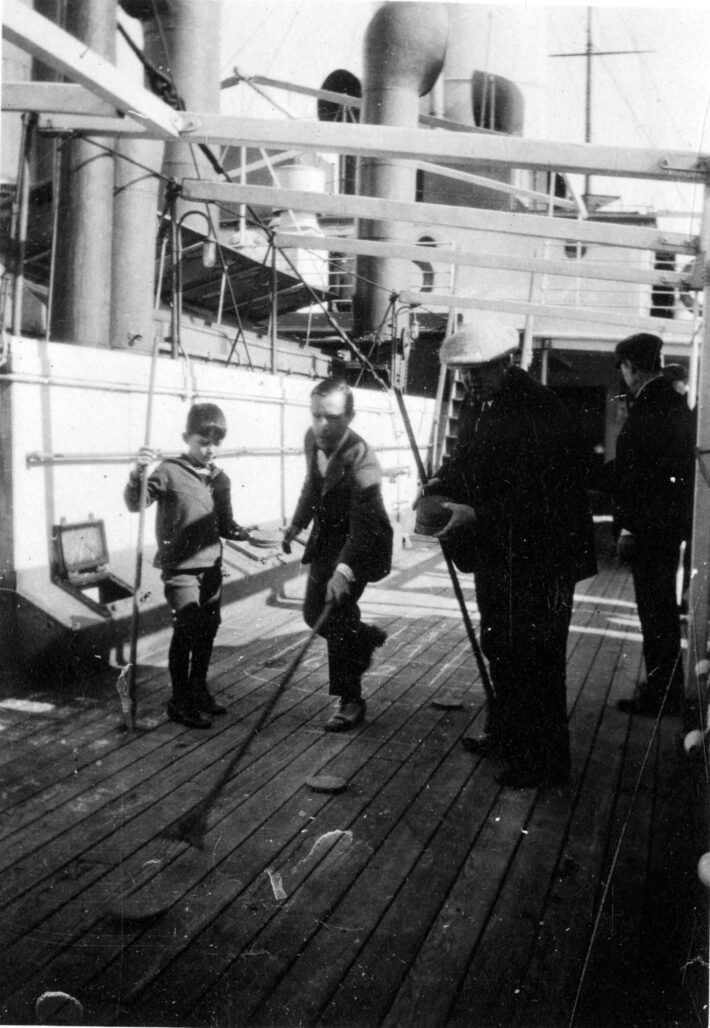
► Howard playing a deck game on board the Saturnia (likely early 1922).
Howard Hanson Collection, accession no. 2005/3/25, box 61/8, sleeve f3.
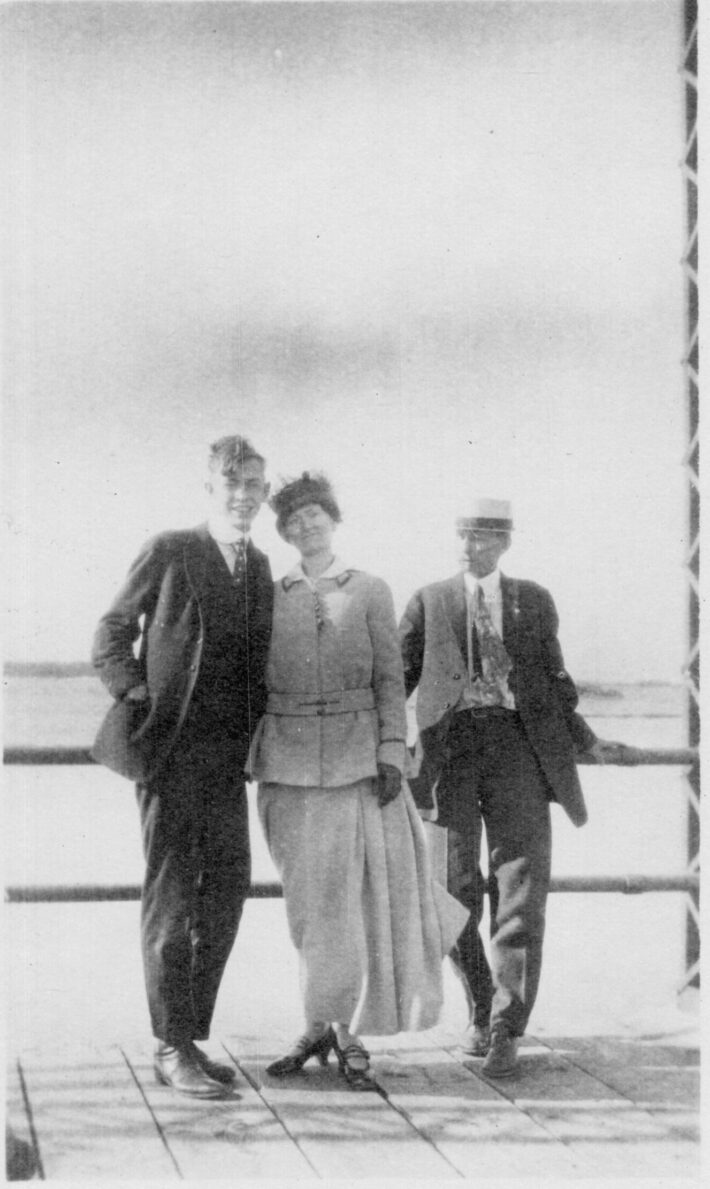
► Howard Hanson with his parents.
Howard Hanson Collection, accession no. 2005/3/25, box 64/18, sleeve b
It’s relevant to share some words about the young Hanson’s correspondence with his parents, now preserved in the Howard Hanson Collection at the Sibley Music Library. As a college student and as a young teacher, and then as a Fellow at the American Academy in Rome, Hanson wrote home regularly to his parents, sometimes at the rate of two letters per week. (His letters from Rome are, in fact, the most complete extant account of those formative years in his life.) The fact is that Howard Hanson was an only son who enjoyed a close relationship with his parents, warmly suffused with filial love and also his own genuine concern for their well-being. That dynamic amply informed his letters home, which were carefully preserved (likely by his mother), the bulk of them (1912-21) pasted into four voluminous invoice ledgers with many more letters (1922-24) saved loosely. In 1924 Hanson brought his parents to live with him in Rochester, and there the correspondence ends. Inevitably, from our perspective today, such notions as correspondence . . . the handwritten letter . . . a postmarked envelope . . . and the rate classifications “first class” and “air mail” and “second delivery” . . . now seem like artifacts of a by-gone age, a time when people took the time to sit down to compose letters in a considered way, and then dropping the letters a a U. S. Postal Service box. Today, when instantaneous digital communication has enabled the rapid and more informal exchange of words, delivery of a hard-copy letter by the U. S. Postal Service is all too often derided as “snail mail”[3].
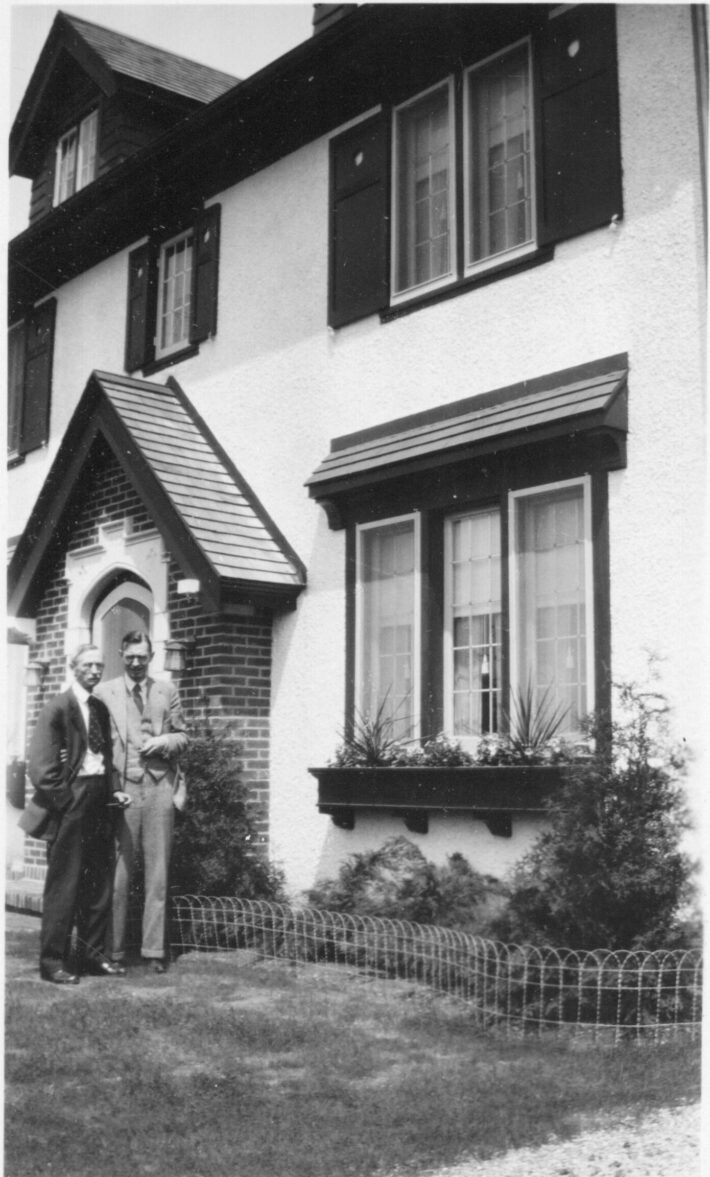
► Howard Hanson with his father.
Howard Hanson Collection, accession no. 2005/3/25, box 64/18, sleeve i.
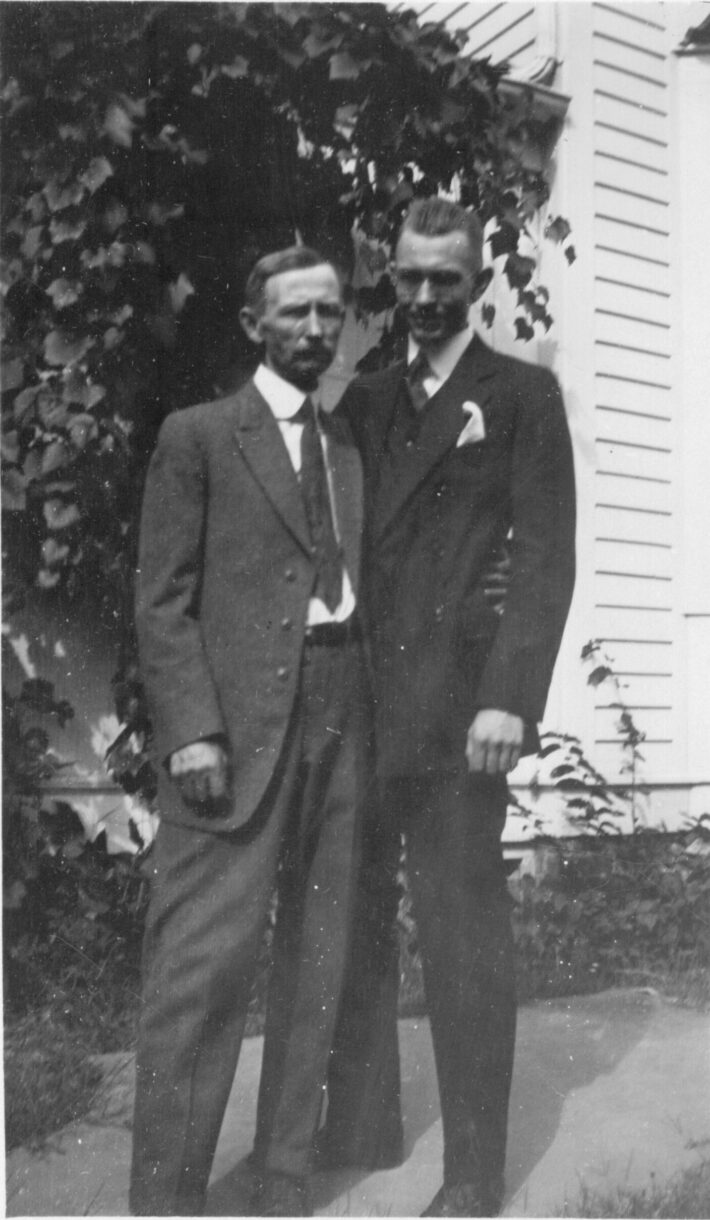
► Howard Hanson with his father.
Howard Hanson Collection, accession no. 2005/3/25, box 64/21, sleeve a.
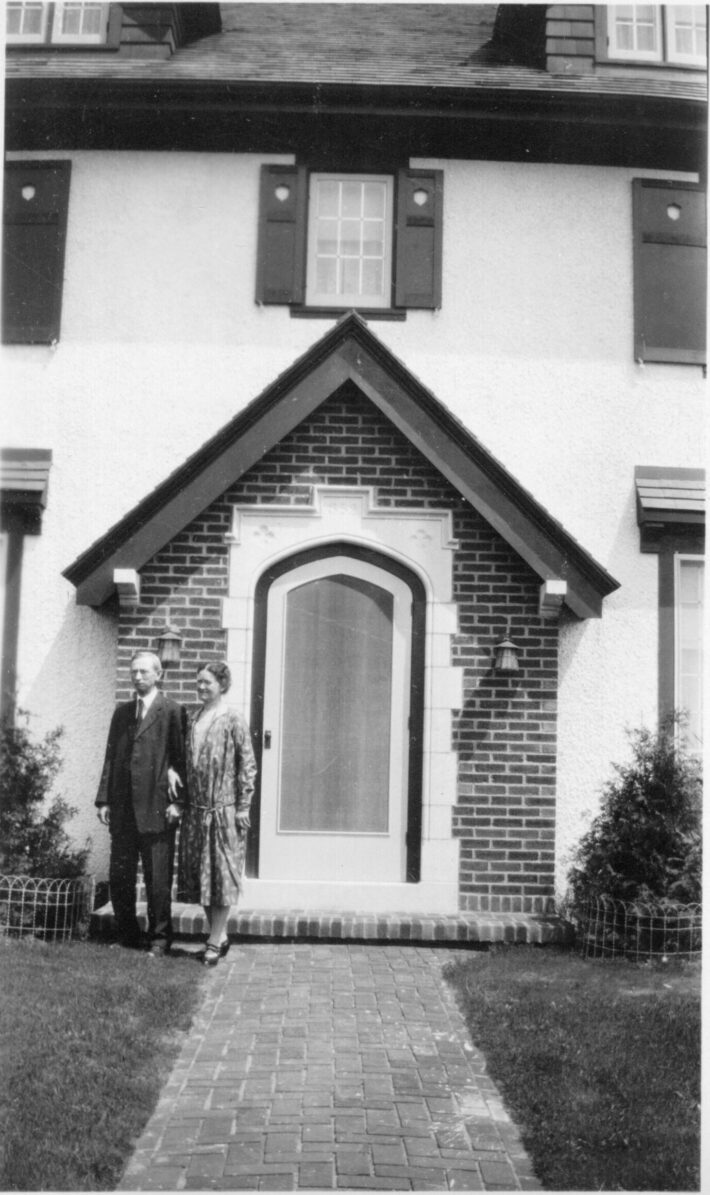
►Howard Hanson with his mother.
Howard Hanson Collection, box 64/18, sleeve i.
Hanson’s letters home were rife with details of everyday life—what he was doing and where he was living, what the food was like, how his music lessons and courses were going, and so on. He frequently wrote on the stationery of hotels, associations, or schools from wherever he happened to be. He routinely addressed his parents as “Dear Honies” and signed his letters “from your loving boy, Howard” (he signed himself as their “boy” even in his twenties). He not infrequently appended his closing salutation with an invocation of God; one letter written on December 5th, 1914 in New York closed with “May God Bless You, Honies. / Lots and Lots of Love / and God’s Blessings, / from your loving Boy, Howard.” He took special care to assure his parents of his well-being, hence the numerous details about his health and what he was eating. In a letter of August 23, 1914, written on stationery of the Depot Hotel in Fairfield, Nebraska, he opened with “Dear Honies, / I have arrived !! / I got into Lincoln in plenty of time to get some more ‘cello strings and also a “shine” which made / ‘some’ improvement. / On the train to / Lincoln / Dennis Moyer sat / behind me and pumped / Life Insurance into / my ear almost all / the way. Very interesting.” He went on to describe his hotel room: “I got into / Hastings about 8:35 / and went directly / to the best hotel. And it is some [underscored twice] hotel. My / room had running / water, electric lights, / nicely furnished for / only $ 1.00. It was / a very fine place.” And also what he’d eaten for breakfast: “Had a fine breakfast / here this morning. / Canteloupe, shredded / wheat with real cream [twice underscored], bacon, scrambled / egg, fried potatoes, fried mush, / hot biscuit, wheat cakes / and coffee. Some / breakfast for a small / man. But I didn’t have / any supper last night, / only some nice cream.”
Eventually Hanson would send his parents the occasional typescript letter (i.e. rendered on a typewriter). One of the earliest such was written on August 14, 1917 aboard the Pacific Limited heading west to San Francisco. Just when the train had passed the Great Salt Lake, he typed the lines, “I have been spending a good deal of time with the typewriter and have written several letters and typed about a dozen more of my experiments for the acoustics class. One man told me that I was the busiest man he had ever seen. One man asked me if I were a war-correspondent. I finally admitted that I was a teacher and they knew the worst.” ! Young Hanson industriously at a typewriter on a train; keep that image in mind as you read these next lines from that same letter: “Have been practicing the touch system with another young man who is carrying a Oliver that is almost as heavy as my machine. I think I will laern [sic: Hanson’s own misspelling] the touch system so that I can type write more quickly.” Inevitably, Hanson’s professional duties were occasionally so strenuous that he was unable to take the time to sit down and write. On at least one such occasion he filled the gap by ending a telegram, inevitably more expensive, such as one sent from San José on September 25, 1921: “Have been unusually busy and have not been able to write you until today feeling fine lots of love Howard”. Those of an age will recall the customary style when sending a telegram: extreme brevity and omission of punctuation so as to contain the cost.[4]
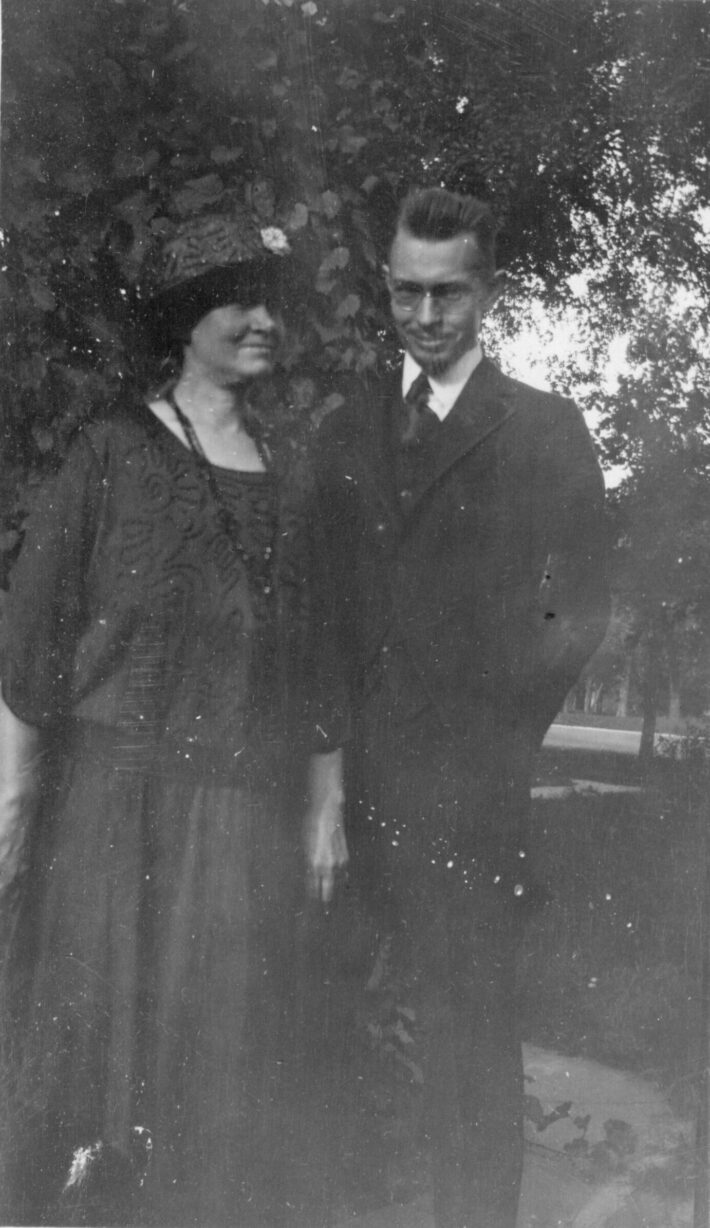
► Hans and Hilma Hanson.
Howard Hanson Collection, box 64/18, sleeve a.
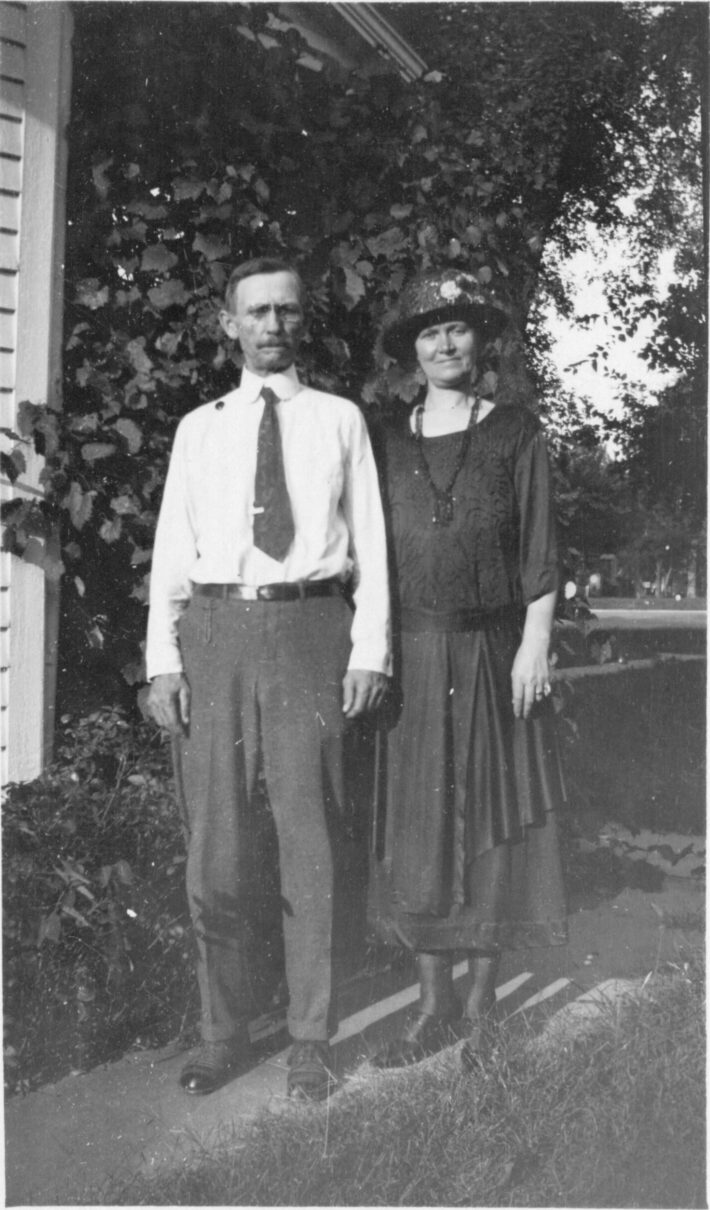
► Hans and Hilma Hanson.
Howard Hanson Collection, box 64/18, sleeve i.
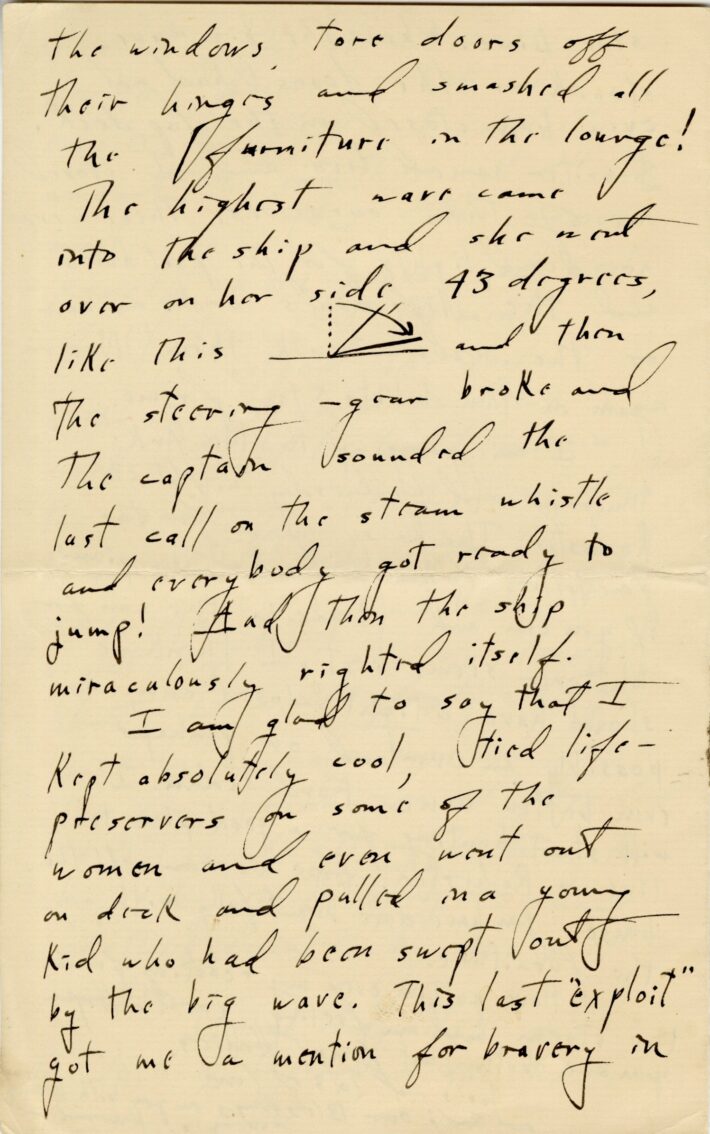
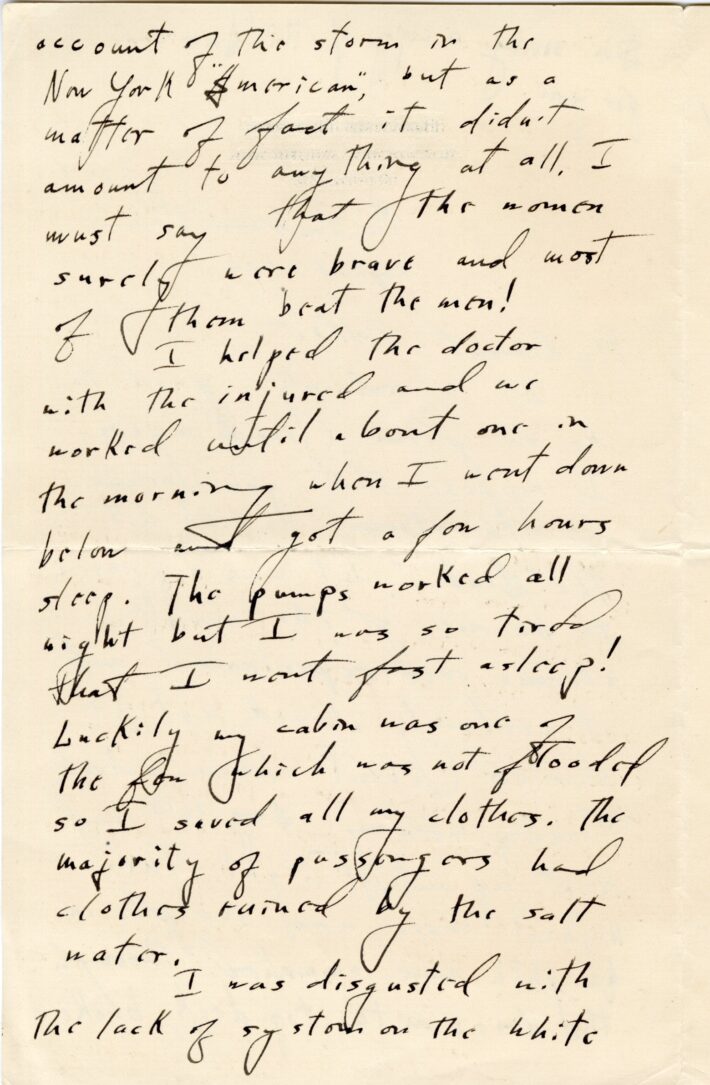
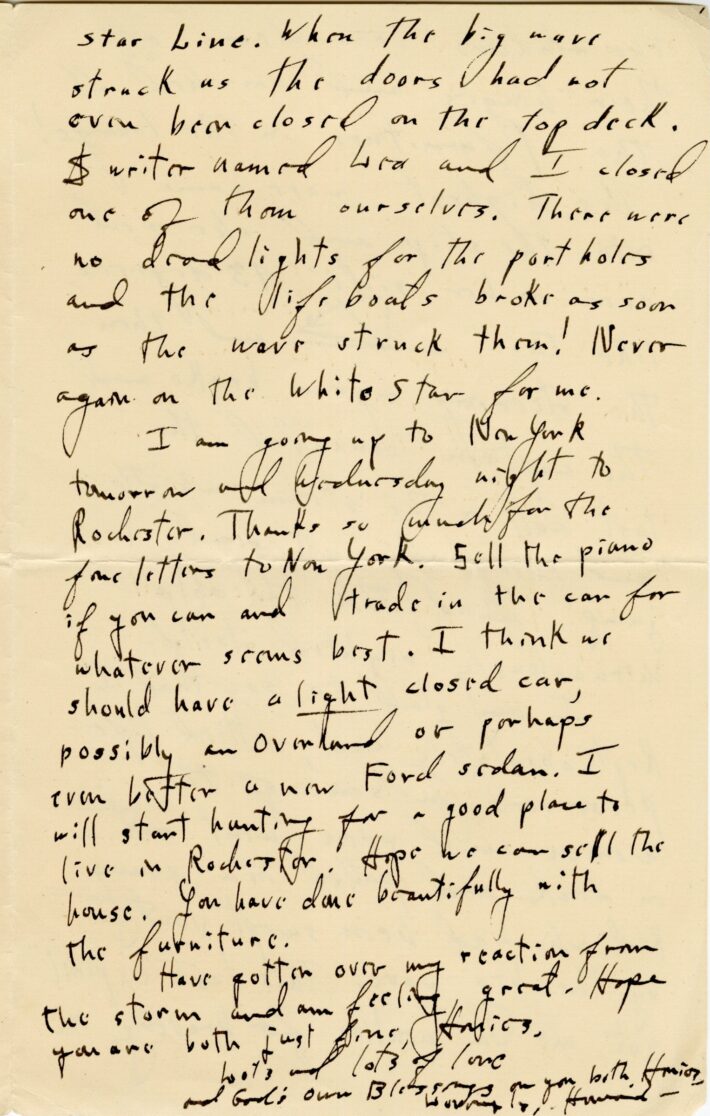
And so the incident on August 26th, 1924, when a hurricane met the S. S. Arabic off the New England coast. Hanson’s letter of September 1st, 1924 is displayed here (4 pages in length). Written in the Catskills before Hanson headed to Rochester and Eastman, the letter opens with his relief at being on firm ground once again, and then plunges into details of the hurricane. The storm had begun in the morning and had kept up until nighttime. “The / highest wave was 100’ in / heighth [sic] and smashed through / the doors on the top deck, broke / the windows, tore doors off / their hinges and smashed all / the furniture in the lounge! / The highest wave came / into the ship and she went / over on her side, 43 degrees, like this [see Hanson’s drawing in his letter] and then / the steering gear broke and / the captain sounded the / last call on the steam whistle / and everybody got ready to / jump!” Hanson further shared that he had “kept absolutely cool, tied life- / preservers on some of the / women and even went out / on deck and pulled in a young / kid who had been swept out / by the big wave. This last ‘exploit’ / got me a mention for bravery in / account of the storm in the / New York American, but as a / matter of fact it didn’t / amount to anything at all.[5] I / must say that the women / surely were brave and most / of them beat the men!” Hanson further reported helping the doctor with the injured, working until around 1 AM when he went down below and “was so tired / that I went fast asleep!”. It’s a vivid letter in which the thoughtful son reassures his parents that he was safe following a dramatic and potentially life-threatening encounter. He closes the letter on the fourth page with news that he will begin looking for a place in Rochester for all of them to live. Further, he described to them his preference for the type of motor-car that they should have.
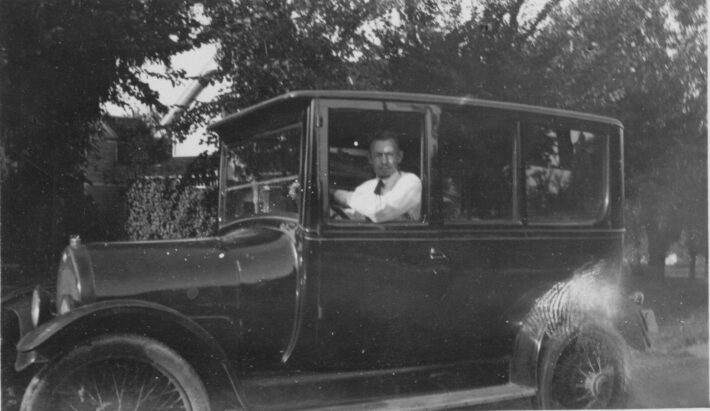
►The young Howard Hanson at the wheel: a covered sedan, just like he’d written to his parents on September 1, 1924
Howard Hanson Collection, box 64/18, sleeve i.
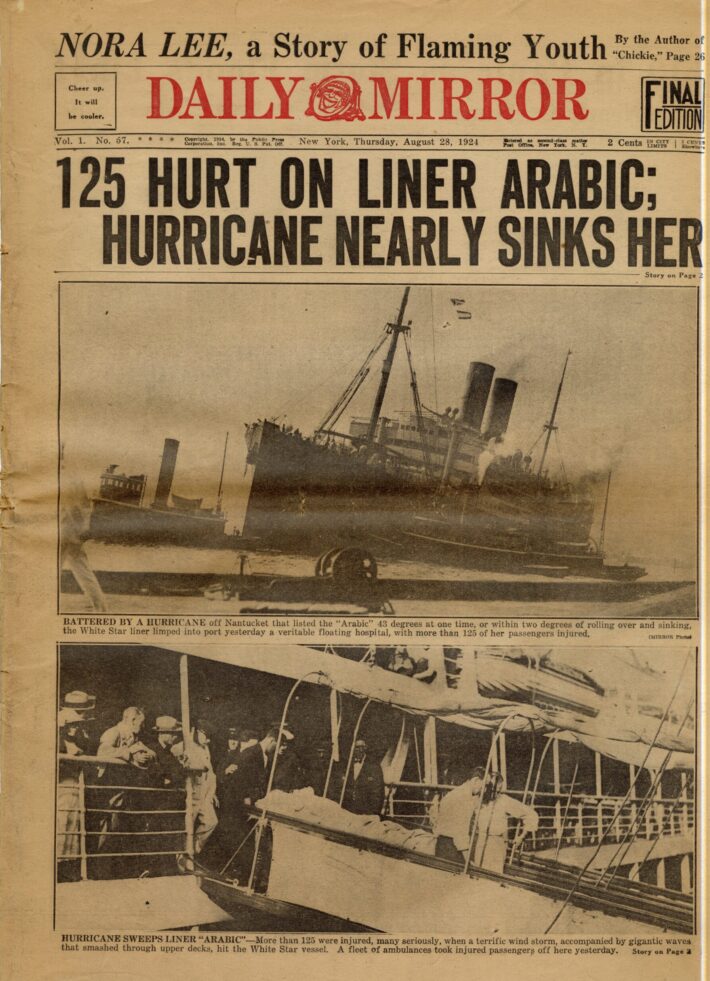
A more formal account of the S. S. Arabic in the hurricane was printed in the Daily Mirror, displayed here (2 pages)[6]. Not surprisingly, Hanson determined never to favor the White Star line with his custom ever again. “I was disgusted with / the lack of system on the White / Star Line. When the big wave / struck us the doors had not / even been closed on the top deck. / A writer named [illegible ] and I closed / one of them ourselves. There were / no [ illegible ] lights for the portholes / and the lifeboats broke as soon / as the wave struck them! Never / again on the White Star for me.” Hanson’s note about a systemic lack of attention to safety on the ship and his refusal to ever again travel on the White Star line is actually more relevant today in light of recent discoveries on the wreck of another White Star liner, the ill-fated RMS Titanic[7].
For Hanson, the incident on the S. S. Arabic was not his first rough Atlantic crossing that year. That previous January, when returning to the U.S. for several guest conducting engagements before beginning his final year at the American Academy in Rome, he was a passenger on the Italian liner Conte Verde which similarly encountered a rough storm. Hanson was mentioned by name as a passenger in a press article that described the incident.[8] Interestingly, several years later in 1930, he had an unusual and totally personalized experience when the close timing of two professional engagements—attending the Boston premiere of his Symphony no. 2 (“Romantic”) and then keeping a guest conducting engagement with the Augusteo Orchestra in Rome—were potentially in conflict. Keeping the first date would interfere with his getting to New York in time to set sail for Rome. A flurry of communications conducted via diplomatic channels between Washington, D.C. and Rome resulted in the decision by the shipping line to make an exception in the ship’s voyage. The Saturnia, on which Hanson had booked his passage, would leave New York harbor and, sailing some 250 miles off its course, turn northwards and stop at Boston so as to pick up Hanson before continuing on to cross the North Atlantic.[9]
Finally, I should note that Hanson’s experience on the S. S. Arabic would not be the only time that an Eastman School Director would have a close call in transit. Five decades later, on December 22nd, 1975, then-Director Dr. Robert Freeman was a passenger on a TWA 707 jetliner that made a crash landing at Milan.[10] The jetliner was damaged beyond salvage, but all 133 souls on board managed to escape with their lives.[11] In the event, Dr. Freeman was not among the injured, and he carried on with his intended travels during the winter break.
Our Eastman School Directors and Deans all undertake extensive travel on the School’s behalf. Let’s wish them all safe and uneventful travel, every time!
[1] Note that there had been an earlier White Star liner RMS Arabic, differentiated in appearance from the one on which Hanson sailed by its one single funnel. That earlier ship was launched in 1903 and was sunk during World War I in 1915.
[2] From the poem “Stopping by Woods on a Snowy Evening” by Robert Frost (1874-1963), accessible in numerous places online and in countless published editions.
[3] “Snail mail” is a reductive term that is both derogatory and pejorative, whether or not the speaker actually intends it as such.
[4] All correspondence cited herein from the Howard Hanson Collection, accession no. 2005/3/25, sub-group III, series 2.
[5] Hanson wrote at the top of the letter’s first page that he was saving a copy of the New York American for his parents, but as it happens, no copy of same is extant now among his papers.
[6] The newspaper section was retained in its entirety, preserved among Hanson’s papers. In archival work I’ve noted numerous instances when an individual has retained an entire newspaper section when one particularly noteworthy article appeared within, as though intending to preserve the context around the event.
[7] “They Scanned Titanic with New Technology — What They Found at 3800m Shocked the World”. Video accessible on YouTube, last accessed by me on August 28, 2026. New exploration in 2022-24 resulted in findings that have prompted a reconsideration of the Titanic disaster, the design of the ship and its consequences, and the actual circumstances behind the tremendous loss of life. The new findings are controversial in that they refute the time-honored reporting on the Titanic disaster and ultimately point to systemic failure on the part of the White Star line.
[8] “Conte Verde battered by her first serious storm”. January 15, 1924. Newspaper attribution lacking. Preserved in Scrapbook 1A, box 112, Howard Hanson Collection, accession no. 997.12, Ruth T. Watanabe Special Collections, Sibley Music Library.
[9] “Italian liner top stop at Boston especially for Dr. Howard Hanson” in the Rochester Democrat & Chronicle, November 26, 1930. Preserved in Scrapbook no. 2, box 113, Howard Hanson Collection, accession no. 997.12, Ruth T. Watanabe Special Collections, Sibley Music Library.
[10] “Jetliner crashes in Milan fog” in the Rochester Democrat & Chronicle, December 23, 1975. Preserved in Rochester Scrapbook November-December 1975, Ruth T. Watanabe Special Collections, Sibley Music Library.
[11] An investigation by Trans-World Airlines later attributed the incident to the failure on the part of the pilot-in-command to follow established procedures. Interestingly, tenor Luciano Pavarotti was also on the plane. While some 30 passengers sustained injuries, all of the 113 passengers and 9 crew members onboard the plane were evacuated with no fatalities. A photograph of the jet, taken a short time later, can be seen online.