
Published on Sep 21st, 2026
1942: Howard Hanson delivers the ESM’s first wartime Convocation address
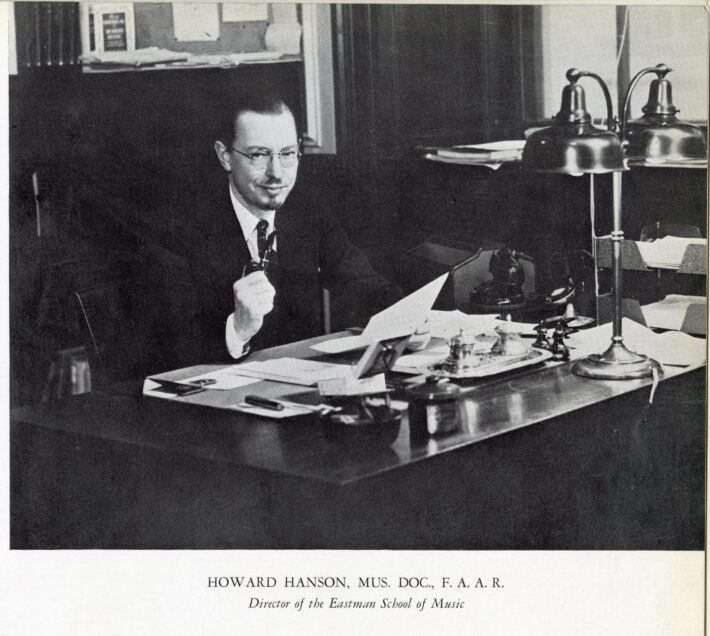
Eighty-four years ago this week, on Monday, September 21st, 1942, Director Howard Hanson addressed the student body at Convocation in Kilbourn Hall, marking his first Convocation address in wartime. The U.S. had entered World War II nine months earlier in the wake of the attack upon Pearl Harbor. Hanson’s typescript text and also his handwritten draft are archived among his papers, as are copies of other of his Convocation addresses. The sheer length of his Convocation addresses attests to how seriously he took this annual event. In 1942, the gravity of the moment called for something significant, and Hanson delivered.
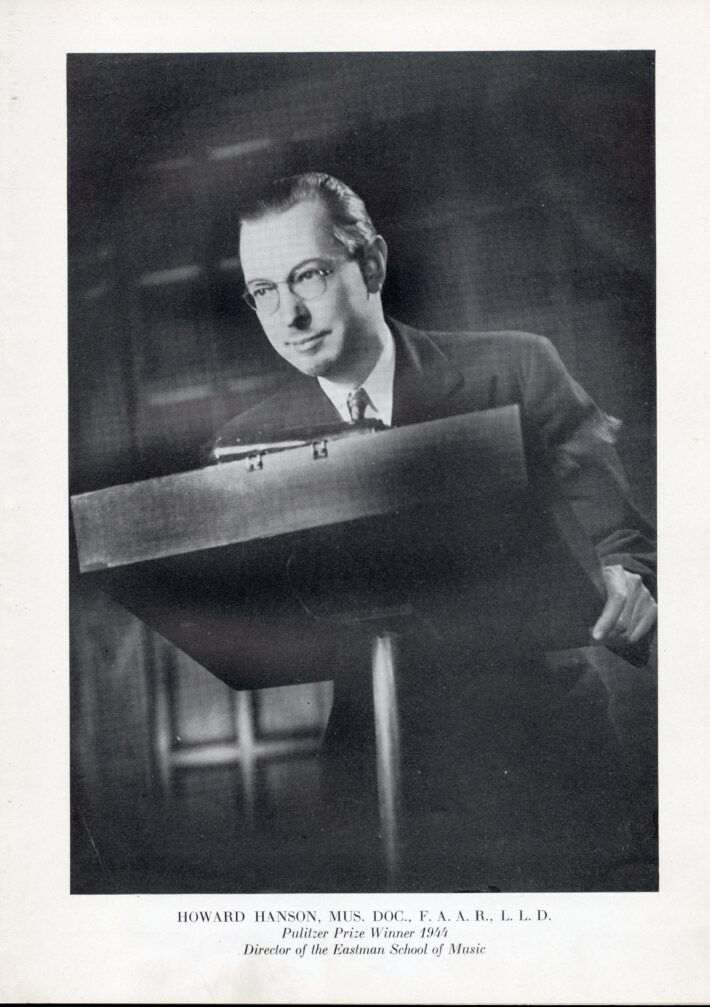
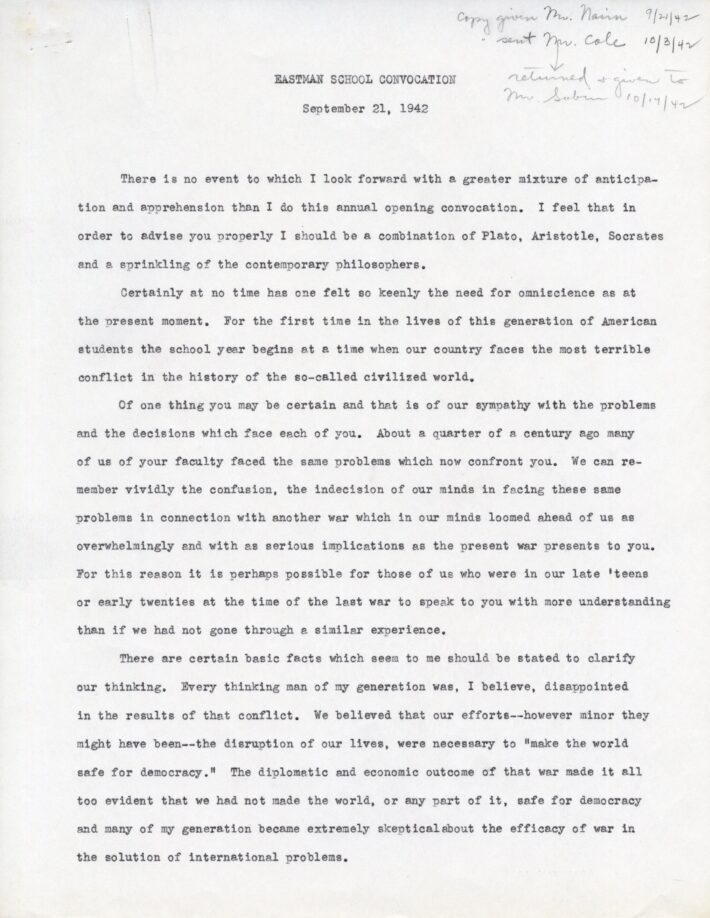
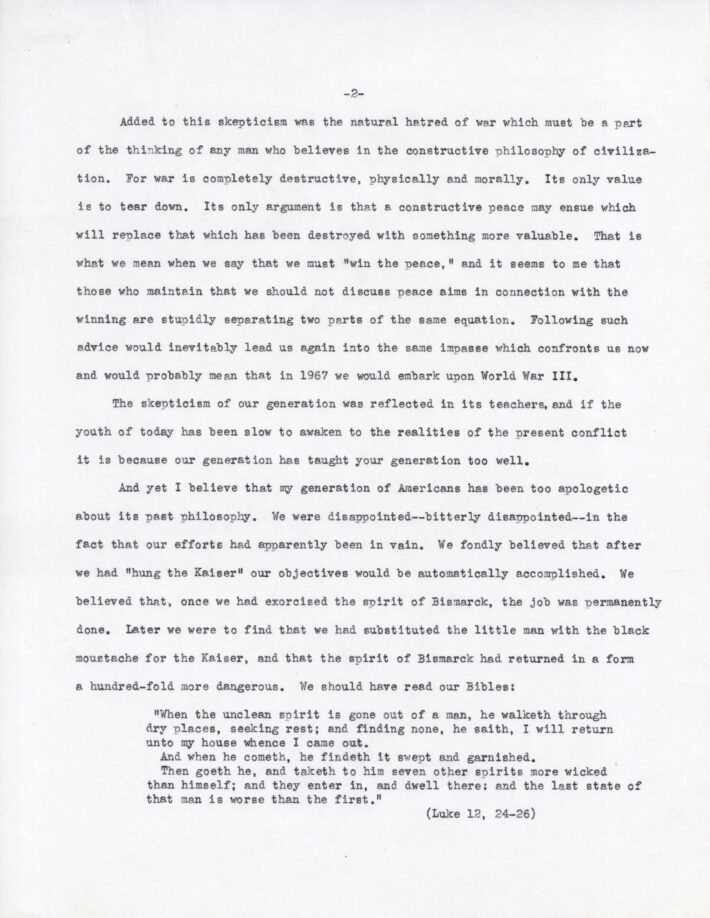
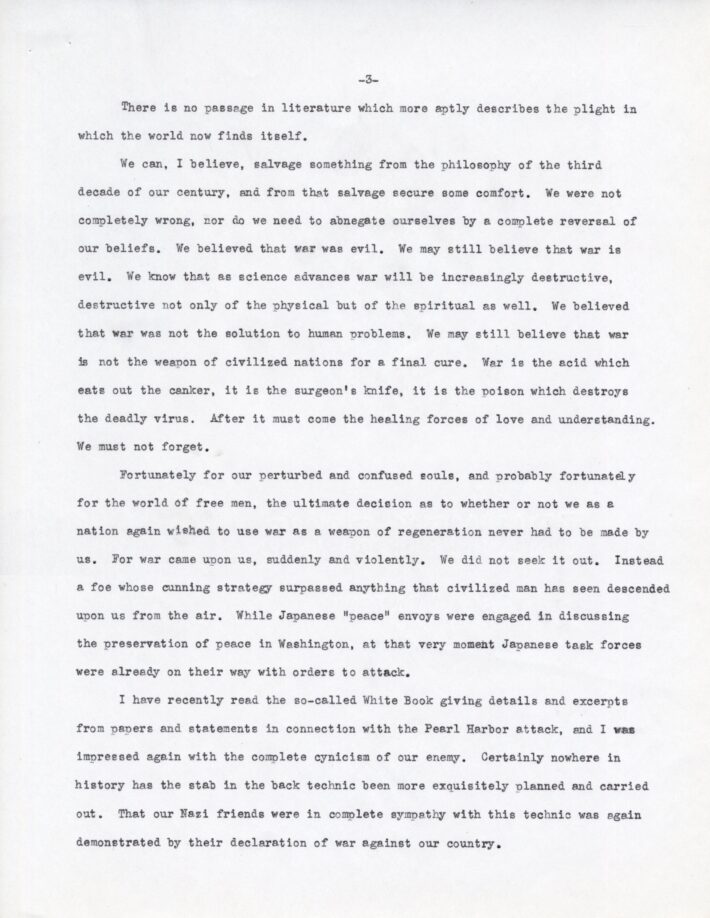
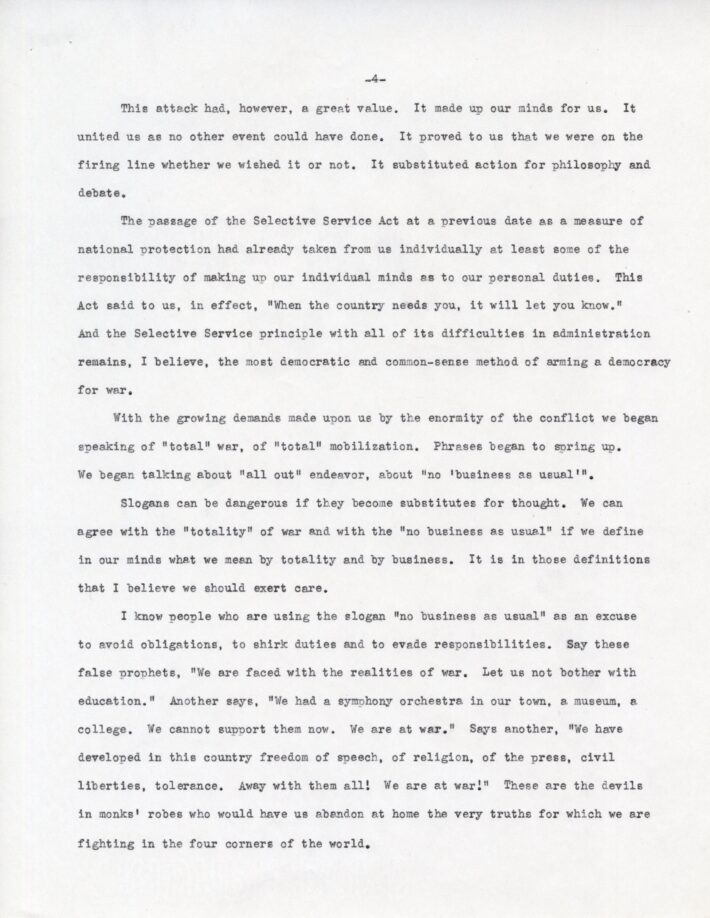
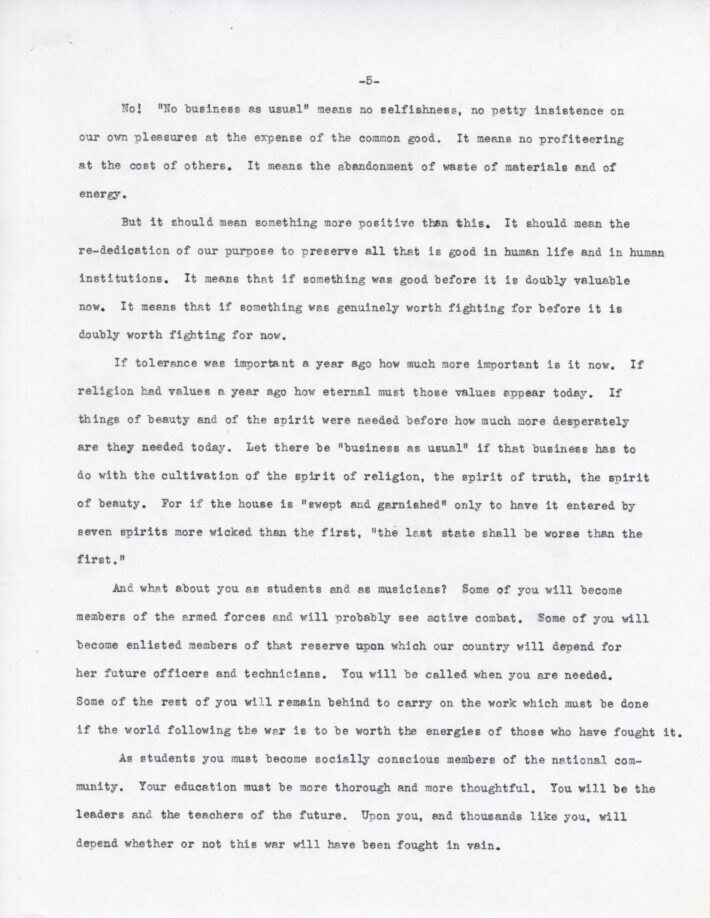
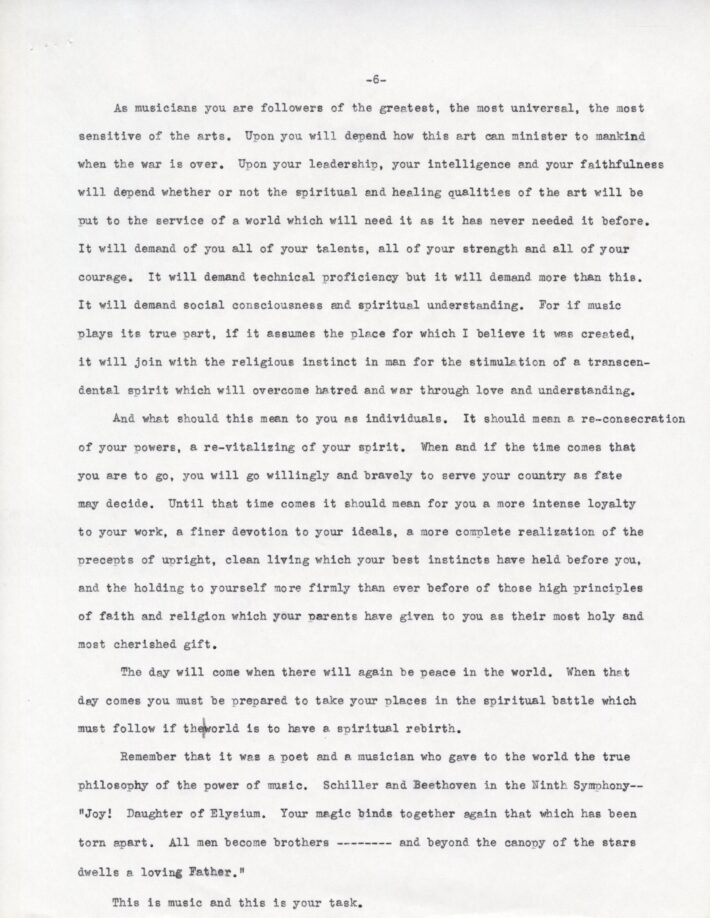
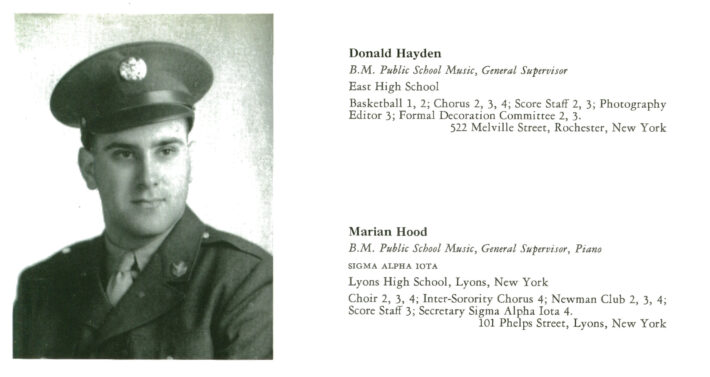
Convocation is normally a time when a Dean or Director addresses an assembled class or student body, perhaps in response to a particular situation or during a gathering of a given body, or as the ritual launch of the academic year, as happens at the Eastman School of Music. An established part of the proceedings is the Dean’s or Director’s statement of welcome; at the Dean’s or Director’s discretion, a local clergyperson or spiritual advisor might be invited to offer a prayer or invocation.[1] The archival record demonstrates that Howard Hanson routinely used Convocation to comment upon the larger issue(s) of the day and to exhort the assembled students to dedicate their talents to the betterment of the world around them. Further, Hanson had no need of a clergyperson, for he himself offered words of spiritual inspiration, freely quoting from the Judeo-Christian Scriptures and more than occasionally concluding his address with a prayer or invocation to the Judeo-Christian Deity (such was Hanson’s own faith practice). In 1942, the Eastman School was beginning an academic year in wartime, and in very short order the War would bring profound changes to the life and activity of the Eastman School. One month before the 1942 Convocation, Hanson had sent a letter to all men enrolling at Eastman to advise them on specific changes to the curriculum that would attend their enlistment.[2] Before 1942 was out, the death of an Eastman School alumnus in the service would be reported.[3] As the ensuing years passed, men would either interrupt their Eastman studies to enlist, or else would join up immediately after graduation. The Eastman yearbooks of 1942 through 1945 would carry photos of men in uniform, and the yearbooks of 1944 and 1945 would list all of the Eastman students who were serving, and also, sadly, those who had perished or else were missing in action. The national anthem would be played at school gatherings and orchestral concerts. One school ensemble, The Little Symphony of Phi Mu Alpha, a men-only ensemble drawn from the Phi Mu Alpha fraternity, would be transformed into a co-ed ensemble to compensate for the diminished enrollment of men. To that same point, for the first time in the school’s history, all four class officers of the 1943-44 senior class would be women. National service was required not only of the young, but also of those of older age who were able-bodied, and so faculty members fulfilled national service in various ways. Conductor Frederick Fennell spent two years as a United Services Organization (USO) conductor based in San Diego[4], and Wayne Barlow, at this time teaching music theory, worked six days a week in a local factory alongside his Eastman School teaching load.[5] One point worth noting is that Dr. Hanson, in his 1943 Convocation address, advised students that customary services around housing, food service, and physical plant maintenance such were carried out in peacetime would not be available.[6] Nationally, the diversion of raw materials to the war effort prompted certain changes at the industrial level. With the diversion of aluminum, the audio instantaneous discs used by the Eastman School’s Recording Department[7] now had glass at their core. Paper-based products were also affected; books published during the war carried an obligatory statement confirming that their production had aligned with Federal wartime regulations.[8] The Sibley Music Library had already at the outset undergone a major change in January, 1942 when the Eastman School’s Board of Managers voted, with the support of the University President and the President of the University’s Board of Trustees, to withdraw circulation privileges from the public, one reason being that under wartime conditions, replacement of lost or worn-out foreign editions would be next to impossible.[9] These are but a few examples of the many wartime changes in the lives and routines of Eastman students, faculty members, and employees. The Eastman School was not alone in this, for just as in any general emergency, whether war, weather event, industrial strife, or pandemic, the prevailing conditions and changes would affect all aspects of life for the entire population for the duration.[10]
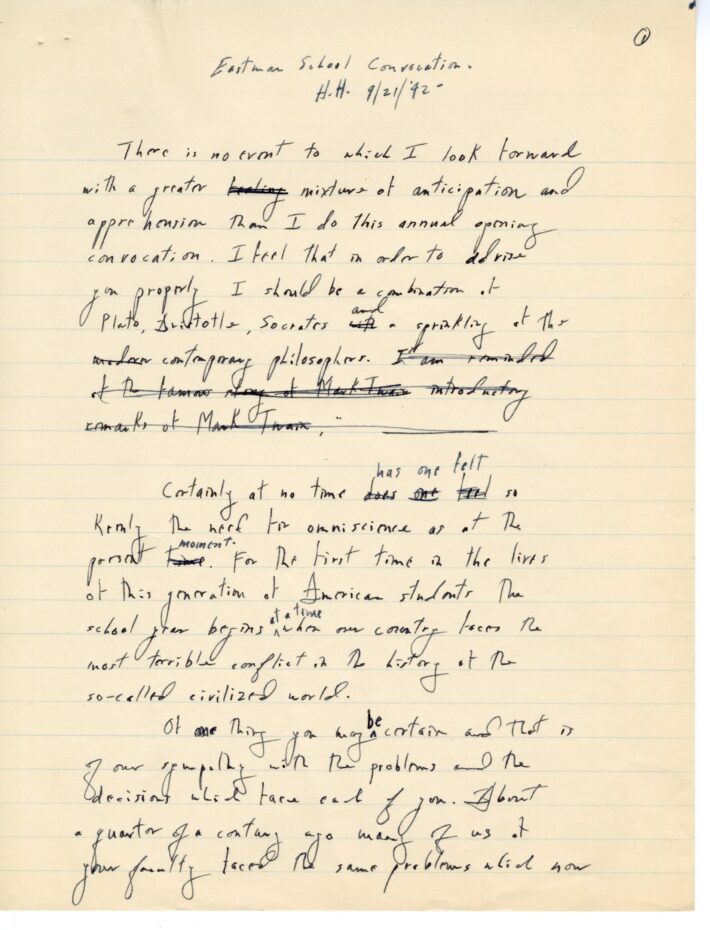
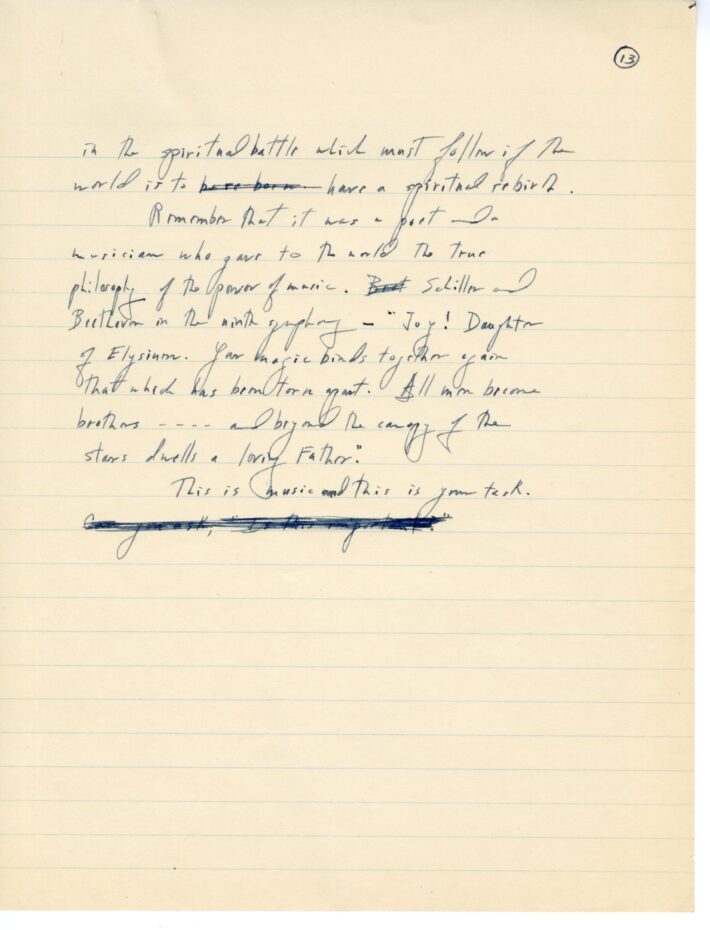
As Howard Hanson prepared for Convocation in 1942, the scale of the conflict in both the Pacific and in Europe, and the sheer urgency of the fight, called for some appropriate statement to the assembled student body. In this Convocation address Hanson more than lived up to his customary flare for oratory; the charged moment of the War had given him a focus far surpassing the customary academic round that normally commanded his and the students’ attention. He opened on an aspirational note, yearning to be “a combination of Plato, Aristotle, Socrates and a sprinkling of the contemporary philosophers” and here it’s relevant to note that in his original handwritten draft, he followed up those illustrious Classical names by penning a reference to a much-celebrated American man of letters — “I’m reminded of the famous story of Mark Twain” — which he ultimately deleted, and so we don’t know exactly which story he had in mind. Moving on, Hanson assured the students of his understanding, and that of others of his generation, of their dilemma, their uncertainties, their problems, pointing out that his own generation had experienced similar one quarter-century earlier.[11] He expressed the regret felt by his generation over the outcome of the 1914-1918 war, with its failure to ensure a lasting peace. That sense of regret had bred a skepticism as to the efficacy (his word) of war, in combination with “the natural hatred of war”.
Making his segue to the subject of music, he advised the students to beware of slogans, lest these be used to justify any undesirable ends. Further, regarding the words “No business as usual” which had come into constant usage, he defined at some length his vision as to what those words should mean: spurning selfishness, ill-gotten gains, and waste, and then a “re-dedication of our purpose to preserve all that is good in human life and in human institutions.” That very re-dedication should be accompanied by “the cultivation of the spirit of religion, the spirit of truth, the spirit of beauty.” Hanson further spoke to the students’ responsibilities as musicians, and exactly here was where he saw them called upon to leave the world a better place. For Hanson, dedicating oneself to music was no less than a spiritual charge, a “spiritual battle” which must be won “if the world is to have a spiritual re-birth.” He called on the students of the Eastman School of Music to exercise “[their] leadership, [their] intelligence, and [their] faithfulness to ensure that music would play its part by “join[ing] with the religious instinct in man for the stimulation of a transcendental spirit which will overcome hatred and war through love and understanding.”
These are lofty words, uttered with deep conviction by a man who felt a responsibility for his school that was not only professional, but indeed, deeply personal. In Hanson’s eyes, the Eastman School was preparing its students for the highest service. With the prospect of military service looming for a number of the students, Hanson offered these words:
And what should this mean to you as individuals. It should mean a re-consecration of your powers, a re-vitalizing of your spirit. When and if the time comes that you are to go, you will go willingly and bravely to serve your country as fate may decide. Until that time comes it should mean for you a more intense loyalty to your work, a finer devotion to your ideals, a more complete realization of the precepts of upright, clean living which your best instincts have held before you, and the holding to yourself more firmly than ever before of those high principles of faith and religion which your parents have given to you as their most holy and most cherished gift.
—In conclusion, Hanson cited Schiller as set by Beethoven—“Joy! . . . All men become brothers – – – – and beyond the canopy of the stars dwells a loving Father.” And his last concluding words, “This is music and this is your task.” Hanson’s handwritten draft shows that he initially added another line, but then omitted it. His chosen ending is a compelling statement, embodying a challenge to the students.
One passage is less fortunate in that it revisited an issue that had already been put to bed, so to speak, by events. Hanson alluded to one of the U.S. political dynamics of the 1930s (“the philosophy in the third decade of our century”) devoted several lines to attempting to justify, after the fact, the isolationist viewpoint that had informed U.S. national politics throughout the 1930s and up until the attack on Pearl Harbor. After 1933, with Nazism ascendant in Germany, and Hitler openly threatening the rest of Europe, many Americans were loathe to become involved in what they perceived to be another looming European war. Once the U.S. had entered World War II, that isolationist, non-interventionist position had been rendered a moot point, and in 1942, Hanson was a speaking to a younger audience, many of whom were facing the prospect of enlistment and combat. The time for revisiting what had been a point of policy debate of the past was over, and for that reason, he might well have omitted altogether any mention of that “philosophy in the third decade of our century”.
Nevertheless, Hanson’s Convocation address of 1942 is an inspiring statement, surpassing many another of his public statements through the sheer oratorical force with which he portrayed the service of music as a spiritual undertaking. Just as armed combat was necessary to defeat the forces of cynicism and cruelty to win the lasting peace in the world outside, so, too, within the Eastman School of Music, Hanson exhorted the students to take up the spiritual battle that would be necessary for a spiritual rebirth. It is a powerful address. Excerpts from Hanson’s address were published in the Rochester press the following day[12], and Hanson’s address was later published in its entirety in the Eastman School’s Alumni Bulletin.[13]There is no archived recording; whereas Convocation was recorded and archived in some years during the Hanson era, the 1942 Convocation was not. We’ll never know, but I’ll wager that the students greeted Dr. Hanson’s words with spirited applause.
[1] Opening Convocation with a prayer or other spiritual invocation was the custom at Eastman under Dean Undercofler (served 1997-2006), Dean Lowry (2007-2013), and Dean Ross (2013-2024).
[2] Hanson’s letter of August 29, 1942 to Eastman School Men Who intend to apply for enlistment in the Army and Navy Enlisted Reserve Corps, Hanson Hanson Collection, accession no. 2005/3/25, box 54/57. An interesting document that will be covered in a future entry.
[3] Marvin R. Lee, an Army Air Force cadet, had received his degree under special arrangements with the Eastman School before enlisting. “Plane crash claims life of air cadet” in The Rochester Times-Union, November 20, 1942 and “Army cadet killed with 2 in midair” in The Rochester Democrat & Chronicle, November 20, 1942, preserved in Rochester Scrapbook 1941-1942, Ruth T. Watanabe Special Collections, Sibley Music Library.
[4] Frederick Fennell’s military service took the form of conducting the USO Service Little Symphony (1943-45) an ensemble comprised of players drawn from eight military and naval installations around San Diego. Two excellent photographs among his papers capture him on the podium before an orchestra of men and women in uniform. Frederick Fennell Collection, Ruth T. Watanabe Special Collections, Sibley Music Library.
[5] “Composer finds it helps to hum while you work” Rochester Times-Union, February 13, 1945. Preserved in Rochester Scrapbook 1945, pages 43-44. Ruth T. Watanabe Special Collections, Sibley Music Library.
[6] 1943 Convocation address, box 2/71, Howard Hanson Collection, accession no. 997.12; and printed in Alumni Bulletin of the Eastman School of Music, vol. 15, nos. 1-2 (December, 1943), pages 1-2, 17.
[7] Forerunner of today’s Technology and Media Production department.
[8] There are still such copies in the stacks today. One such is the circulating copy of The World of Yesterday by Stefan Zweig (Viking Press, 1943), call number PT2653 .Z97w. The statement reads: THIS EDITION IS PRODUCED IN FULL COMPLIANCE WITH ALL WAR PRODUCTION BOARD CONSERVATION ORDERS. Another Viking Press book that I recently borrowed from Rush Rhees Library, published in 1944, carries a similar, slightly longer statement.
[9] “The Sibley Music Library” by Barbara Duncan in University of Rochester Library Bulletin, volume I, no. 1 (November, 1945), page 29.
[10] One area worth exploring is the vast amount of popular sheet music published during World War II—specifically songs composed to inspire the civilian population and to express patriotism and national pride, and faith in the men and women who were actively engaged in combat and in supporting roles. The Sibley Music Library holds several collections of relevant sheet music, of which the World War II Sheet Music Collection is the most noteworthy in this regard.
[11] When the U.S. entered World War I in 1917, Hanson was 21 years old and of sound mind and body—still of an age to have enlisted if he had chosen to do so. As it was, Hanson undertook no national service of any kind during the United States’ involvement in World War I.
[12] “Music called war antidote by Dr. Hanson: most universal of arts, he tells students,” Rochester Democrat & Chronicle, September 22, 1942. Preserved in Scrapbook no. 11, Howard Hanson Collection, accession no. 997.12. Ruth T. Watanabe Special Collections, Sibley Music Library.
[13] “Dr. Hanson’s Convocation Address,” Alumni Bulletin of the Eastman School of Music, vol. 14, no. 1 (February, 1943), pages 1-3, 10.