
Published on Sep 7th, 2026
1956: The first time when an Eastman School Director met the President of the United States
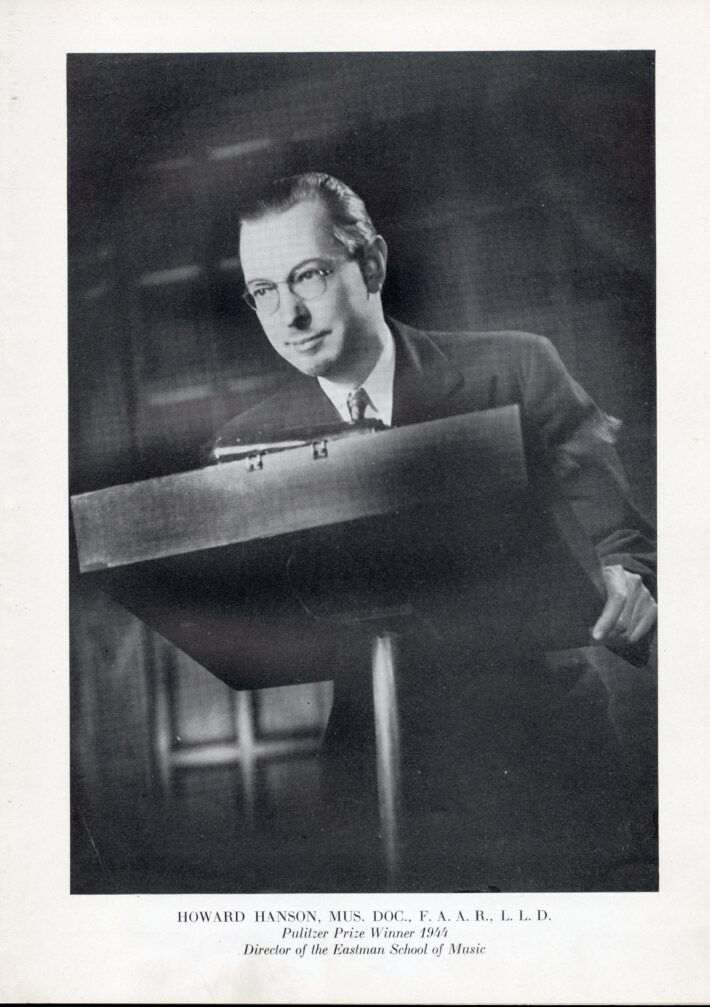
Seventy years ago this week, on Monday, September 10th, 1956, Howard Hanson met President Dwight D. Eisenhower in the Oval Office at the White House, marking the first time that an Eastman School Director had met the President of the United States. Also present was Maestro Arthur Fiedler, conductor of the Boston Pops Orchestra. Photographs of the three men in conversation were printed in newspapers across the nation that evening and the following day.[1]
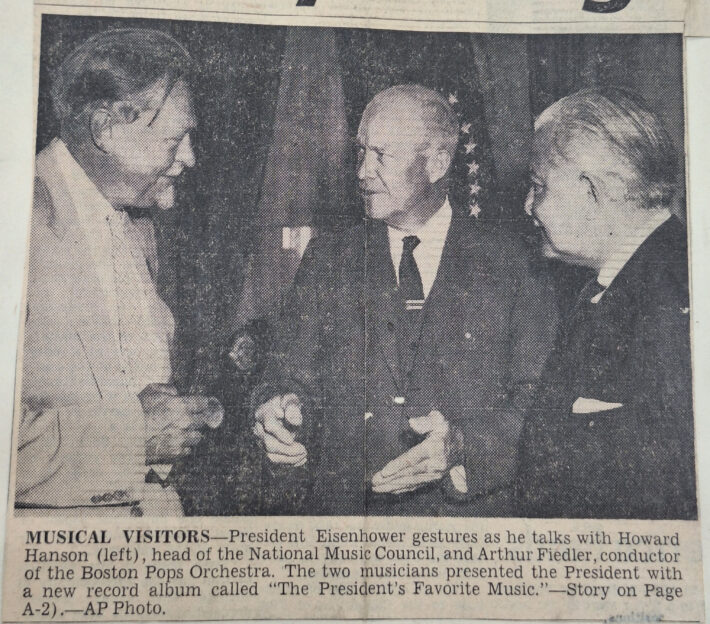
► Photo printed in The Evening Star, September 10, 1956
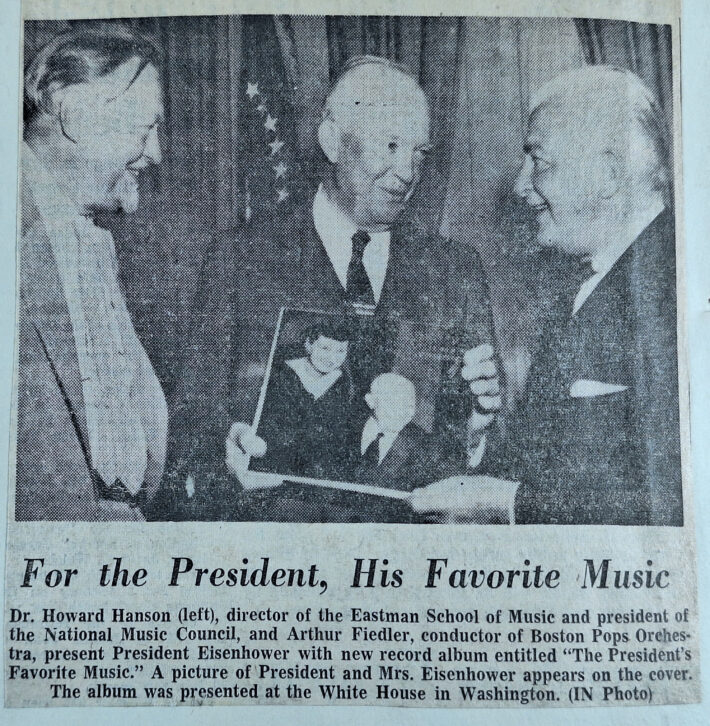
► Photo printed in the Rochester Times-Union, September 11, 1956
Why this meeting, why were the two musicians Hanson and Fiedler in the Oval Office with the President? The reason that was publicly promoted in the press is that the two men were presenting President Eisenhower with a new recording, The President’s Favorite Music. [2] Bolstering that message was the fact that Maestro Fiedler was the conductor on some of the LP’s tracks. Dr. Hanson, for his part, was likely not there to represent the Eastman School of Music, but rather, the National Music Council, of which he had been President since 1946. President Eisenhower had just recognized the National Music Council by signing legislation that had granted it a Congressional Charter, thereby incorporating it. The granting of the Charter capped ten years of effort on Capitol Hill by many, including Hanson.
The National Music Council, founded in 1940, is a voluntary non-profit membership association representing some 50 musical organizations in the U.S., including some of the bigger ones that one can think of—NASM, MTNA, and MENC. The NMC’s mission is spelled out on its website, which emphasizes six action points that cover music teaching and learning in schools; the protection of creative and intellectual property rights; providing member organizations with a forum for the exchange of information; speaking with a unified voice when collective expression is determined to be the most advantageous; reporting on concerns of importance to the membership; and encouraging the development of the art of music and fostering the highest professional standards throughout the music community. Further, the NMC has been the official U.S. representative to the International Music Council for over seventy years.
During Howard Hanson’s ten years as President of the NMC, he had actively advocated for the Congressional Charter, including speaking before Congressional committees. [3] Bills had been introduced before 1956, but none had progressed to the point of an actual vote on the floors of Congress. The time was finally right in 1956, when a new bill (H.R. 8110) was actively supported by influential members of the 84th Congress. The House of Representatives passed the bill on May 21st and the Senate had passed it on July 23rd; President Eisenhower signed the legislation on August 1st. President Eisenhower’s statement on signing the legislation is worth including in its entirety:
In approving the bill (H.R. 8110) to incorporate the National Music Council, I wish to salute musicians and the important part they play in the life of our people. American music has brought us pleasurable distinction at home and abroad.
Congress has chartered the National Music Council because of its important and effective role as a central body representing virtually all of the major voluntary musical organizations in our country. Its members include symphony orchestras, song writers, choruses, educational associations, publishers, labor unions, music clubs, and others. Thus the National Music Council is truly representative of the American way of life, in which music can flourish as it should in a free democratic society, as a voluntary activity under the nourishment and control of private citizens.
Millions of Americans are engaged in the creation, performance and active appreciation of music. Indeed it is a rare day when any one of us does not hear some form of music; it is hard to imagine our lives without it. The enjoyment of music—speaking for myself, at least—has a moral and spiritual value which is unique and powerful. IOt reaches easily and quickly across lingual, racial and national barriers. The development of American music, and the native development of any art, is therefore the development of a national treasure. [4]
Hanson greeted this news with enthusiasm and gratitude. He was quoted as saying, “This recognition comes at a very opportune time. Music is having its problems, as we in Rochester well know. People are taking a closer look at these problems, which affect such matters as the support of symphony orchestras. This action by congress and the President will give music a real shot in the arm by emphasizing the essential place of music in the life of the nation. Although it makes no provision for the appropriation of funds for music, it none the less gives an official standing to music that will greatly help n the advancement of worthwhile musical projects.”[5]
Hanson had received the summons to the White House entirely unexpectedly while vacationing on Bold Island, his island retreat off the coast of Maine. Suddenly that Sunday morning, a small boat with an outboard motor drew up at the dock and an excited young man jumped out bearing a message from the city manager of Stonington, the nearest town. The message was succinct: “President Eisenhower wants to see you Monday morning at 10 o’clock.” —Whereupon Hanson was obliged to make a hurried dash to Washington, D.C. by boat, car, and then airplane. Not having anticipated a White House engagement when packing for his vacation, Hanson was forced to choose from a limited assortment of clothes, taking his one rumpled suit (which would have to be drycleaned urgently on arrival in Washington); a borrowed tie; and a pair of canvas shoes with rubber soles. Hanson would later note that the [attendant] who met him on his arrival in Washington, D.C. had cast a somewhat questioning look at his appearance. [6] In any event, Hanson regarded the meeting with President Eisenhower as a success, a positive outcome of the efforts to win recognition for the National Music Council.
The meeting with President Eisenhower was, to be certain a source of immense personal satisfaction for Howard Hanson. For the record, Hanson had a second, and more purely political, association with President Eisenhower at this time. That summer, in August, 1956, Hanson had been named to the newly organized Committee of the Arts and Sciences for Eisenhower (CASE) that was working for President Eisenhower’s re-election.[7] The specific objective of CASE was to canvass professionals in the fields of education, literature, science, theater, music, and other arts, segments of the electorate that would normally lean Democratic. The group’s national co-chairs were actress Helen Hayes and Professor Harry Carman, Dean Emeritus of Columbia College; the group included such distinguished individuals as Dr. Isidore Rabi, the 1944 Nobel laureate in physics and professor of physics at Columbia University; Dr. Detlev Bronk, the then-President of the National Academy of Sciences; and several college and university presidents. The prominent musicians in the group included not only Hanson but also Maestro Eugene Ormandy of The Philadelphia Orchestra. The formation of CASE was widely reported in the press, and further news of the group’s activity would appear as the election campaign wore on. Hanson’s involvement with CASE marked the first time that he would be openly associated with a partisan political candidate. Moreover, Hanson’s efforts on President Eisenhower’s behalf were undertaken with explicit use of his professional affiliation with the Eastman School of Music, including sending letters above his signature on Eastman School letterhead. [8]
Besides meeting President Eisenhower in 1956, Howard Hanson would enjoy later opportunities to meet other heads of government. In December, 1956, he was a guest of Secretary of State John Foster Dulles at a Washington, D.C. dinner honoring Prime Minister Jawaharlal Nehru of India; in November, 1961, he was a guest of President and Mrs. John F. Kennedy at a White House dinner honoring violoncellist Pablo Casals [9]; in December, 1961, during the Eastman Philharmonia’s 1961-62 tour, he had an audience with Archbishop Makarios III, President of the Republic of Cyprus; in May, 1963, he met (former) President Eisenhower a second time, this time in Rochester on the occasion of W. Allen Wallis’ inauguration as President of the University of Rochester; in June, 1964, he was a guest of President and Mrs. Lyndon B. Johnson at a White House dinner honoring violinist Mischa Elman; and in January, 1969, he met the newly inaugurated President Richard Richard Nixon, to whose inauguration Hanson had been invited.
As the record shows, Howard Hanson was a public man in numerous more ways than has generally been known to the musical community. In demeanor, statement, and conviction, he represented ably and well all of the institutions and organizations with which he was affiliated throughout his long career.
[1] Among them were The Evening Star (Washington, D.C.), the Rochester Times-Union, and the Rochester Democrat & Chronicle, all preserved in Scrapbook 17, Howard Hanson Collection, accession no. 997, 12, Ruth T. Watanabe Special Collections, Sibley Music Library.
[2] The recording had been the idea of George R. Marek of RCA Victor. It contained ten tracks, including a selection from George Gershwin’s Porgy and Bess conducted by Maestro Fiedler; the spiritual “He’s got the whole world in His hands” sung by contralto Marian Anderson; the main theme from the motion picture High Noon; and Beethoven’s Coriolan Overture. The recording was detailed in the press. “Eisenhower gets record album of favorite music” in The Evening Star (Washington, D.C.), September 10, 1956; and, “President presented with record album” in The Wilmington (Delaware) News, September 11, 1956. Scrapbook 17, Howard Hanson Collection, accession no. 997.12, Ruth T. Watanabe Special Collections, Sibley Music Library.
[3] Speaking on one occasion before a Congressional committee, Hanson based his argument on three points (on which he duly elaborated): that music as an art is important to the people of the U.S.A.; that a Federal Charter for NMC would have significant value for the development of music in the nation; and, that the NMC was the proper organization to be recognized with a Charter. Howard Hanson Collection, accession no. 2005/3/25, box 35/126. Ruth T. Watanabe Special Collections, Sibley Music Library.
[4] “Eisenhower signs National Music Council Charter bill” in Musical Courier, vol. 154, no. 3 (September, 1956), page 7.
[5] “Newly signed music bill opportune, says Hanson” in the Rochester Democrat & Chronicle, August 4, 1956, preserved in Scrapbook 17, Howard Hanson Collection, accession no. 997.12, Ruth T. Watanabe Special Collections, Sibley Music Library.
[6] Hanson later described the 1956 meeting with President Eisenhower in his column “Cherished Memories” in the Rochester Times-Union, April 7, 1969, which was printed shortly after former President Eisenhower’s passing. Preserved in the Rochester Scrapbook March-May 1969, Ruth T. Watanabe Special Collections, Sibley Music Library.
[7] Numerous press items detailing CASE are preserved in Scrapbook 17, Howard Hanson Collection, accession no. 997.12, Ruth T. Watanabe Special Collections, Sibley Music Library. These include: “Arts-for-Ike Group”, Variety (New York), August 8, 1956; “GOP seeks ‘Egghead’ votes, too,” Corpus Christie (Texas) Caller, August 8, 1956; “Dr. Hanson gets post with group boosting Ike” in the Rochester Times-Union, August 16, 1956; “Dr. Hanson to head Arts, Sciences unit” in the Rochester Democrat & Chronicle, August 16, 1956; “New unit for Ike bids for the ‘Egghead’ vote” in the Minneapolis (Minnesota) Morning Tribune, August 8, 1956; and, “GOP sets out to win ‘egghead’ vote” in The Philadelphia Inquirer, August 8, 1956. Hanson’s prominence in national music circles guaranteed him mention in the national press coverage of CASE.
[8] CASE file, box 18/37 in Series 2: Correspondence, the Howard Hanson Collection, accession no. 997.12, Ruth T. Watanabe Special Collections, Sibley Music Library.
[9] On the following day, President Kennedy conferred with Hanson and with representatives of the National Cultural Center on general cultural problems and programs. “Casals ‘astonishing’ Hanson says” in the Rochester Tmes-Union, November 14, 1961. Rochester Scrapbook October-November-December, Ruth T. Watanabe Special Collections, Sibley Music Library.