
Published on Sep 14th, 2026
1924: Accessioning of the SML’s first Scriabin Concerto manifestation
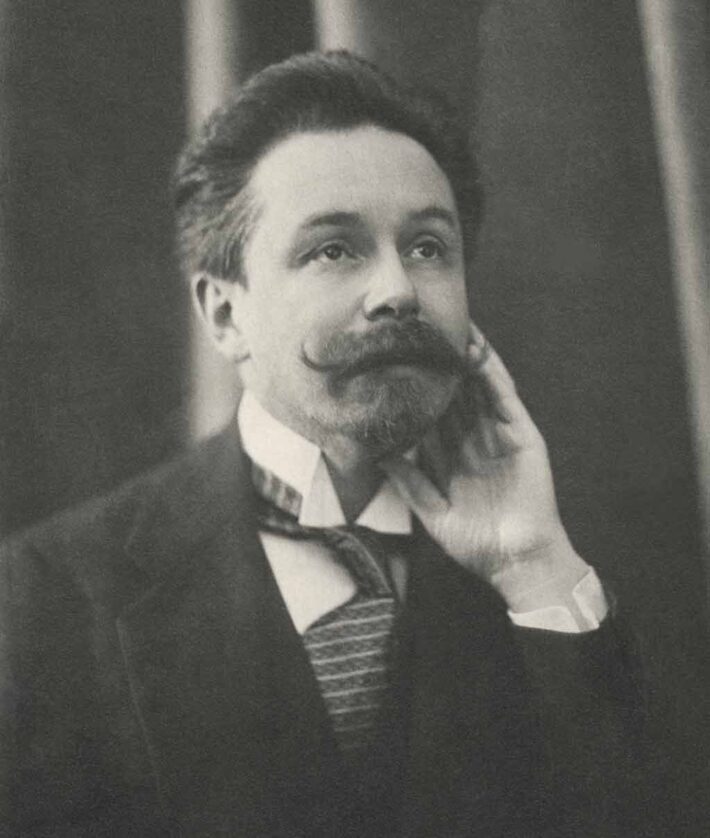
► Alexander Nikolayevich Scriabin (1872-1915), photographed in 1914. Photo appears on several websites, unattributed
An Eastman piano major recently asked me about the Sibley Music Library’s acquisition of a particular concerto score, having found a .PDF of the item in the Library’s digital repository. She noted that the edition was an older one, and the work in question not in the standard repertory, hence her curiosity. I welcomed her interest, for informing patrons of the ins and outs of library and archival procedure is part of what I love about this job. And so, for the record, one hundred and two years ago this week, on September 14th, 1924, the M. P. Belaieff edition of the piano reduction score of A. N. Scriabin’s Concerto for Piano and Orchestra, opus 20, was formally accessioned in the Sibley Music Library, thereby initiating that work’s continuing presence in the Library’s physical stacks and intellectual corpus. This story illustrates the logical progression that is being enacted every day of the week in a performance/research library such as the Sibley Music Library: from informed acquisition to accessioning to cataloguing to digitization and networked access; and separately, the magic of realization in performance in the concert hall.
By way of background, Alexander Nikolayevich Scriabin composed his Concerto, opus 20 between October, 1896 and May, 1897; the work was premiered in Odessa on October 23rd, 1897, conducted by Vasily Safonov and with the composer at the piano. The Concerto belongs to Scriabin’s early period, when his music was of a noticeably Romantic character, solidly diatonic, and composed in the time-honored formal structures. (Chopin has frequently been mentioned as an influence.) Scriabin’s music has been extensively analyzed (and, at times, psychoanalyzed) in both the scholarly and popular music literatures; it is unnecessary for me to repeat or volunteer anything in that vein here. Suffice it to say that the Concerto is a musically appealing work that for decades suffered the fate of obscurity and under-rated status. Was that because the piece lacked the overt virtuosity and showmanship of such piano concertos as those by Tchaikovsky and Rachmaninoff? Whatever the reason(s) may have been, unappealing this work is not. The composer himself performed it while he lived, both at home in Russia and abroad, and Rachmaninoff himself is also known to have performed it.[1] While it doesn’t appear to be in the repertory of every performing pianist, the Concerto today enjoys more visibility via commercial recordings than ever before, and video of numerous live performances can be accessed on YouTube.[2]
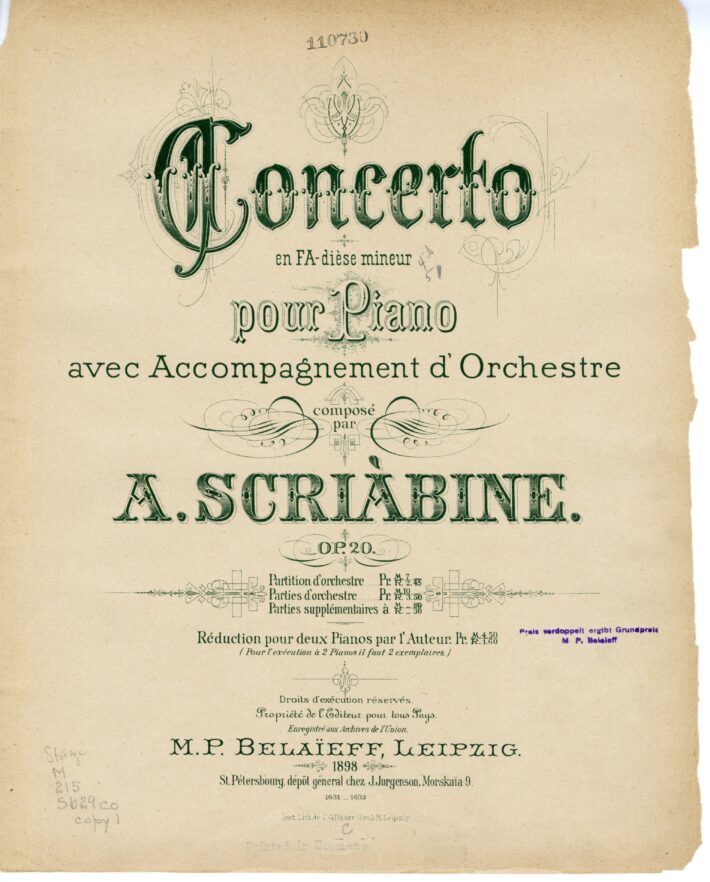
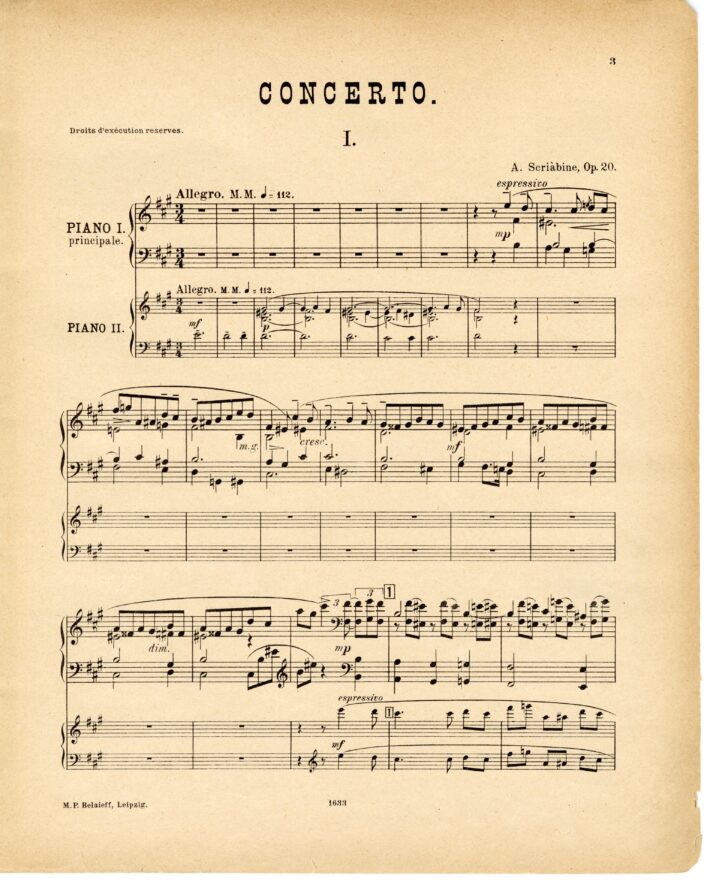
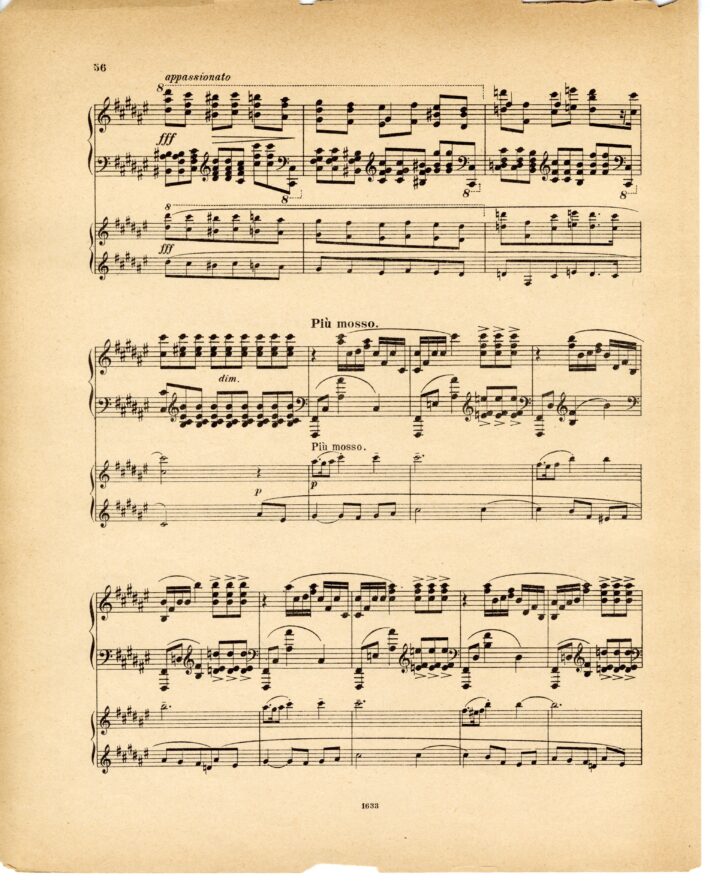
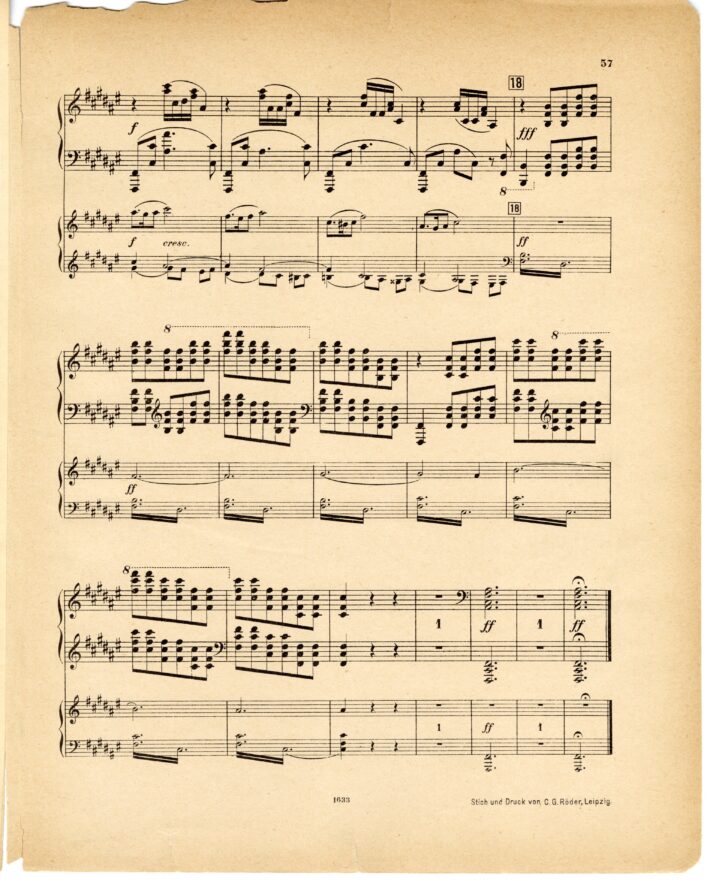
The Concerto was published in 1898 by the firm of M. P. Belaieff—that is, the full score, orchestral parts, and piano reduction score. The title page and first page of music of the piano reduction are displayed here; note the rubric “Printed in Germany”. Belaieff was one of several Russian publishers who performed a huge service by bringing out the first editions of works by many Russian composers. (Other leading Russian publishers of the day were Bessel, Gutheil, and Jurgenson.) Mitrofan Petrovich Belaieff, son of an affluent timber merchant, founded the firm in 1885 in Leipzig, choosing the German location so as to secure international copyright (which at that time did not extend to music published in Russia), and also identifying the superlative quality of the work of local printer C. G. Röder, who would become a resource. The firm eventually published more than 200 works by Russian composers, and further, promoted Russian music in other ways that included concert management. Significantly, the Leipzig office ensured the firm’s survival in the wake of the Bolshevik Revolution in 1917, when private enterprises throughout Russia were seized and nationalized. Belaieff’s printed editions are noteworthy for their artistic appeal and quality, featuring handsome multi-tinted title pages of distinctive design, the musical text laid out with generous spacing, and the paper of a durable quality. Indeed, it was M. P. Belaieff’s actual intention to create artifacts that would appeal first of all to the musician’s eye. A recent monograph, The Beauty of Belaieff, preserves a visual record of many of the beautiful title pages and/or covers together with invaluable historical data.[3]
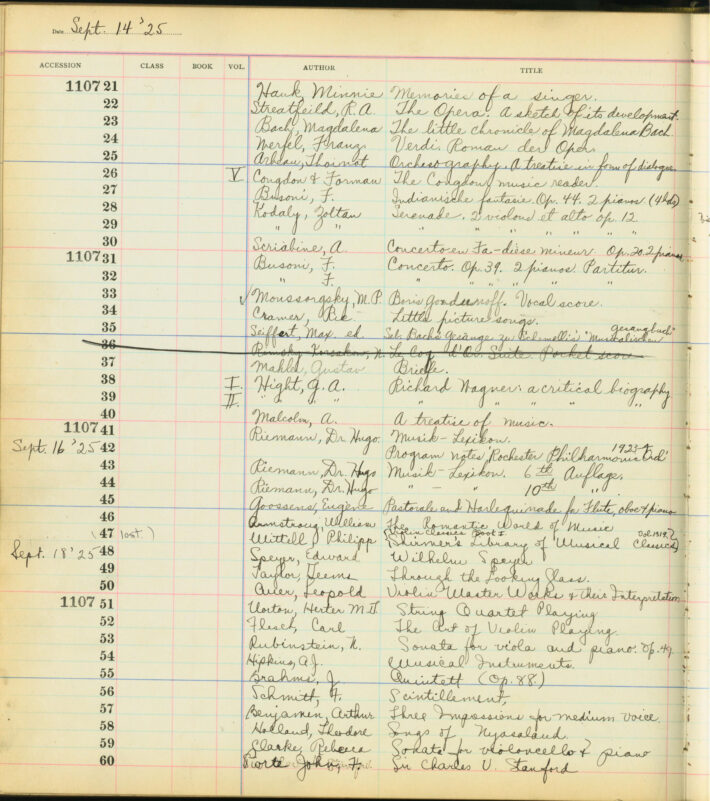
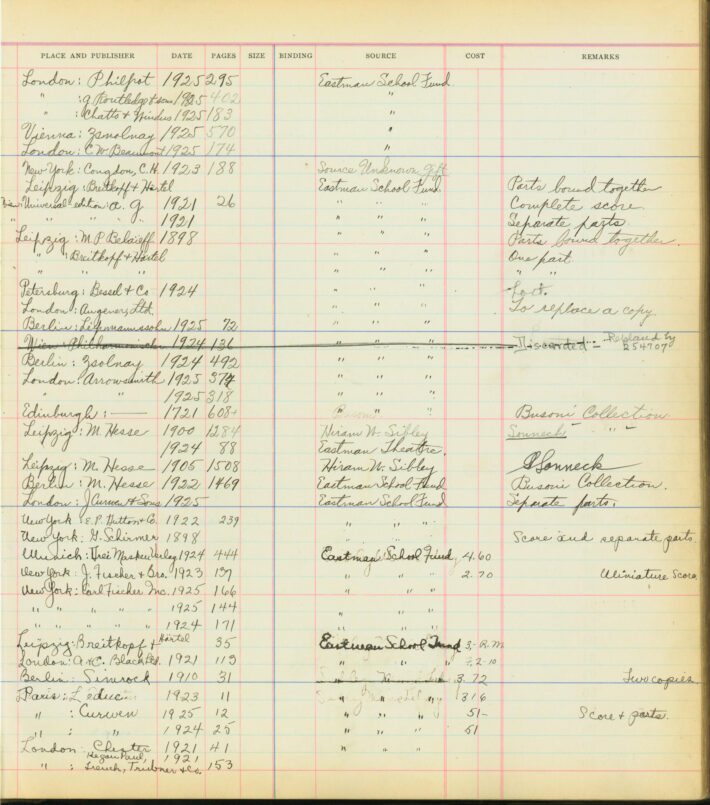
When the Sibley Music Library acquired the Belaieff score in 1924, the Library had only recently become a conservatory library following its early years as a circulating public music library for the townspeople of Rochester.[4] The level of difficulty in the Scriabin Cocnerto demands a higher degree of technique than was generally required for the music that the Library acquired between 1904 and 1921, which was mainly solo piano pieces and four-hand piano music, art songs, and the easier chamber music literature. The Scriabin Concerto more appropriately fit a class of piano majors studying at the collegiate level. The copy bears (on the first page of music, and also on page 31) the stamped number 110730, which is the Library’s accession number, which can be traced to September 14th, 1924 when the score was accessioned. In any library or archive, the action of accessioning is the all-important administrative step of entering each new acquisition in a given tool, whether that be (in an earlier time) an accession book[5], or in our digital era, a database or some other management system. Each institution maintains maintains its own manner of accessioning based on its own needs and infra-structure. The point is that each acquisition is accounted for, and further, the order of acquisition is preserved and can be tracked. Thus, the Belaieff score was entered in the Library’s accession book as the 110,730th item acquired by the Library. The price is not indicated, nor is the vendor from whom the score was purchased, but it’s nevertheless recorded that the funds for the purchase came from the Eastman School Fund—that is, out of the school’s budget, rather than any gift funds from Mr. Sibley.[6]
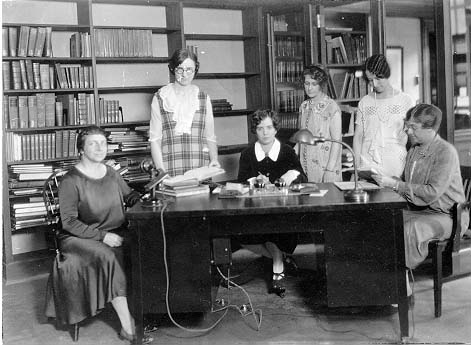
► Staff of the Sibley Music Library, 1920s; at right, head librarian Barbara Duncan; at left, cataloguer Elizabeth Schmitter. Eastman School Photo Archive.
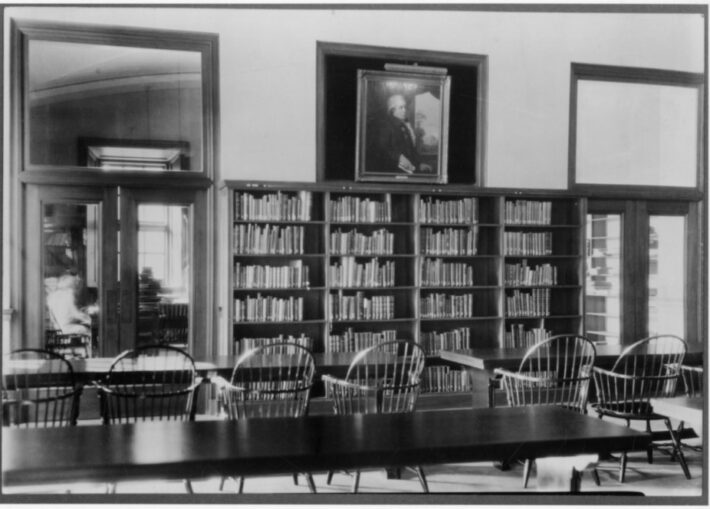
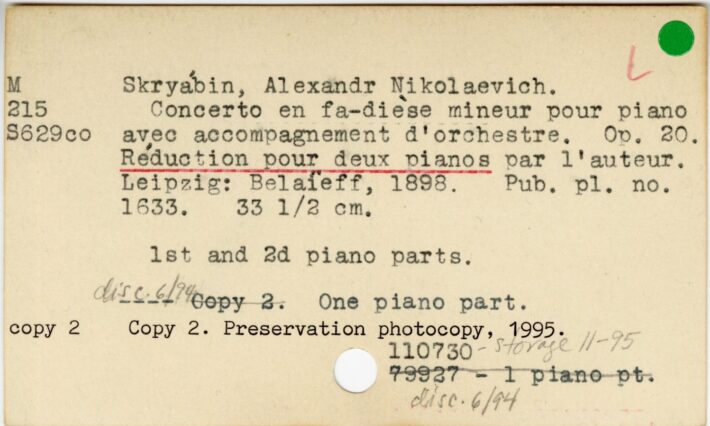
Following accessioning, the score would have gone into a queue for cataloguing, eventually receiving the attention of Elizabeth Schmitter, the SML’s designated cataloguer for more than a quarter-century. The step of cataloguing would have generated at least two printed cards: one for the shelflist, and at least one for the card catalogue[7]. The Sibley Music Library’s card catalogue is now gone, having been closed in the 1990s[8] and later physically removed. The shelflist, however, is still extant, standing in the Library’s technical services area. A shelflist is exactly what its name suggests—a list of what’s on the shelves, arranged sequentially in order by call number. The Library’s shelflist resembles a card catalogue, comprised of standing wooden cabinets bearing drawers filled with cards. It is an artifact from an earlier generation that nevertheless continues to yield useful information to members of the Library staff. The shelflist card for the Scriabin score indicates that when initially catalogued, the score was assigned call no. M215 .C629co; the classification M215 signifies “Instrumental music—Music for two or more solo instruments—Duets—Two pianos, two performers”. More recently, when the score was digitized in 2022, it was assigned the new call number M1011 .S434 op.20 1898, its new classification M1011 signifying “Instrumental music—Orchestra—Original compositions—Solo instrument with orchestra—Piano—Solo with piano”. The earlier classification under M215 was no doubt based on considering each piano as one half of a duet, whereas the later classication under M1011 more accurately recognizes that the Concerto, opus 20 is for orchestra with solo piano, rather than a duet of two solo instruments.
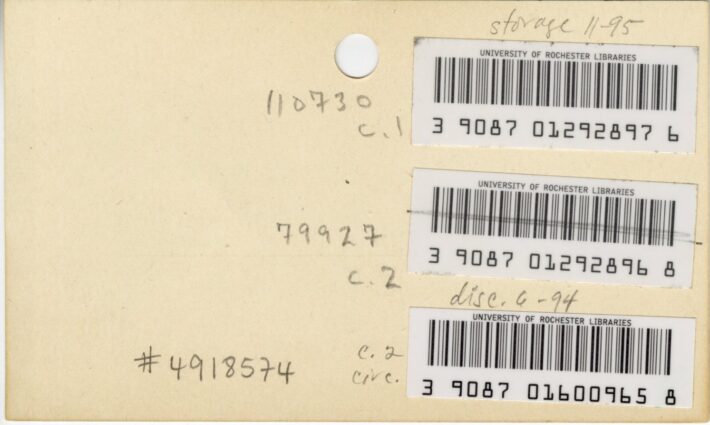
In time, the Sibley Music Library would acquire other editions of the Scriabin Concerto. To date, these have included a 1945 printing by Broude Bros. (New York) of the full score, which was possibly a facsimile of the earlier Belaieff score; a 1963 printing of the full score (plate no. М.Г. 21934) by the USSR’s State Musical Publishing House (Государственное Музыкальное Издательство)[9]; a 1975 printing by M. P. Belaieff of the full score in miniature format; and a 2003 printing of the piano reduction score (plate no. 15787) by Moscow-based publisher Музыка (Music). (Музыка had previously issued the piano reduction in 1990; I own a copy which I bought in Moscow that same year). Moving into the 21st century, digitization became a daily concern. In 2022, the bibliographic rarity of the 1898 Belaieff score prompted the Sibley Music Library to digitize it; since then, a .PDF is accessible in the Library’s digital repository that is maintained on a University server.[10] In addition, two copies that were printed from the .PDF and then bound are in the circulating shelves. Copies of their barcodes were placed on the reverse side of the shelflist card, thereby indicating a continuing use of the shelflist.
When the Sibley Music Library acquired the Belaieff piano reduction, Scriabin had been dead for nearly a decade, but his music was gaining a definite following in the West. The Eastman premieres of Scriabin’s works can be discerned from the Eastman School’s archived concert programs. To name just a few: throughout the 1920s and ‘30s, several Eastman piano majors performed selected Preludes and Etudes; in 1926, guest artist Josef Hofmann performed the Sonata no. 4 in an Eastman Theater recital; in 1937, faculty artist Sandor Vas performed the Sonata no. 5 in Kilbourn Hall. From among Scriabin’s orchestral works, the Rochester Philharmonic Orchestra performed the Rochester premiere of the Symphony no. 3 (The Divine Poem) in a matinee concert in 1927, and the Eastman School Symphony Orchestra performed the Eastman premiere of the Poème de l’Extase in 1935, conducted by Howard Hanson. As for the Concerto, opus 20, there has been only one Eastman School performance to date. The third movement (Allegro moderato) was performed in a graduation recital with orchestra on March 27th, 1936; the Rochester Civic Orchestra was conducted by Howard Hanson, with undergraduate Kathryn Kettering, from the class of Sandor Vas, at the piano.[11] Perhaps the 21st century will see some new local interest; with the accessibility of the digitized score, any interested pianist with access to a printer can acquire the score.
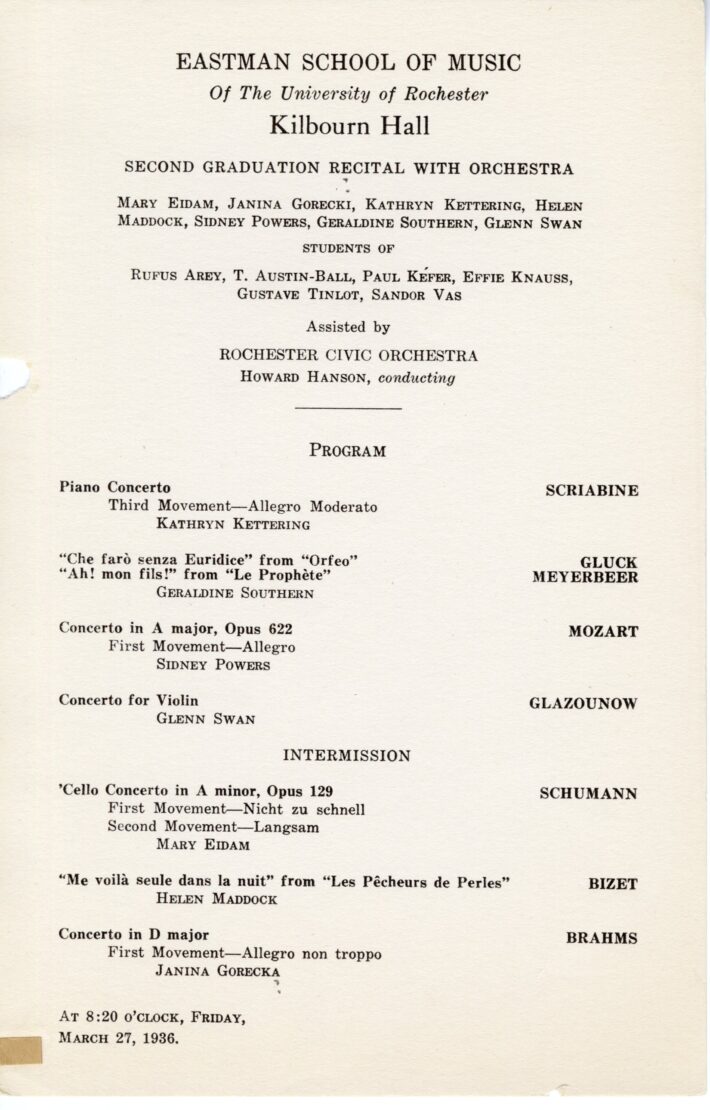
► Concert program for the Second Graduation Recital with Orchestra of the 1935-36 academic year, March 27th, 1936. The third movement of the Scriabin Concerto, opus 20 opened the concert.
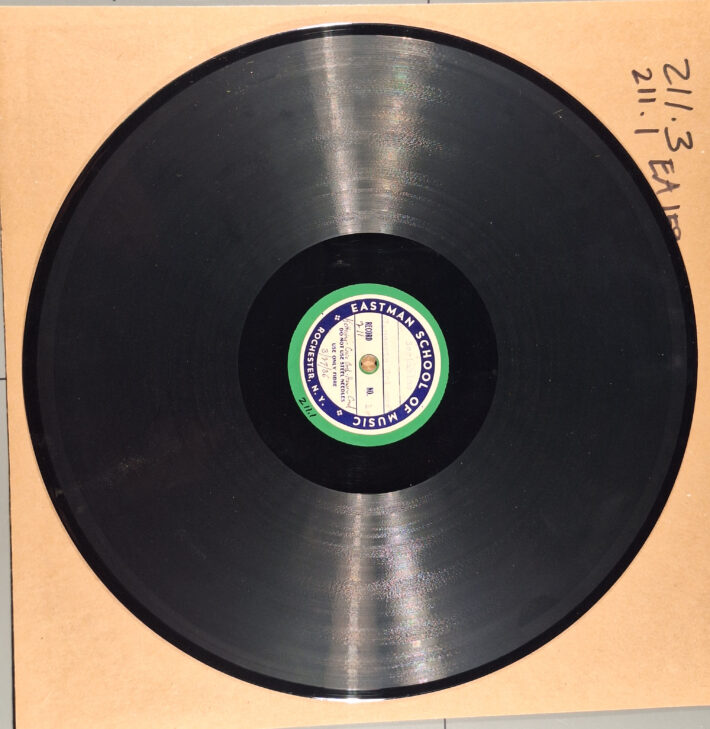
► One of two instantaneous discs on which the March 27, 1936 performance of the Scriabin was captured, 12” diameter and 78rpm playing speed; three sides were necessary to capture the movement. Eastman Audio Archive, call no. 211.1 : 211.3.
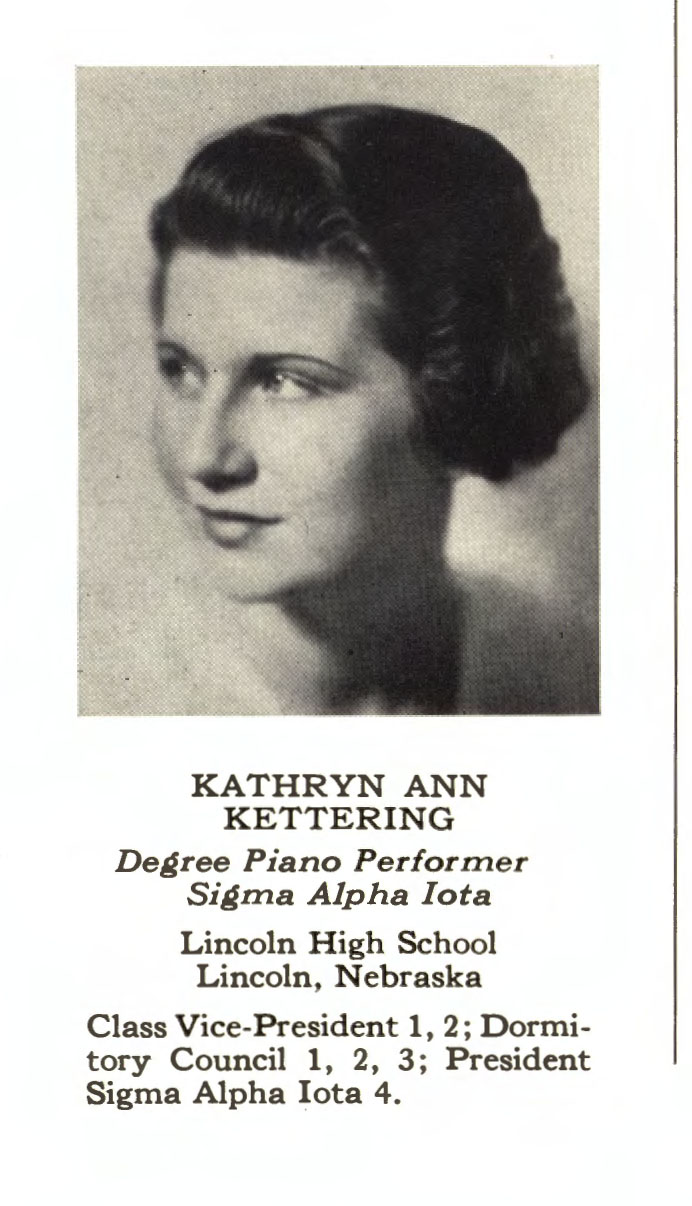
► Kathryn Kettering, pianist, senior photo in the 1936 Eastman School yearbook. Her public performance with orchestra signified that she graduated in the performer’s stream in her class, rather than the teacher’s stream.
.
After the Sibley Music Library was joined to the Eastman School of Music —
a union on which ESM founder George Eastman and SML founder Hiram Watson Sibley shook hands in person—the most immediate changes were the Library’s relocation to a dedicated space on the ESM’s ground floor, the appointment of a full-time head librarian, and a profound and deep change in the library’s acquisitions program. The necessary funds were provided by the Eastman School and by Mr. Sibley himself, but supporting collegiate education in music performance, music history and music theory, and music education (which we now call music teaching and learning) required an enlightened, deliberate, and judicious approach to book selection and collection development. The Scriabin score under consideration here was one such acquisition that aligned with the goals of the post-1921 Sibley Music Library. That the 1924 purchase was followed by other, later editions of the same manifestation of the Concerto, opus 20 was a logical development as the Library has continued to grow. Further, digitization and networked access to the Belaieff score were another logical development as the Library has continued to adopt new technologies in fulfilling its mission to the Eastman School, to the University, and to patrons both local and remote. One score—one purchase –one essential part, among many, of the story of the Sibley Music Library.
[1] Rachmaninoff performed the Concerto in his own memorial series honoring Scriabin in 1915, and also in 1916 during the nationally observed one-year anniversary of Scriabin’s death. The Alexander Scriabin Companion: History, Performance, and Lore (Rowman & Littlefield, 2017), p. 80.
[2] These include live performances featuring soloists Daniil Trifonov, Mikhail Pletnev, and Bertrand Chamayoux, among others.
[3] Written by scholar-collector Richard Beattie Davis, the book was published by G-Clef Music (2009). It constitutes an invaluable history of Belaieff, as well as providing a treat for the eye. A copy is upstairs at the Ruth T. Watanabe Special Collections.
[4] A substantive account of the Sibley Music Library’s early decades is found in Mary Wallace Davidson’s article “The Research Collections of the Sibley Music Library of the Eastman School of Music, University of Rochester” in The Library Quarterly, vol. 64, no. 2 (April 1994). In the later 1920s an additional responsibility was added to the Sibley Music Library’s mission after Howard Hanson founded the Eastman School’s Graduate Department. Head Librarian Barbara Duncan took seriously the mandate to collect suitable holdings for graduate research.
[5] Vendors such as stationers sold blank Accession Books, printed specifically for library use.
[6] Perusal of the archived Librarian’s correspondence might well reveal the vendor and the price, but I haven’t taken the time. Further, the Sibley Music Library maintains the practice of guttering—that is, recording in pencil certain data elements in the gutter of a new acquisition. Specifically, three data elements: the date of accessioning, the source of the item (i.e. dealer’s name or donor’s name), and the price rendered (if applicable) in the given currency. That information is added in pencil in the gutter on the first odd-numbered page after the title page. The information that was guttered on the Scriabin score in 1924 is no longer present, the score’s markings haven’t been scrubbed in advance of the score’s digitization.
[7] One card for the main entry (i.e. access by composer), and possibly also one or more cards for subject access, but that’s more detail than is truly necessary here.
[8] The card catalogue was formally pronounced closed—that is, no further cards to be added—after the completion of retrospective conversion, that being the multi-year process whereby the content of the card catalogue was made machine-readable in the form of an online catalogue.
[9] Transliterated, the name is Gosudarstvennoe Muzykal’noe Izdatel’stvo, or State Music Publishing House. In colloquial Russian, the name is often shortened to Музгиз, or “Muzgiz”.
[10] The digitization of the score fell neatly into the SML’s overall digitization program. The SML launched its digitization in 2005, a process greatly assisted by a substantive NEH grant in 2008-2012. Since then, digitization has continued under three separate streams: the Brittle Books program, maintained out of the SML’s Conservation unit, and in the Ruth T. Watanabe Special Collections, the “All the Chamber Music in the World” project and the on-going stream of public domain requests.
[11] Ms. Kettering, B.Mus. 1936, was born in Kansas in 1915, and died in California in 2002. In a noontime student recital on December 6, 1935, she performed Scriabin’s Four Preludes, opus 37. Her 1936 performance with the Rochester Civic Orchestra was captured on 12” instantaneous discs and was later re-formatted and saved on a preservation tape. A digital copy was created in 2026.