
Alarm Will Sound at 25: From Gibbs Street to the Grammy Stage

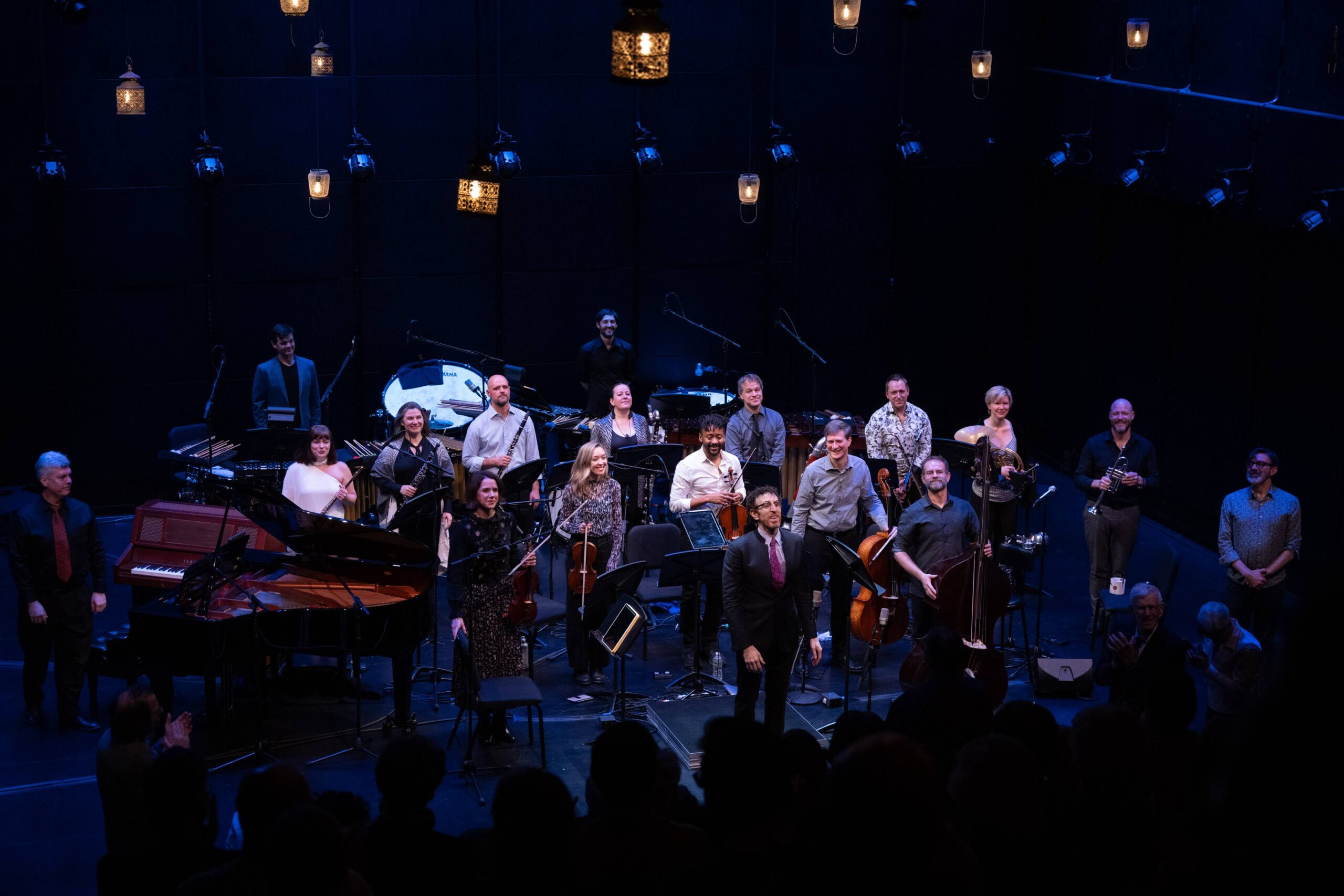
Eastman Presents: Alarm Will Sound – Homecoming
Friday, October 2, 2026
8:00 p.m. | Kodak Hall at Eastman Theatre
Details + Tickets
This article first appeared in the Fall 2026 issue of NOTES, Eastman’s alumni magazine.
…
Born out of an atmosphere of fearless experimentation, Alarm Will Sound has spent 25 years redefining what a chamber ensemble can be. The group’s story is one of friendship, curiosity, and artistic risk-taking without limits.
When Alarm Will Sound’s Alan Pierson ’06E (DMA) saw his phone “blowing up” with messages that they’d been nominated for their first Grammy Award, it didn’t occur to him right away that this meant actually going to the awards ceremony. Attendance would mean photographers, press, red carpet treatment, and the well-known faces of the commercial and pop music worlds swirling around them. “It was such a weird, otherworldly experience,” he recalls. “It’s set up for celebrity. So, as a result, when you’re doing it, you feel like a celebrity.”
And yet, winning a Grammy had been on his mind—and a goal for Alarm Will Sound—for more than a decade. After the release of their Radio Rewrite album featuring music by Steve Reich, Pierson recalls, “That was the first time we articulated that winning a Grammy was a desirable thing, a thing we wanted to try to aspire to.”
To be nominated and win their first during the ensemble’s 25th anniversary year feels almost like a dream. But in truth, it reflects the group’s DNA as consummate musicians and risk-takers who, for 25 years, have mined the depths of contemporary music and built a catalog of music that is expansive, inventive, meditative, kinetic, and overwhelmingly original.
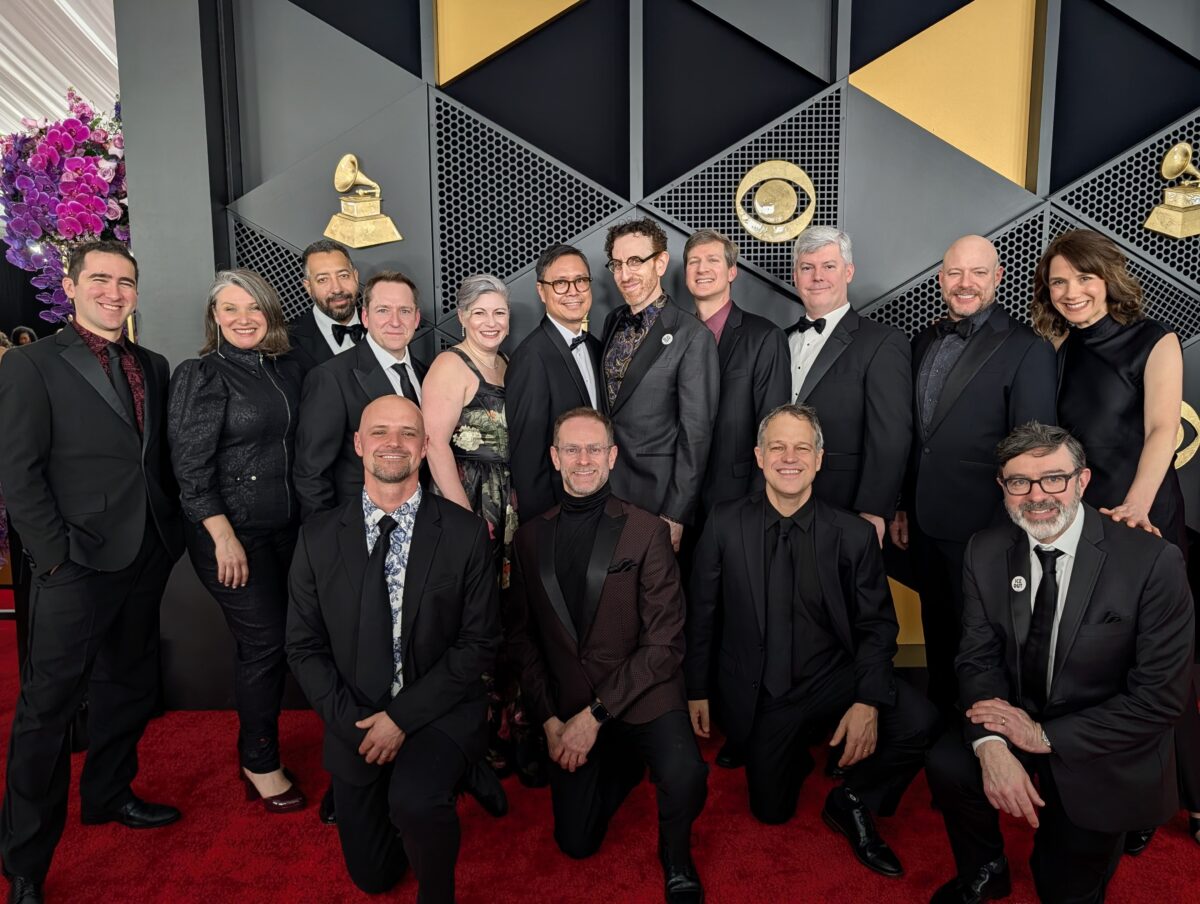
GRAMMY WINNERS: Many members of Alarm Will Sound were in the audience at the 68th Grammy Awards in Los Angeles, CA, on February 1, 1026. Pictured, from left to right, back row: Peter Ferry, Christa Robinson, Yousef Ali, Michael Clayville, Erin Lesser, Gavin Chuck, Alan Pierson, Stefan Freund, John Orfe, Tim Leopold, and Courtney Orlando. Front row: Bill Kalinkos, Miles Brown, Michael Harley, and composer Donnacha Dennehy. Photo Credit: Paul Melnikow.
To understand how Alarm Will Sound has cultivated that identity, one must return to where it all began: Eastman School of Music in the years surrounding the millennium. Late-night rehearsals. Excited conversations at Java’s. The founding of OSSIA. Meaningful mentorship. Friendships that deepened over decades. From the sum of these parts, what began as a student experiment gradually evolved into one of the most respected and influential contemporary music ensembles in the world. The prestige of a Grammy is simply the cherry on top of a cake already made from the finest ingredients.
For Pierson, artistic director and conductor, and many of the ensemble’s founding members, Eastman in the late 1990s felt like an incubator for ambitious ideas. “Eastman was, for all of us, just an extraordinary place of meeting,” he says. “There was such incredible energy around contemporary music.” Violinist Courtney Orlando ’01E (MA), ’03E (DMA) remembers the atmosphere similarly: “It felt like a very special moment at Eastman. There was just so much going on in terms of thinking and doing.”
That energy extended far beyond the classroom. Students organized concerts, formed ensembles, and pursued projects driven as much by curiosity as by curriculum. Pierson credits Eastman’s culture—and its willingness to trust students—with making Alarm Will Sound possible in the first place. “The school really supported that,” he says, describing the freedom “to do non-curricular ambitious music-making.”
Much of that spirit coalesced around OSSIA, Eastman’s student-run new music ensemble founded in 1997. “We started OSSIA as students because it was just in the air,” recalls Gavin Chuck ’96E (MA), ’04E (PhD), composer and executive director of Alarm Will Sound. “It felt possible to make something ourselves.” For many students, OSSIA became both laboratory and launchpad: a place where contemporary music was not treated as a niche specialty but as a living, collaborative art form. That spirit continues today.

THE EARLY DAYS: In 2006, Dean Kate Sheeran spent time with Alarm Will Sound in Pennsylvania, pictured here with Alan Pierson, Gavin Chuck, John Orfe, Stefan Freund, Elizabeth Stimpert, Michael Harley, and early members Dennis DeSantis, John Pickford Richards, Matt Marks, Clay Greenberg ’01E, ’04E (MM), Jessica Johnson ’99E (MM), and Alex Hamlin ’00E, among others.
Eastman Dean Kate Sheeran remembers those years not as a distant chapter in Eastman history, but as something deeply personal. “When people ask me how I know Alarm Will Sound,” she says, “I share, ‘I grew up with them.’” She describes the ensemble’s evolution as part of a much broader creative ecosystem emerging from Eastman at the time. Early members and collaborators went on to shape many of today’s leading contemporary music organizations, including Jason Treuting ’99E of Sō Percussion, violist John Pickford Richards ’02E, ’04E (MM) of JACK Quartet, and composer Dennis DeSantis ’05E (DMA), now associate professor of music and technology at Eastman and leader of the new Music Creation and Technology Bachelor of Music program. “There are a lot of these connections,” Sheeran says. “It’s like a family tree.”
Today, Alarm Will Sound still bears the imprint of its Eastman origins. Among its many Eastman alumni are Pierson; Chuck; Orlando; Miles Brown ’00E, ’12E (DMA); Peter Ferry ’13E; Stefan Freund ’99E (MM), ’02E (DMA); Michael Harley ’11E (DMA); Bill Kalinkos ’03E; Michael Clayville ’00E; John Orfe ’99E, ’99; Christa Robinson ’00E; Uday Singh ’20E, ’25E (DMA); and Elisabeth Stimpert ’99E (MM), ’01E (MM). They are joined by Andrew Griffen, Patti Kilroy, Tim Leopold, Erin Lesser, Nigel Maister (Russell and Ruth Peck Artistic Director of the University of Rochester’s International Theatre Program), Daniel Neumann, Matt Smallcomb, Chris Thompson, Jason Varvaro, and Laura Weiner, who came to the ensemble at different moments in its evolution. Many other Eastman alumni have shaped the ensembles history, including founding members Matt Marks ’02E and Jason Price ’04E (MM), ’05E (DMA), both of whom have since passed away but remain deeply woven into the ensemble’s story.
What the founding members recognized early on was a shared artistic philosophy beginning to take shape. Rather than confining themselves to a single repertoire or aesthetic lane, Alarm Will Sound embraced a deliberately expansive view of musicmaking. Pierson describes it as “looking at the musical world with a wide-open lens,” an approach rooted in curiosity rather than categorization.
That openness soon became one of the ensemble’s defining traits. Alarm Will Sound developed a reputation for programs that dissolved boundaries between classical music, electronic music, minimalism, theatre, and multimedia performance. Their performances could be technically rigorous and emotionally immersive, equally comfortable interpreting works by famed American composer Steve Reich or translating the electronic textures of artists like Aphex Twin into acoustic performance.
One of the ensemble’s earliest defining artistic statements came with Acoustica, their groundbreaking project reimagining electronic music for live acoustic instruments. The concept required equal parts virtuosity and ingenuity. “Other groups had tried to do it,” Orlando recalls, “but we somehow did it better.”
Much of that experimentation took shape during a residency at Dickinson College, where ensemble members lived and worked together in a 250-year-old farmhouse affectionately referred to as “A Farm Will Sound.” Following her graduation from Yale University, Kate Sheeran joined the ensemble there. “I think my title was personnel and scheduling manager, but essentially I was the intern,” Sheeran says with a laugh.
The farmhouse became both workshop and creative laboratory. “A lot of concert ideas were workshopped there,” Sheeran recalls. “It was a really formative time for the band.” Orlando remembers the atmosphere with equal fondness: “We used to have these epic sing-alongs.” Producing Acoustica required constant invention, including multiple trips to Home Depot in search of materials that could recreate electronic sounds acoustically.
The resulting performances felt revelatory—not novelty for novelty’s sake, but a bold reimagining of what a chamber ensemble could be. In retrospect, Acoustica crystallized many of the qualities that would come to define Alarm Will Sound in the years that followed.
As Alarm Will Sound’s artistic ambitions grew, so too did their visibility. Major milestones followed in succession: a breakthrough performance at Carnegie Hall, collaborations with composers including Reich and John Adams, and a relationship with Nonesuch Records that elevated the ensemble’s national profile. Pierson remembers realizing, during one major concert, that Alarm Will Sound had become more than a vehicle for performing music—it had developed its own artistic voice. “Here was a show about us,” he says. “It was really expressing us as an ensemble.”
That identity was reinforced by the caliber of composers increasingly drawn to the group. Pierson still sounds faintly astonished recalling Reich and Adams reaching out to the ensemble directly. Yet even as the group’s profile expanded internationally, its internal culture remained remarkably grounded in the friendships formed at Eastman decades earlier. Orlando describes the ensemble as “my family, my absolute family,” noting that many members still genuinely enjoy spending time together while touring—an uncommon reality for groups with such long histories. “There are a lot of groups that, when they’re at a hotel together, they ask to be put on different floors,” she jokes, “but not us!”
Those relationships sustained the ensemble through years of artistic and logistical uncertainty. “We’ve been scrappy,” Orlando says. “We’re always fighting for what we believe in.” Even after achieving international recognition, Alarm Will Sound retained the DIY ethos that characterized its student beginnings. “For me, Eastman was a place of possibilities,” says trombonist Michael Clayville. “There was never a ‘no.’ It was always, ‘Yes—let’s try it.’”

LAND OF WINTER: The Grammy-winning album, Land of Winter, was released on Nonesuch Records in 2024
That spirit ultimately shaped the project that earned the ensemble its first Grammy Award for Land of Winter—a collaboration with Irish composer Donnacha Dennehy. The relationship between Dennehy and Alarm Will Sound stretched back years, built through mutual trust and artistic affinity. When he approached the ensemble in 2021, there was immediate excitement to be reunited. “I think we had a sense from the beginning that this was a special piece,” Clayville says. “Donnacha knows us so well—he’s almost a member of the ensemble. That knowledge of us as individuals really informed his writing.” The music itself proved immersive and elusive, resisting simple interpretation. “You’re not sure when it started or where it’s going to end,” Clayville says. “You’re just experiencing what’s happening to you in that moment.”
For Pierson, the work resonated on an especially profound level. He describes Land of Winter as a meditation on time, memory, and human life itself. “The arc of the piece,” he says, “is about life and the shape of life.” Reflecting on the work’s luminous final passages, he adds quietly, “I hope that’s what my old age is like.”
Though ‘winter’ appears in the title, Chuck came to understand the work more in terms of illumination than darkness, especially while designing lighting for early performances. “Light is the sculptor of the world,” he says, describing how the music gradually revealed itself as something spatial and almost architectural. The piece also challenged assumptions audiences sometimes bring to Irish music. “People expect reels and fiddles,” Clayville notes. “Instead, they encounter this intricate spectral world that demands deep listening and technical precision.”

REHEARSAL: The ensemble rehearsed and recorded the album at the University of Chicago’s Reva and David Logan Center for the Arts in October 2023. Pictured, left: Courtney Orlando; center: Alan Pierson conducting the group; right: Stefan Freund. Photo Credits: Zoe Markle ’23E (MM).
By the time the album reached audiences, it seemed to embody everything Alarm Will Sound had spent decades cultivating, so when they won the Grammy Award for Best Chamber Music/Small Ensemble Performance, the moment felt surreal but deeply earned. Pierson sees the recognition not simply as validation for a single album, but as acknowledgment of the ensemble’s broader artistic trajectory. “The award,” he says, “is an expression not just of the immediate work, but of the body of work before that.”
For many observers in the contemporary music world, the reaction was less surprise than overdue affirmation. Pierson recalls hearing variations of the same response repeatedly after the win: “You haven’t gotten a Grammy already?” For those closest to the ensemble, the award carried emotional weight beyond industry recognition. “Does the Grammy win feel like recognition of 25 years of their work?” Sheeran says. “Oh, 100%.”
And yet, even amid the celebrations, Alarm Will Sound’s focus remains fixed forward. This fall, the ensemble returns to Eastman for a performance of New Acoustica, a project that revisits and reimagines one of their earliest artistic breakthroughs. Building on the inventive spirit of the original Acoustica performances, the project expands Alarm Will Sound’s long-running fascination with translating electronic music. No longer focused on a single artist, New Acoustica embraces the astonishing breadth and diversity that electronic music has achieved since 2005.
For Pierson, the project represents continuity, not just nostalgia. The same curiosity and experimentation that shaped the group’s earliest days at Eastman continue to drive its work today. Orlando sees it similarly. “We’re not just rehashing the exact same thing over again,” she says. “We’re putting a new spin on it.”
That makes the ensemble’s October 2 headlining performance at Eastman during Meliora Weekend feel especially meaningful—not simply as a concert, but as a homecoming and celebration of the ensemble’s journey from Gibbs Street to the Grammys. More than 25 years after those late-night rehearsals, OSSIA concerts, and conversations at Java’s first sparked Alarm Will Sound into existence, the ensemble returns to the place where its artistic philosophy took shape.
In many ways, that may be the clearest explanation for Alarm Will Sound’s enduring influence. The ensemble never stopped behaving like the ambitious Eastman students who first gathered to share their big ideas—curious, collaborative, unafraid to experiment, and convinced that music could always become something larger than expected.
Eastman Presents: Alarm Will Sound – Homecoming
Friday, October 2, 2026
8:00 p.m. | Kodak Hall at Eastman Theatre
Details + Tickets