

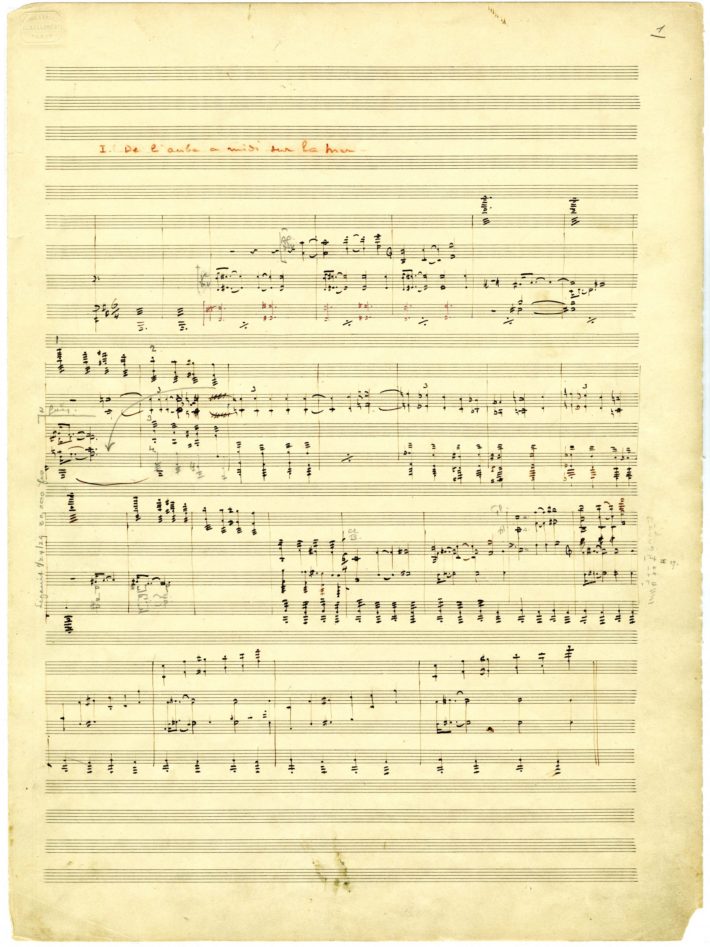
The title of the first movement—like those of the ensuing two movements—is in the composer’s hand. It has been written over an erasure, the original wording of which cannot be easily deciphered. In a letter to publisher Durand in the summer of 1903, Debussy indicated that he would call the first movement Mer belle aux Iles Sanguinaires—which happened to have been the title of a short story by Camille Mauclair that had recently appeared in Echo de Paris Illustré, which Debussy had quite likely read—but in a subsequent letter (January 6th, 1950) to Durand, Debussy indicated having changed the title to De l’aube a midi sur la mer (From dawn until noon over the sea).
Altogether, the manuscript presents an explicit compendium of Debussy’s working habits with respect to his manuscripts; the first page demonstrates certain conventions that will recur throughout the movement. The notation is distributed among four staves, with just a few exceptions when Debussy scored specific passages on five staves. The customary marking medium for the musical text and barlines in black ink, with lead pencil used for added notes and for elaboration on details of orchestration. Debussy also uses red ink to fill in counterpoint to notation that he has already penned in black ink. With characteristic economy, Debussy dispenses with such formalities as clefs, key signature, and time signature after their initial appearance at the outset of each movement; key signatures will re-appear only when imposed by significant modulations in the music.
Debussy’s use of numbers as a shorthand device is evident in the first three bars of the second score (i.e., the second group of four staves), corresponding to bars 8-11 in the published score. The penciled numbering (1 through 4) indicates the order in which the bars should be read in light of Debussy’s evolving musical plan, which is being realized by the added notation in pencil. The musical line proceeds bar by bar according to the numbers 1 through 4; the third bar of the second score therefore corresponds to bar 12 in the published score (at which point rehearsal no. 1 appears).
Further, just as on the title page, the Sibley Music Library saw fit to enter essential information of its own, here appearing in the gutter, i.e., the margin to the left of the text (that would normally run up against the binding of a bound work). The name of the manuscript’s source, the date of accessioning, and the sum rendered were recorded for posterity.