

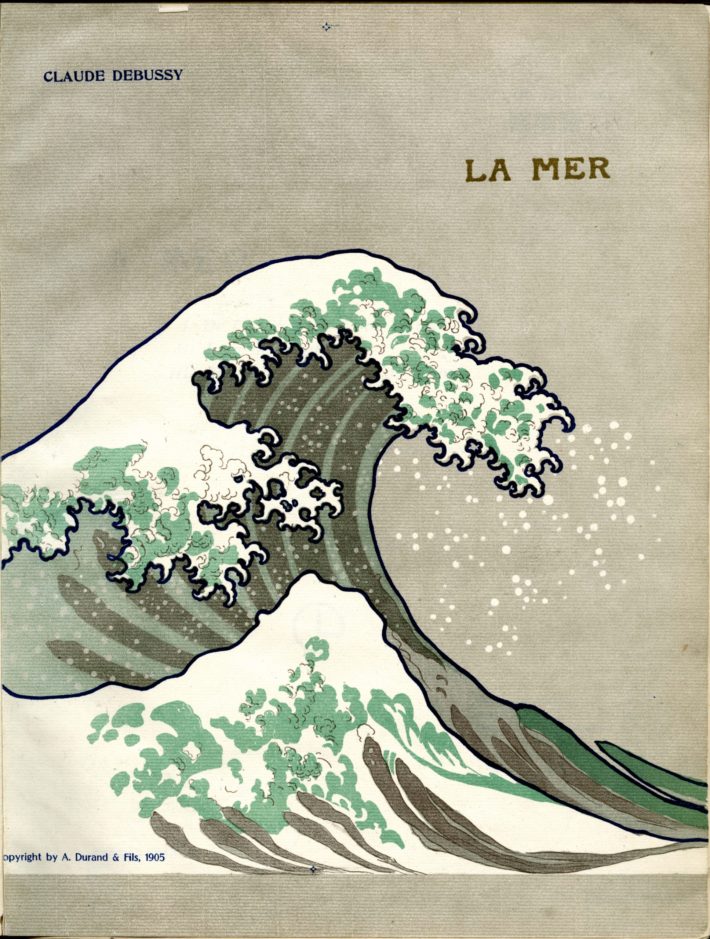
The firm of Durand et Cie. (Paris) published the first edition of the orchestral score in 1905, and subsequently brought out the second and third editions in 1909 and in 1938, respectively. As the cover illustration of the first edition, Durand used a detail from The Great Wave off Kanagawa, a woodblock print by Japanese artist Katsushika Hokusai (1760–1849). The print, published sometime between 1830 and 1833, was one image out of the series Thirty-Six Views of Mount Fuji, all of which depicted the area around Mount Fuji under specific conditions, with the mountain appearing in the background, portrayed from various angles. The artist’s choice of Mount Fuji was significant, owing to the mountain’s near-sacred status in Japan, and its recognition as a symbol of beauty and of national identity. Today the image is one of the most instantly recognized and iconic images of Japanese art from any era, and copies are held in numerous art collections around the world.
In its entirety, the print The Great Wave depicts a vast wave threatening sea-going craft near the Japanese prefecture of Kanagawa, while the stately image of Mount Fuji looms serenely in the distance and the sun shines overhead. In formatting the image to be used on the cover of the published score, publisher Durand selected essentially the left half of the print, which shows the “great wave” of the print’s title, together with a smaller wave in the foreground that, when seen in the entire print, actually reflects the image of the distant Mount Fuji (not seen on the orchestral score’s cover). Inevitably, a tension in created in the image by the viewer’s keen sense and expectation of the impending breaking of the wave.