

By Jonathan Heath
Curtis Stewart doesn’t call himself a storyteller in the traditional sense. He prefers the title “curator of feelings.” Yet Seasons of Change, his latest work, tells the kind of bold, layered story that writers dream of—a reimagining of a classic with a contemporary twist, a vivid dreamscape that invites immersion, and a social reckoning that lands like a gut punch.
This isn’t a performance that lets you sit back. Once you hear it, once you feel it, action is inevitable. You are implored to “Wake Up!” That’s what Stewart means by curating feelings. Across four movements, Seasons of Change charts an emotional arc that leaves audiences breathless—devastated, elated, and everywhere in between. You might arrive expecting Vivaldi’s Four Seasons—and given the title, perhaps you’re braced for surprise—but by the final note, Stewart wants you grappling with what comes next. He calls it the Trojan Horse method: presenting one thing, delivering something far deeper. Not a bait-and-switch, but a story within a story.

Curtis Stewart. Photo Credit: Titilayo Ayangade.
On April 22, 2025, Stewart ’08E, ’08 will debut Seasons of Change in Hatch Recital Hall during Gateways Music Festival, before taking the concert on tour. Stewart was involved with Gateways as an Eastman student and says, “It’s amazing to see how the organization has evolved over the years.”
He credits his time in Western New York—studying violin performance at Eastman and mathematics at the University of Rochester—as foundational in finding like-minded people to learn and create with. “I didn’t feel judged to explore all the sides of my artistry,” he says, “and I found other students and faculty that encouraged growth in so many directions.”
That growth has fueled a formidable career. Now Artistic Director of the American Composers Orchestra and a professor at Juilliard, Stewart has earned six Grammy nominations, including two this year, and was named recipient of the 2025 Sphinx Organization Medal of Excellence. As a soloist, he has performed at Carnegie Hall, Lincoln Center, and The Kennedy Center, and has accompanied orchestras across the country.
But spending time in Rochester has helped shape Seasons of Change into what it’s become. Stewart interviewed local climate scientists and activists, recording their voices to layer over his orchestral arrangements. These insights join the testimonies of unhoused individuals he encountered in Phoenix, AR, and his own spoken-word poetry which serves to dismantle and reframe the four poems Vivaldi wrote as the basis for his concertos.
As such, Seasons of Change becomes a re-composition—a remix rather than a remake. “It’s somewhere in between a theme and variations, and a fantasy,” Stewart explains. “It takes compositional elements—motif, harmonic movement, textural orchestration—and expands on them using contemporary composition techniques. Musical graffiti, in a way.”
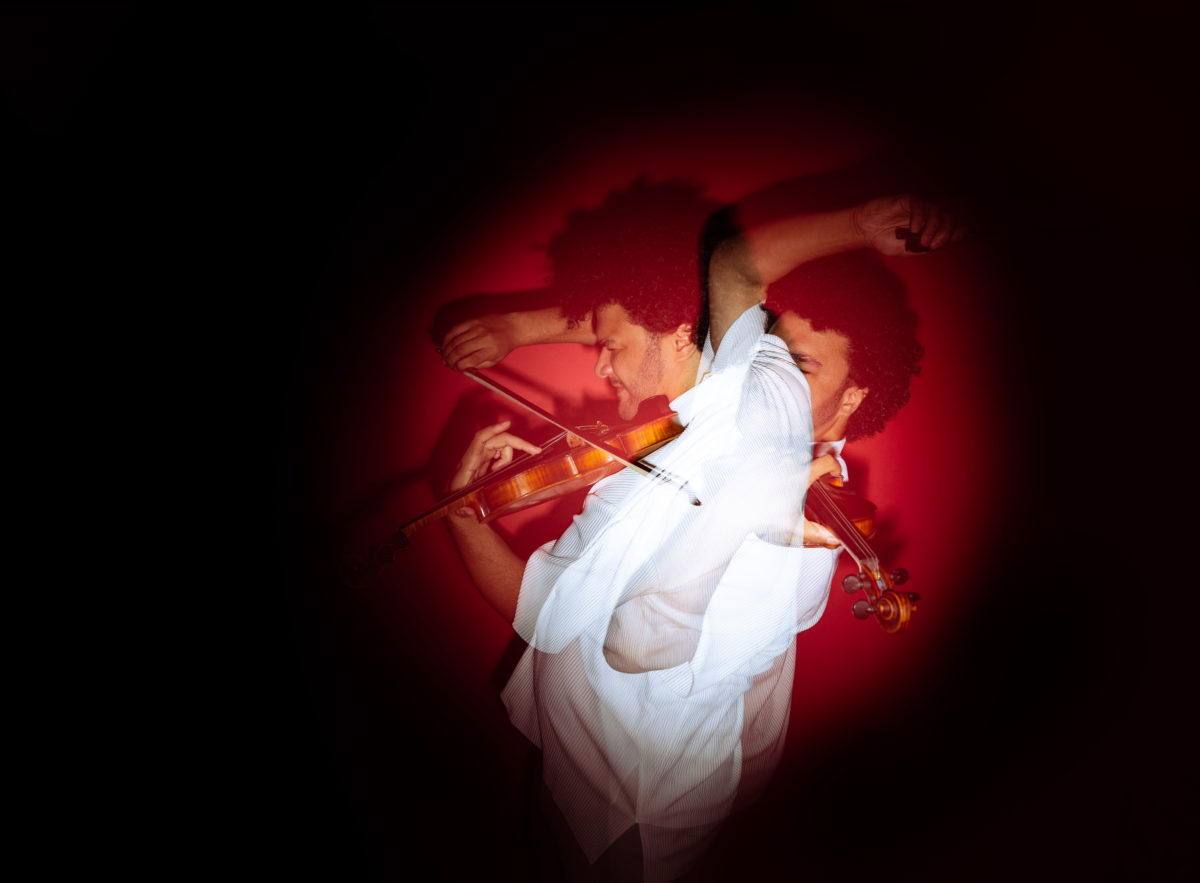
Curtis Stewart. Photo Credit: Titilayo Ayangade.
With this work, Stewart constructs an Afrofuturist dreamscape—part meditation, part manifesto—on climate change, class, and the fragility of digital memory. Through the concert experience, he invites the audience to reckon with how class shapes vulnerability, particularly for those living on the front lines of a warming planet.
Which brings us back to story. A fan of science fiction authors Ursula K. Le Guin and Ted Chiang, Stewart has developed a “lore” that underpins Seasons of Change with depth and a narrative ideology. In his vision for the future, climate collapse has left only a slither of humanity behind—adrift, severed from history, humbled by nature, and unable to learn from their mistakes. In this hallucinatory aftermath, artificial intelligence rises not as overlord, but as a savior, of sorts.

Curtis Stewart. Photo Credit: Titilayo Ayangade.
“I am interested in taking the idea of AI to an exaggerated place—an imagined future where AI outlasts us and becomes a caretaker for humanity,” he says. With history and culture obliterated, civilization relies on AI to piece together the clues to its past. But in doing so, the machine becomes storyteller, reshaping fact and memory to help each survivor endure. “I’m almost imaging what AI would have to do to tell the story of humanity to itself,” Stewart continues.
This conceptual scaffolding sets the stage for Stewart’s first disruption. On the 300th anniversary of Antonio Vivaldi’s The Four Seasons, his re-composition, radical from the first note, begins not with ‘Spring’—the most recognizable of Vivaldi’s movements—but with ‘Summer,’ recast as ‘A.Recent.Summer.’ It’s the first of many flips in expectation.
Instead, Stewart ends in spring (named “Life Times”), a move that reclaims the season as something more than a musical tradition—it becomes a symbol of hope. By the final movement, the original Vivaldi has nearly vanished as Stewart strays further, deconstructs more. He’s reaching forward now, not to repeat, but to innovate.
As the music fades, his final words linger: “With Bounds and leaps. These, our streets. Hope be found. Cool is now. Hope be found. Hope be …” This sanguine sentiment is echoed in the testimony of those he spoke with in Phoenix, and so, Stewart asks of all of us, “If they can do something to change their lives, can we?”
This instinct for reinvention is something Stewart traces back to his parents—an artistic inheritance. His father, Bob Stewart, was a jazz musician who worked to reclaim the tuba’s role as a foundational voice in jazz. His mother, Elektra Kurtis, a U.S.–Greek violinist born in Poland, spent her career weaving the numerous cultural threads of her heritage into her compositions.
“I hope both of these qualities emerge in my own music and performance,” Stewart concludes.
And they do. Seasons of Change is both comforting and groundbreaking. A homage and a revelation. It’s a journey through transition, across landscapes both familiar and unknown, and it works as a reminder that we only have this one precious life. So, how will we change to preserve it for everyone?
Gateways Music Festival
Curtis Stewart – Seasons of Change
Tuesday, April 22, 2025
7:30 p.m. | Hatch Recital Hall