

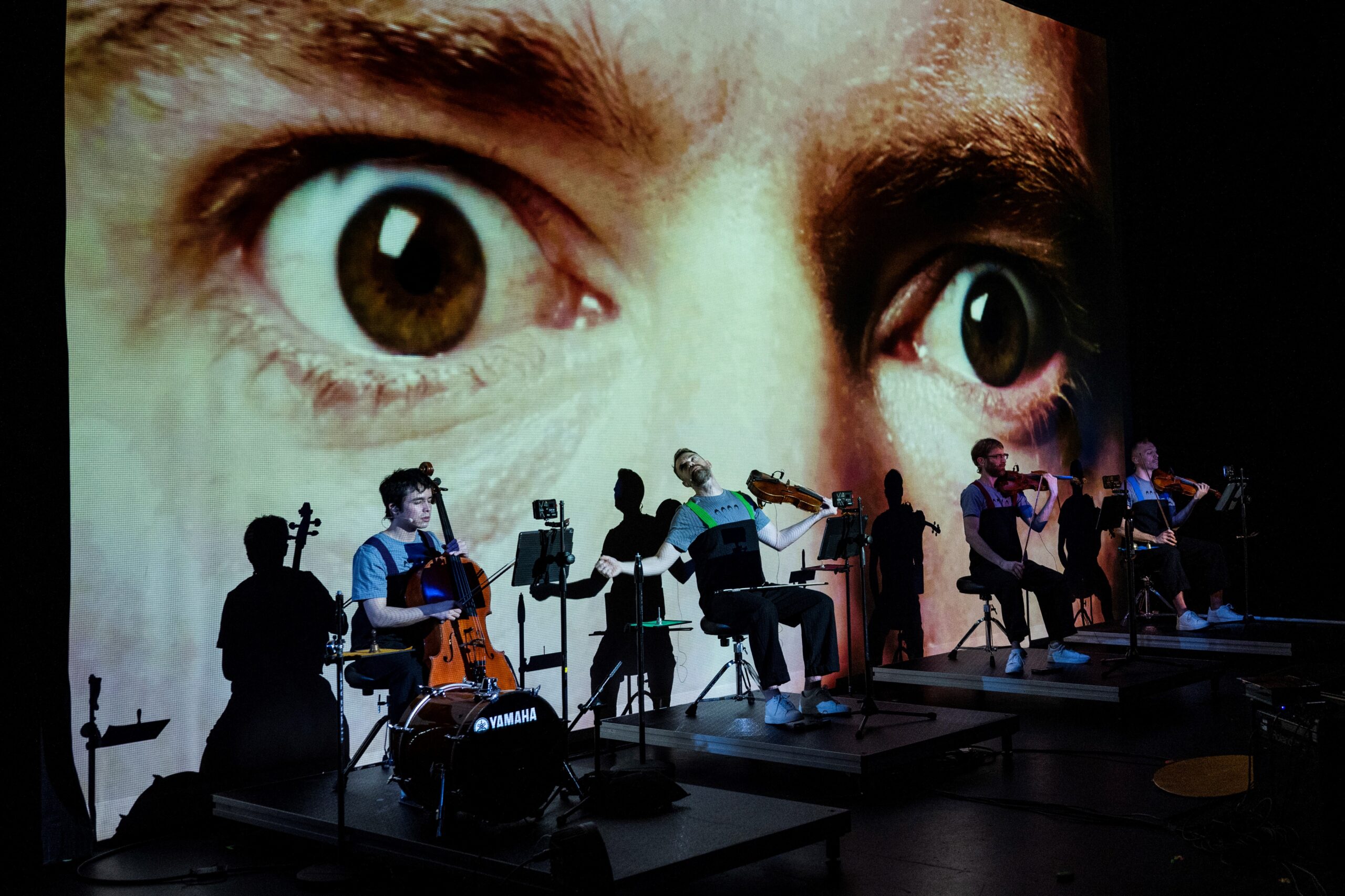
This article first appeared in the Spring 2026 issue of NOTES, Eastman’s alumni magazine.
…
At Eastman, distinction is never singular. It lives at the intersection of artistry and service, curiosity and leadership—expressed by alumni who carry the school’s values far beyond its classrooms and concert halls and translate them into impactful lives. This year’s recipients of Eastman alumni awards reflect that range, honoring graduates whose paths diverged in practice but converged in purpose.
Joel Luks ’99E will receive the James S. Armstrong Alumni Service Award, established in 1990 to recognize alumni whose outstanding leadership, loyalty, and commitment have strengthened the University of Rochester in broad and lasting ways. Meanwhile, John Pickford Richards ’02E, ’04E (MM) and Christopher Otto ’06E, ’06, founding members of the internationally acclaimed JACK Quartet, received the Distinguished Alumni Award during a presentation before their concert at the 92nd Street Y in New York City on March 20, 2026, bestowed by the dean upon alumni who embody the essence of the Eastman experience through exceptional musicianship, scholarship, and leadership in the arts.
“Presenting these awards is a moment of great pride for me,” says Kate Sheeran, Joan and Martin Messinger Dean at the Eastman School of Music. “Eastman alumni shape the musical world in extraordinary and enduring ways—as performers, educators, innovators, and leaders who understand that excellence and purpose are inseparable.”
Together, their stories offer a portrait of Eastman alumni as builders—of communities, institutions, and artistic futures.
Joel Luks ’99E
Service as Creative Practice
For Joel Luks, music was the first place he ever truly felt at home. Born in Peru and raised in Canada, he found in music not only expression but connection. “Toronto became this place where I could explore different things, even though I had a little trouble with English at the time,” Luks reflects. “But music was the thing that made me feel like I belonged somewhere.”

TELEVISION WORK: Luks makes an appearance on Great Day Houston with host Deborah Duncan.
This belief eventually led him to Eastman, a school he viewed as the summit of artistic aspiration. Before the internet made searching for information easy, Luks, an aspiring flutist, relied on the guidance of his teachers and recordings of the Eastman Wind Ensemble to determine that Eastman was right for him. Adding to that sense of possibility, one of his high school mentors was a friend of Bonita Boyd ’71E, Eastman’s legendary professor of flute.
“Walking into Eastman for audition day was electric,” Luks recalls. “The nerves came in. I could see the energy in the room, so many people just hoping to get in, and honestly, at that point, I didn’t think I had a chance.”
When his acceptance letter arrived, Luks knew Eastman was where he belonged. Yet his time in Rochester proved formative in ways that extended well beyond performance. As his interests broadened toward education, storytelling, and leadership, Luks began to imagine a creative life not defined by a single stage, but by reach. In the early days of Eastman’s arts leadership program, he was, as he puts it, “romanced by the concept of arts in education.”
“Marketing is very similar to music,” he says. “You look at the data, find the story, and interpret it in a way that connects people to something of value.” That philosophy carried him into a multifaceted career spanning arts initiatives, journalism, marketing, and higher education. Today, he is director of marketing and communications at the Hobby Center for the Performing Arts in Houston.
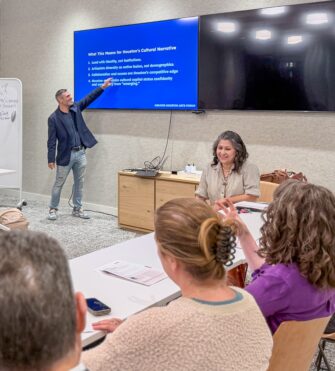
TEACHING: Luks leading a messaging workshop for HouArts in Action, a collaborative initiative designed to strengthen Greater Houston’s arts and culture sector.
At the core of Luks’s career is a conviction that artistry carries responsibility. “I wish all artists would view their work as an element of community service,” he says. That ethos has guided decades of volunteer leadership, alumni advocacy, and mentorship—service rooted not in nostalgia, but in forward motion, and always with Eastman close in his thoughts.
Though Luks didn’t return to Eastman until his 20th reunion, he remains connected to so many that took the journey with him. “People often say, it’s not the school, it’s the people. I think it’s both that make you successful,” Luks affirms. “Friends from Eastman connect me to resources. I reach out to them when I need something, but I also reach out when they need something. There’s always a possibility to lift each other, whether it’s through our common work, our common mission, or our common struggles. Our lives in those four years unite us in this way.”
Humility and resilience, then, are key tenets of Luks’s work. Many of his strengths emerge on a personal level, where he seeks to unlock the full potential of those he works with—a skill he has developed across a diverse career. Shortly after completing his master’s degree at Rice University, Luks began his professional life as education director at Young Audiences of Houston, an arts-infused nonprofit. He later worked as a journalist for CultureMap, a digital publication spotlighting arts and culture throughout Texas. During this period, he deepened his expertise in marketing, became involved with the American Marketing Association and the Public Relations Society of America, and began participating in senior leadership conferences. He now draws on this broad background for his role on the University of Rochester’s Alumni Board, where he leads the marketing and communications committee.
Now reconnected to Eastman, that same ability to activate creativity and learning shows up in his commitment to the school and its graduates: teaching classes at Eastman’s Institute for Music Leadership, acting as a resource for musicians in Houston, and simply showing up—for recitals and moments that really matter. “I want to be more connected to Eastman,” he says. “I want to make a difference here.”
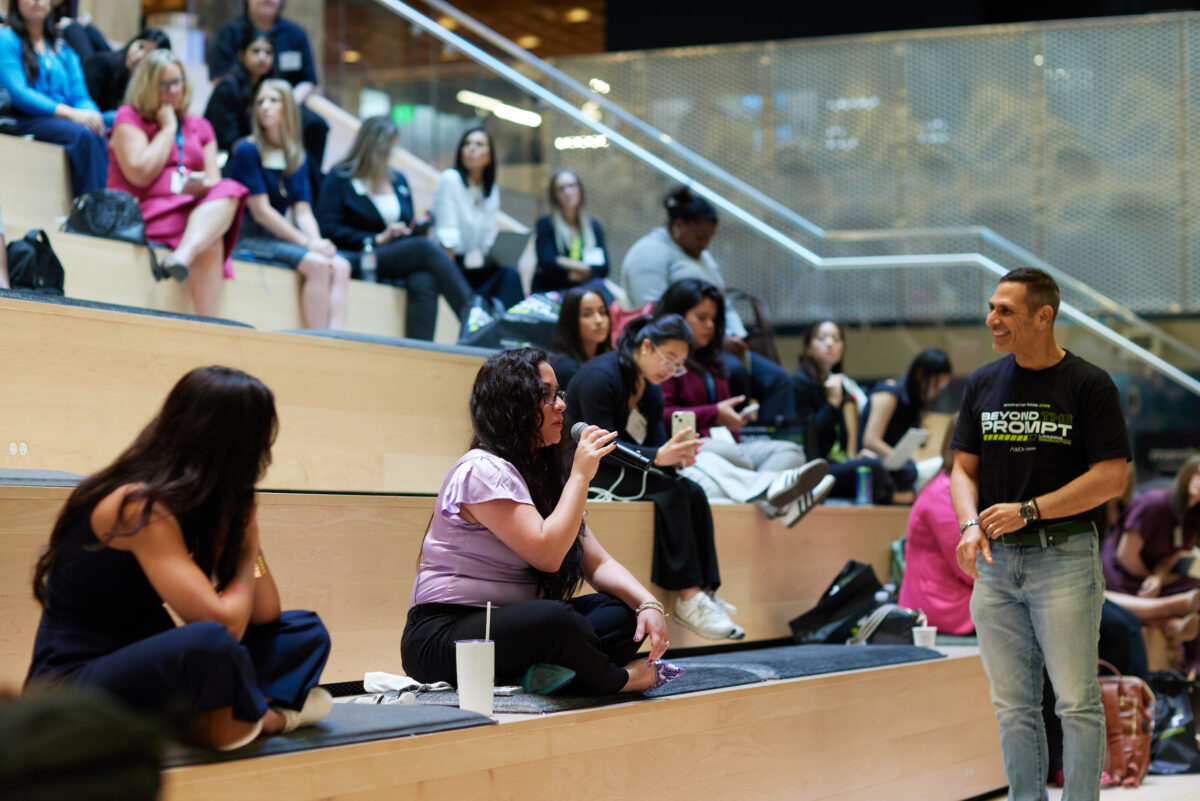
BEYOND THE PROMPT: Luks engages with participants during an AI marketing conference in Houston, TX, in 2025. Photo Credit: Nathan Lindstrom.
Receiving the James S. Armstrong Alumni Service Award, Luks notes, feels like an affirmation of Eastman’s broader imprint. “Eastman is always a part of you,” he says. “Whether you’re physically there or not.” He may have left professional performance behind, but Luks carries Eastman’s values forward in unexpected and enduring ways.
John Pickford Richards ’02E, ’04E (MM) and Christopher Otto ’06E, ’06
Building the Long Game
Violist John Pickford Richards and violinist Christopher Otto, founding members of the JACK Quartet, continue to perform on stages around the world, yet their experience aligns closely with Luks’s in purpose and principle. For them, Eastman was not simply where careers began, it was where an artistic philosophy took shape. Both entered the school drawn by its intensity and possibility, and both found, within its student-driven culture, the freedom to experiment, collaborate, and take risks without guarantees.
Richards became immersed in a culture that demanded excellence and rewarded initiative, while Otto, balancing a dual degree in mathematics and music, remembers the defining permeability of the place itself. “One of the key things about my time at Eastman was the cross-pollination,” Otto says. “Composers, performers, student projects—all mixing freely.” That ecosystem gave rise to the JACK Quartet.
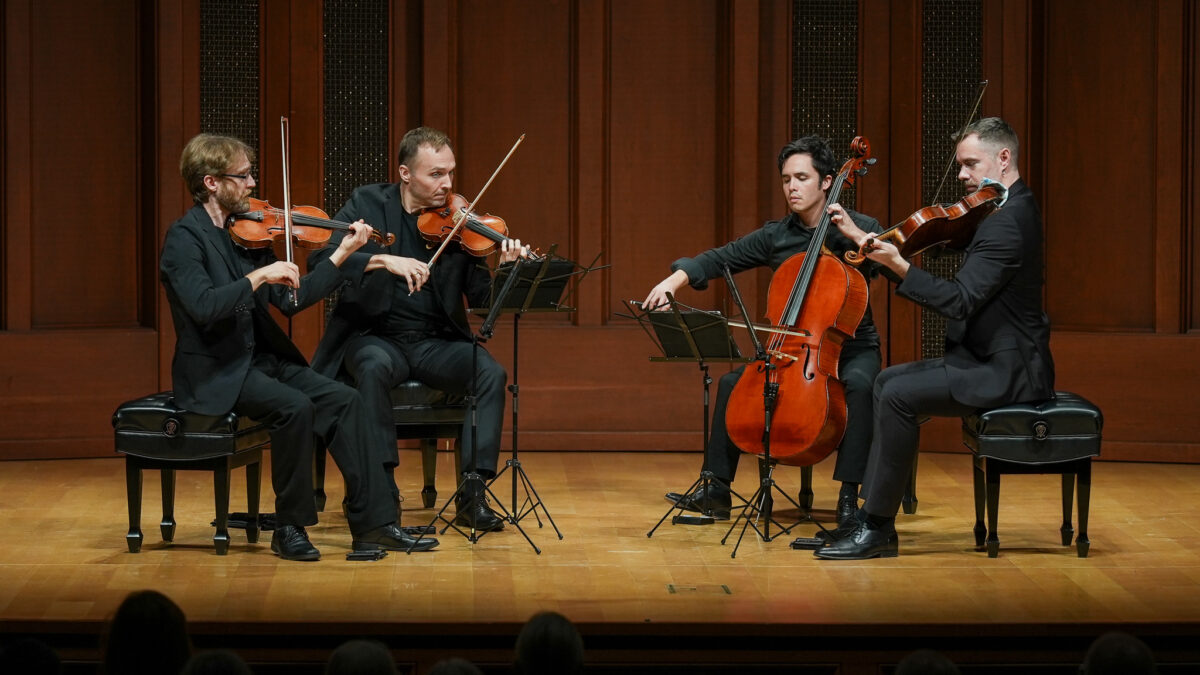
ENSEMBLE OF THE YEAR: The JACK Quartet performing at the Music Academy of the West in Santa Barbara, CA. Photo Credit: Emma Matthews.
During a trip to perform at a festival in Mexico, Richards and Otto, along with violinist Ari Streisfeld ’05E and cellist Kevin McFarland ’04E, found themselves tackling a new work by German composer Helmut Lachenmann. “Of course, the four of us knew each other quite well, but we weren’t by any means a string quartet,” Richards recalls. “But at this festival, we became a string quartet and were treated like one. The experience was very powerful.”
Upon their return, they took one initial from each musician to form the acronym JACK, and the name stuck. What began as a spontaneous collaboration—four students learning a new work from a handwritten manuscript—became an ensemble committed to patience, rigor, and fearless exploration.
Decades later, those principles remain central. Eastman had taught them not only how to play difficult music, but why sustained collaboration, slow development, and shared responsibility mattered. “To really investigate and develop new work takes years,” Richards says; and they value that commitment more than short-lived accolades. Now structured as a nonprofit, JACK Quartet commissions new music, invests deeply in long-term collaborations, and prioritizes education and mentorship alongside performance. For Otto, that model reflects lessons learned as a student. “The nonprofit allows us to bridge the gap between our idealistic vision and material reality,” he explains.
JACK’s accomplishments are remarkable. Twice nominated for a GRAMMY Award, the group has been awarded Musical America’s 2019 Ensemble of the Year Award, New Music USA’s Trailblazer Award, and an Avery Fisher Career Grant, among other honors. They serve as quartet-in-residence at the Mannes School of Music at The New School; have collaborated closely with Philip Glass, Caroline Shaw, and the Kronos Quartet; performed on major stages worldwide, including Carnegie Hall, the Sydney Opera House, and London’s Wigmore Hall; and produced or appeared on numerous recordings.
But just as importantly, both Richards and Otto have remained committed to teaching and mentorship—passing forward the values first modeled at Eastman. Whether coaching student ensembles, serving as artists-in-residence, or working closely with young composers, they view education not as an obligation but as a continuation of the collaborative culture that shaped them. In that way, Eastman is not simply their past; it is an active presence in how they work, lead, and listen today.
Along the way, Richards, Otto, and the evolving membership of the JACK Quartet (which now includes violinist Austin Wulliman and cellist Jay Campbell) have brought innovative music and theatrical performances to stages across Australia, Europe, Asia, and South America. “Seeing the world is my favorite thing about being in the quartet. Being on stage is always an adventure, and in many ways, it’s the energy of the audience that really makes that powerful,” Richards says. Their shows involve multimedia work, choreography, animation, costumes, and sometimes even total darkness. “Every day is a completely different artistic experience,” he says.
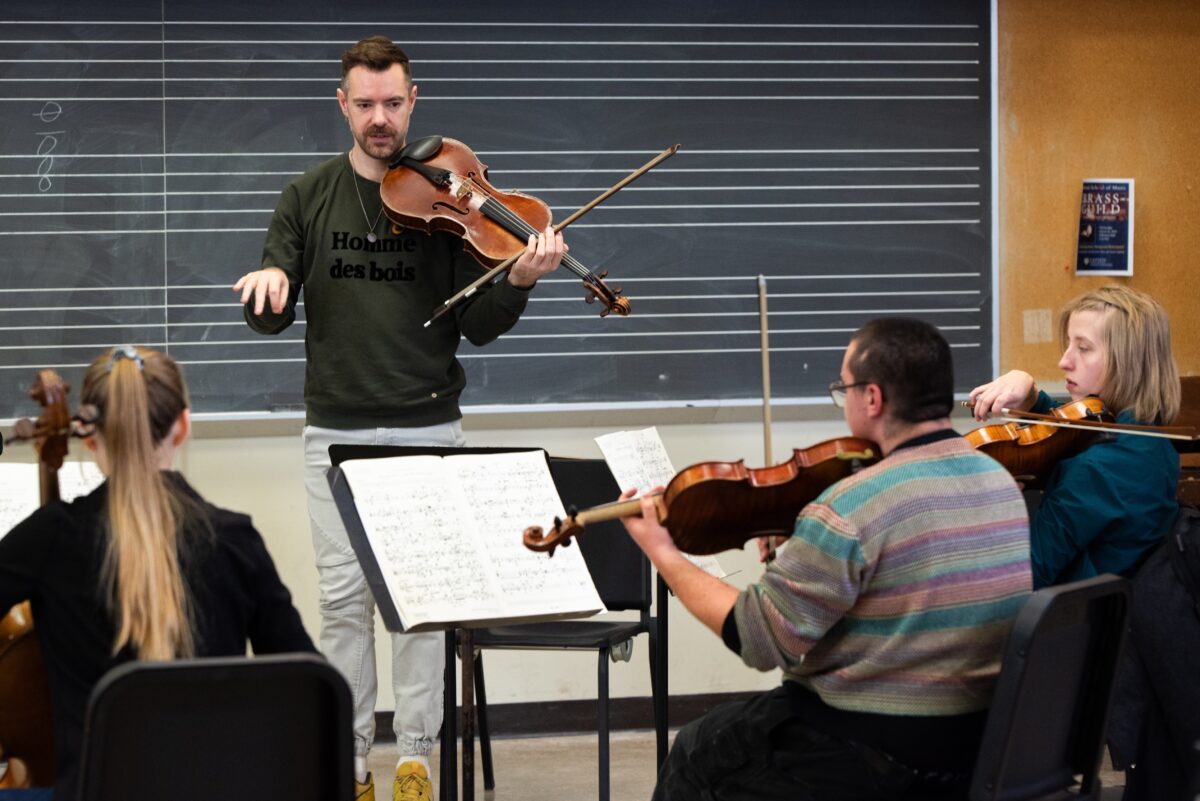
GIVING BACK: John Pickford Richards led a rehearsal with Musica Nova students on repertoire by Helmut Lachenmann during a visit to Eastman in 2023. Photo Credit: Lauren Sageer.
Receiving the Distinguished Alumni Award from Eastman carries particular weight for both musicians: recognition not just of accomplishment, but of values lived consistently over time. “When I was at Eastman, what I wanted more than anything was recognition by my peers and professors,” Richards recalls. “Eastman was my whole world. So, to receive this recognition now feels extremely deep and uplifting for me.”
“It’s really meaningful to be recognized by Eastman,” Otto adds. “It’s a reminder of what the school offered me—the community, the opportunities, the collaboration.”
A Shared Throughline
Working across performance, education, and advocacy, Luks, Richards, and Otto exemplify the lasting influence of an Eastman education. Their work points beyond individual achievement toward leadership that sustains the art form and the people around it. The impact of that leadership will continue to unfold, shaped by the next generation of artists now finding their way. If one thing is true, Eastman alumni always follow their passions.
“I’m genuinely curious to see what people coming out of Eastman will create, and where they’ll go,” Otto concludes.