
Eastman Case Studies Enter a New Chapter with Open Access


Ten years after launching the Eastman Case Studies, the Eastman School of Music’s Institute for Music Leadership (IML) is opening the collection to everyone. Beginning this fall, the Eastman Case Studies will move from a paid resource to a free, open-access collection through the Sibley Music Library, making the series available to students, educators, music professionals, and anyone interested in the challenges facing today’s musical organizations and leaders.
The move marks an important new chapter for a resource created in 2016 to fill a gap in music leadership education. Developed by the IML under the guidance of former director Jim Doser ’79E, ’84E (MM) and with the help of a generous gift from philanthropist Paul Judy, benefactor of Eastman’s Paul R. Judy Center for Innovation and Research, the case studies place readers in the role of decision-makers, asking them to examine real-world challenges and consider how they might respond.
The case studies reflect the IML’s role in preparing Eastman students for careers outside of musical performance and scholarship. Alongside their rigorous training as musicians, students have opportunities to develop the full spectrum of skills needed to navigate the profession—whether they go on to form an ensemble, take on an administrative role, build a community program, or shape their own careers in new ways.
Case studies have been a primary teaching tool for business schools for more than a century. Modeled on the Harvard case method, the Eastman Case Studies bring that approach into the arts and non-profit sector—a distinctive resource in music education. They provide students with an opportunity to step beyond theory and grapple with complex decisions in a field they may soon enter.
Now, on the 10th anniversary of the series’ launch, making the case studies freely available expands their reach beyond the classroom, sharing Eastman’s expertise in music leadership with anyone who has an internet connection. Through the Sibley Music Library, the collection becomes part of Eastman’s broader commitment to making its knowledge and resources accessible to the musical community worldwide.
Sibley has already demonstrated the global reach of such efforts. Its digitized collection of public-domain scores, for example, has been downloaded more than 13 million times around the globe.
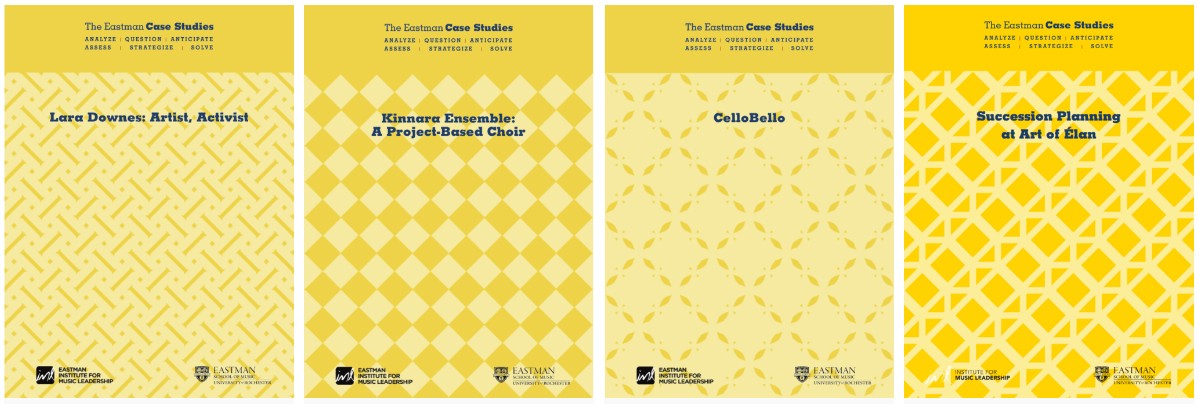
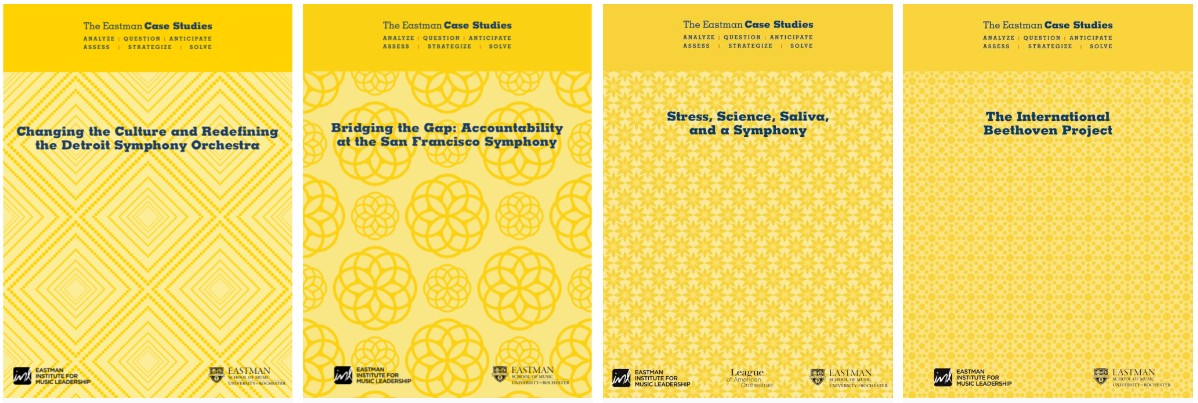
There are currently more than 50 published case studies, with more on the way. Each is built around a real or closely modeled management challenge, exploring topics ranging from community engagement and cultural humility to audience development, labor relations, strategy, and the changing music industry.
Eastman Associate Professor of Musicology Michael Alan Anderson has been involved with the series from the beginning, contributing to numerous case studies over the past decade and at one point serving as managing editor. Following his role on the search committee that selected a new IML director in 2014, Anderson says his “eyes were opened to the impact of the school’s alumni in the field.” Upon Doser’s appointment, Anderson helped develop the idea for a series to leverage this wealth of experience.
“The great appeal of the Eastman Case Studies series,” Anderson says, “is that it brings the complicated realities of running musical organizations into the classroom.”
Anderson authored the first case study, “Taking up Residence with Eighth Blackbird,” which examines two contrasting artist-residency agreements involving the contemporary chamber ensemble Eighth Blackbird. The case asks students to consider how partnerships can shape an ensemble’s artistic and organizational opportunities.
In 2019, Anderson prepared “Chanticleer, Youth, and the Choral Art,” which explores the Grammy Award-winning all-male a cappella group’s efforts to establish an educational program involving San Francisco high school choirs and create an annual youth choral festival. Drawing on the results of surveys completed by student singers over several years, the case study examines the role of education and the ways such initiatives can engage and develop young musicians.
Other cases take on equally varied questions. “Refugees and Cultural Humility at Buffalo String Works” examines how a community music organization can deepen its understanding of the families it serves. “Small Town, Big Prize: Building the Audience for the MostArts Festival” asks how a small arts festival can expand its audience while maintaining its distinctive identity. Other cases explore different facets of decision-making at the Nashville Symphony and New World Symphony, while “After Monetization: The New Recording Landscape for Artists” considers how changes in the recording industry and the rise of streaming have reshaped opportunities for musicians.
“Making the series freely available through the Sibley Music Library will extend its educational value enormously,” Anderson adds. “Students, faculty, working musicians, and arts leaders everywhere will be able to learn from these challenges, regardless of their location or their institution’s resources.”
Eastman alumnus Myles Boothroyd ’15E (MM), ’18E (MA), ’18E (DMA), now an assistant professor of music at the University of Oklahoma School of Music, contributed to three case studies while studying in Rochester. He describes the collection as “an invaluable resource for music students and teachers to better understand the range and depth of the music industry.”
During his final year at Eastman, Boothroyd authored “The Artist-Staff Model of the International Contemporary Ensemble” which explored the benefits and drawbacks that can arise when artists fill administrative roles in a professional ensemble.
The Eastman Case Studies are “a critical teaching tool for any school of music, and they model the various career pathways open to music students after graduation,” Boothroyd adds.
For Dean Kate Sheeran, making the collection freely available represents more than simply changing how it is accessed. It reflects Eastman’s role in sharing its knowledge and experience with the broader musical community. “The Eastman Case Studies are a wonderful example of the kind of contribution a school of music can make to the profession,” Sheeran says. “For a decade, these cases have helped students engage with the complex decisions that shape the types of organizations and careers we lead. It’s a contribution that we’re proud of, and one that reflects Eastman’s commitment to sharing our expertise in ways that can have an impact far beyond our campus.”
To access the Eastman Case Studies, visit the Sibley Music Library website.