

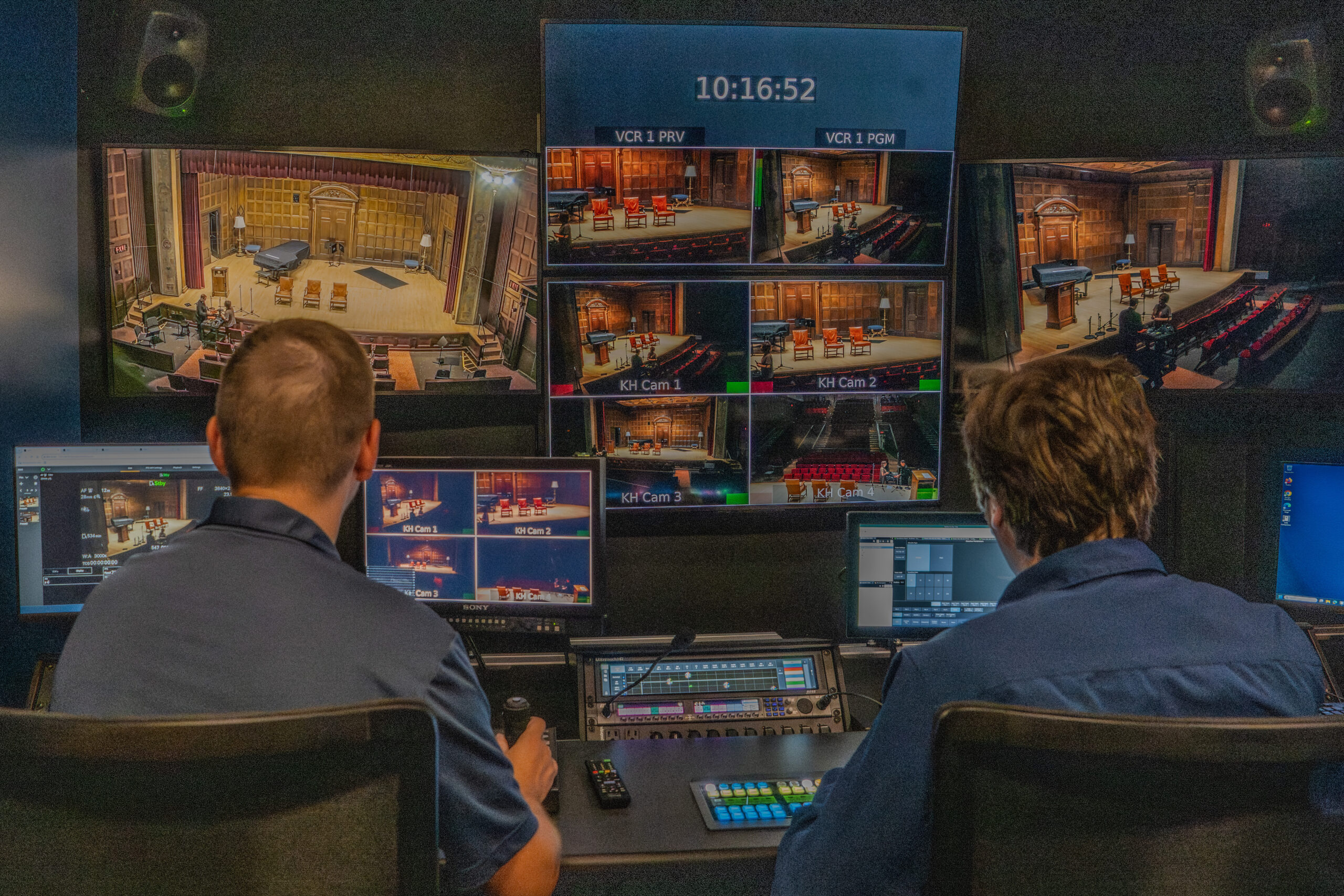
This article first appeared in the Fall 2025 issue of NOTES, Eastman’s alumni magazine.
…
Step into Eastman’s campus today and you’ll find more than echoes of musical greatness reverberating through its historic halls. Behind walk-up counters, beneath freshly painted ceilings, and inside whisper-quiet recording rooms, a quiet revolution is underway—built on gigabit speeds, 4K clarity, and a deep commitment to student-centered spaces and experiences. From practice rooms with Wi-Fi strong enough to stream symphonies and stay connected, to new courses, studios, and a reimagined help desk where students support students, the upgrades stretch from the basement to the top of the Annex. Across Miller Center and beyond, new tech infrastructure is making sure Eastman students, faculty, and staff have the tools—and the bandwidth—to match their artistry.
“We’ve outgrown many of our spaces—not just physically, but in terms of how our students learn, create, and collaborate,” says Dean Kate Sheeran. “This transformation is about meeting those evolving needs. We are looking carefully at how students, faculty, and staff use every corner of this campus, and asking: What’s missing? What could serve them better? From the basement to the upper floors, we’re finding new ways to make Eastman more accessible, connected, and equipped for the future.”
Soundspace

CONNECTING MUSIC AND TECHNOLOGY: Dennis DeSantis joined the Eastman faculty at the start of the fall 2025 semester.
Earlier this year, the University of Rochester announced one of the largest and most ambitious new ventures to date, intended to unite the creative and technical arms of the institution: Soundspace. This cross-campus interdisciplinary collaboration between Eastman and the Audio and Music Engineering (AME) program at the Hajim School of Engineering and Applied Sciences aims to create a shared hub for research, education, performance, and public engagement at the intersection of music, science, and engineering. Spearheading the effort is Mark Bocko, distinguished professor of electrical and computer engineering and director of the AME program, working in close partnership with Eastman composer and professor Mikel Kuehn. Backed by 11 additional faculty members from both campuses, Soundspace is envisioned as a collaborative ecosystem where innovation thrives across disciplines.
As part of this initiative, Eastman also announced the appointment of Dennis DeSantis ’05E (DMA) as associate professor of music and technology. DeSantis is a composer, percussionist, sound designer, author, and educator, and was previously head of music learning at Ableton in Berlin, Germany. In addition to teaching, he will play a leading role in developing new programs and curricular innovations within Soundspace. “The partnership between Hajim and Eastman is very exciting,” he says. “It allows for levels of technical expertise around things like creative coding or electrical engineering and software design at Hajim to be combined with the deep levels of musicianship that Eastman provides.”
By blending exemplary musicianship with superior engineering and design, Soundspace offers students from both campuses access to a truly interdisciplinary education—one that acknowledges how central technology has become to music in all its forms. “Programs like the ones we’re building now can help everyone—from those who want to explore creative coding to those who simply want to capture high-quality performances of themselves acoustically,” DeSantis says. “Technology is not just a tool for documenting music—it’s a tool for creating it.”
EMuSE
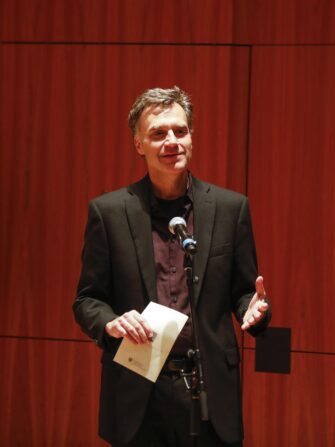
ELECTROACOUSTIC EXPERIMENTATION: Professor Mikel Kuehn continues a decades-long legacy of experimentation at Eastman. Photo credit: Matt Wittmeyer.
At the bottom of Eastman’s grand staircase, the new EMuSE Studio—short for Electroacoustic Music Studios @ Eastman—is evolving into one of the school’s most forward-looking creative spaces. Since its founding in the early 1980s, EMuSE has grown into a central junction for electroacoustic experimentation, live electronics, and immersive sonic experiences.
Today, under the leadership of Professor of Composition Mikel Kuehn ’93E (MA), ’95E (PhD), EMuSE is not only continuing its legacy but reimagining it for a new generation. Kuehn, who joined Eastman in 2023, has overseen a dramatic upgrade to the studio’s physical footprint, its technology, and its educational reach. What was once a small, under-resourced set of rooms has become a fully outfitted, cross-disciplinary space where composers, performers, musicologists, and even River Campus students collaborate on cutting-edge projects. “I really wanted to have studios where we could involve more than just our composition students,” Kuehn explains. “There’s great potential here, and now we’re building a space that reflects that.”
One of the most transformative updates to the studio is the creation of a new, sound-isolated room with a Sound Transmission Class (STC) rating of 60—near the upper limit for airborne sound attenuation. “It’s about as soundproof as we’re going to be able to get in an older building like ours,” says Paul Spaulding, director of facilities and auxiliary operations.
To bring the new spaces to life, Kuehn provided a carefully curated “shopping list” to Mark Wazowicz, director of Eastman’s Technology and Media Production (T&MP) Department, whose team handled the installation of both classroom and studio technology. The result: a fully immersive environment outfitted with a wall of 25 speakers arranged in a dome-like configuration, an 85-inch display, MIDI controllers, custom furniture, and a professional sound booth for recording. “When people see a lot of speakers, they tend to get really excited,” Kuehn jokes.
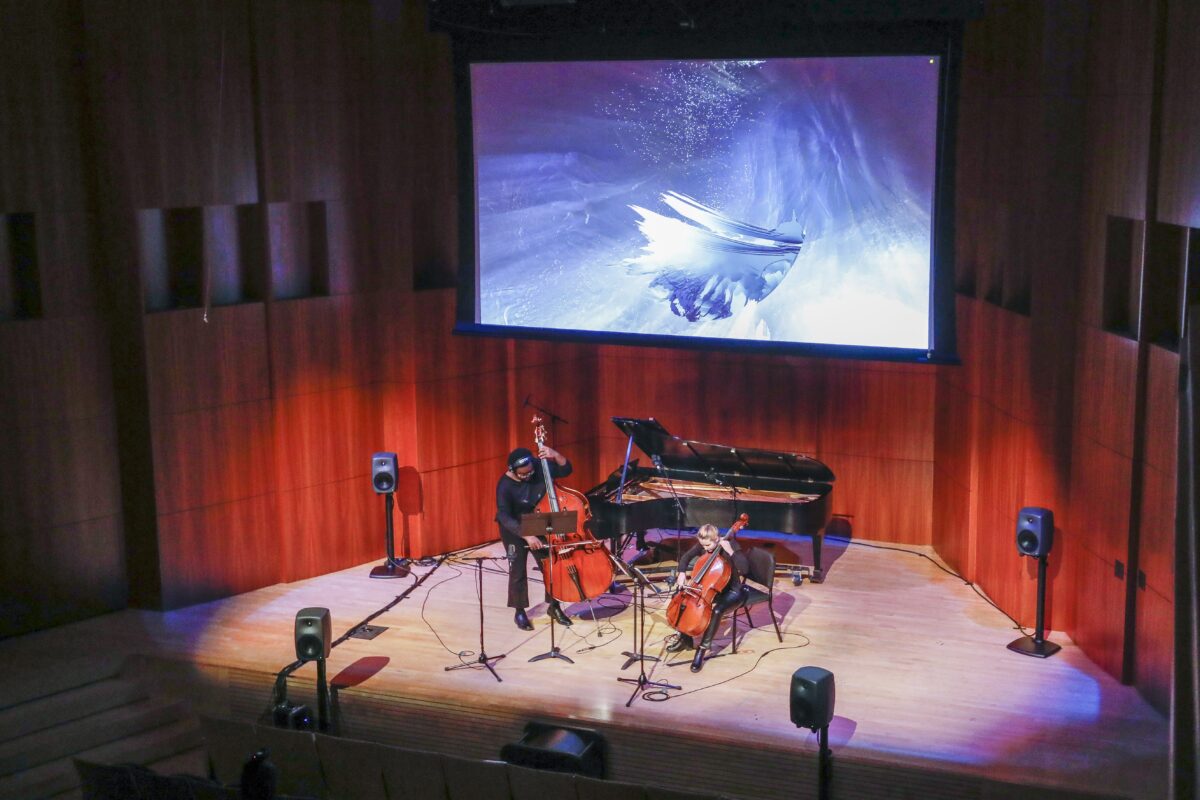
EMuSE ON STAGE: An EMuSE student performance in Hatch Recital Hall. Photo credit: Matt Wittmeyer.
But beyond the visual impact, Kuehn hopes students recognize what the new space makes possible. “When you think about what existed before, the spaces were small, it was hard to see what we had, and nothing functioned properly,” he says. “There was only one computer in the whole computer music studio—and it was from 2013. In computer years, that’s a lifetime.”
Through open studio time, listening sessions, and TA-supported concerts and student recitals, Kuehn is positioning the EMuSE Studio not just as a space for sonic experimentation, but as a vibrant, inclusive hub for creative tech at Eastman.
Miller Center
Across Gibbs Street, the Miller Center—home to the Sibley Music Library, the Institute for Music Leadership, the Office of Admissions, the Dean’s Office, and numerous department hubs—has undergone numerous strategic upgrades of its own.
Renovations throughout include new, flexible-use spaces for students. A newly finished 25-seat classroom adds to Eastman’s teaching capacity and provides much-needed flexibility for small seminars and visiting artist workshops. A dedicated graduate student lounge and expanded seminar and study spaces give students more resources between commitments. “Having a welcoming space for graduate students to use throughout the day to relax, study, eat, and socialize is incredibly important in creating a sense of community and preventing burnout in the library and practice room,” said doctoral student Lauren Ganger ’21 (MA). “I hope our graduate student body enjoys it for years to come.”
With more administrative teams consolidating on the newly refurbished fourth floor, the need for additional hardware and infrastructure continues to grow. A new computer equipment room, built on that same floor, now serves all five stories of the building. This behind-the-scenes upgrade enables easier wiring and significantly boosts the building’s connectivity but, isn’t a one-off—it reflects a long-term commitment to enabling scalable, modular improvements in the future, without the need for disruptive construction each time something changes. “It’s one of those invisible upgrades,” says Spaulding. “But it makes everything else possible—more teaching, more access, and better support for the people doing the work.”
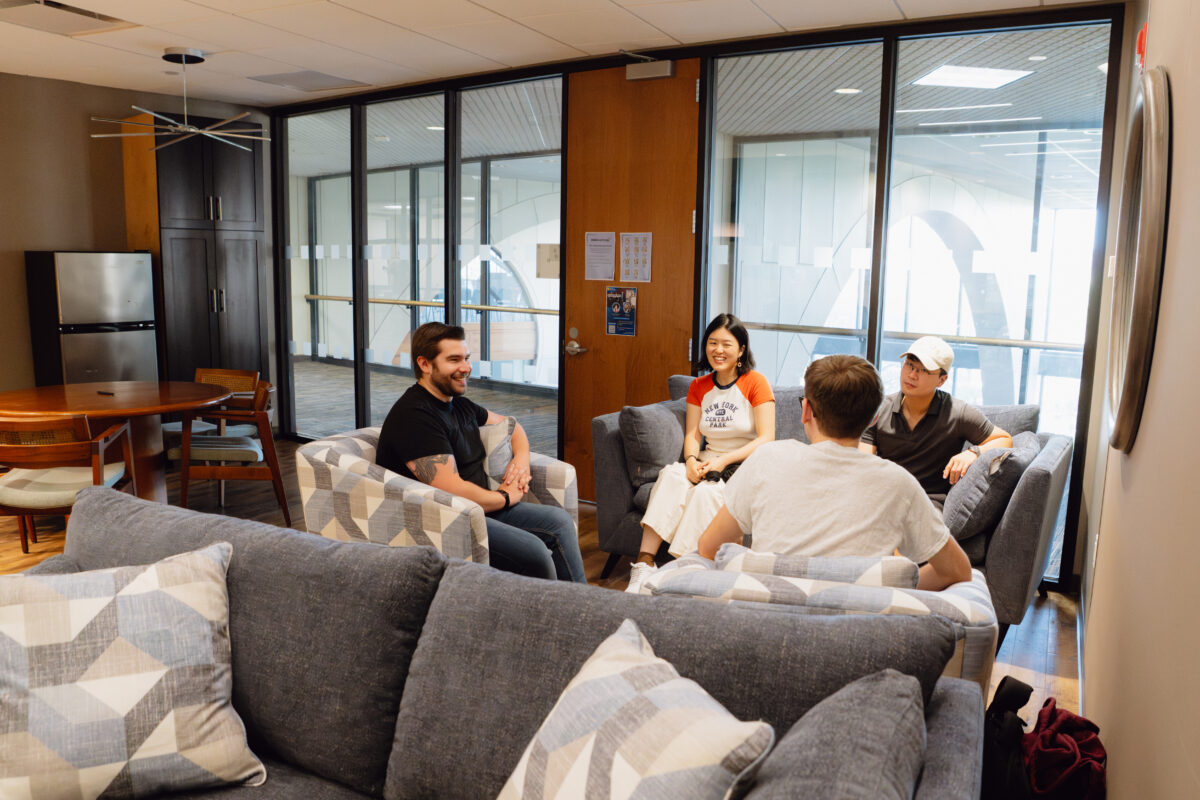
STUDENT COMFORT: Students can use the graduate lounge to both study and relax with friends. Photo credit: Lauren Sageer
Help Desk and the Cave
One of the most notable changes for students is the creation of a new, walk-up help desk and behind that, a refurbished office for the T&MP team—affectionately known as “The Cave” or “Fingal’s Cave” to students. This initiative is just one piece of a broader project led by Wazowicz. After serving in a similar role on the University of Rochester’s River Campus, Wazowicz joined Eastman three years ago to help reimagine the student technology experience. That meant reassessing spaces, upgrading equipment, and building systems from the ground up. “We’re literally building a technology foundation in the basement and expanding that across all of Eastman,” he says.
The help desk is now staffed by student workers as of the start of the 2025-2026 academic year. Here, students, faculty, and staff can ask questions, troubleshoot tech issues, and get hands-on support. They can even borrow equipment. Through a library-like checkout experience, loans are managed using a barcode system ensuring every piece of equipment is tracked and returned on time. The gear includes laptops, audio and video recorders, microphones, speakers, tripods, cables, and a sundry collection of helpful gadgetry. One significant addition to the list is upgraded 4K cameras for self-recorded projects.
Behind the desk, what was once a rarely-used computer lounge (and even earlier, a smoking room) has been transformed into a functional and inviting support hub. Although a 100-year-old building offers no shortage of challenges, paint, new carpeting, furniture, and improved lighting were essential updates—modest changes, perhaps, but transformative in making the space functional and welcoming. The newly renovated suite now houses T&MP’s full-time staff in one convenient location for the first time. “There are 14 spots for audio engineers, AV professionals, computer staff, website developers,” Wazowicz says. “They’re all working in that room and available to help and collaborate if there’s a special project or question that comes up.”
Wi-Fi in the Annex
The Annex, built in 1927, poses one of the biggest challenges to Wazowicz’s campus-wide overhaul: unreliable internet. Accessed by one of two bridges from Lowry Hall, the Annex is 10 floors housing practice rooms, faculty studios, classrooms, a black box theatre for opera, and a large ensemble rehearsal space. Designed with acoustics in mind, the building’s thick masonry—12 to 14 inches thick in places—became a natural enemy to modern wireless connectivity. “In the Annex, Wi-Fi used to vanish the deeper you went—by the time you hit the basement, you were basically off the grid,” Wazowicz says.
To solve the issue, a centrally located practice room on the fifth floor was repurposed into a computer equipment room—now the “main brain” of the network. From there, over 170 access points are being installed throughout the building, with nearly every other room receiving its own dedicated signal. “In the end, that entire building from top to bottom will have high-powered internet with brand new hardware, meaning state-of-the-art Wi-Fi,” Wazowicz says. “Anybody can be in there and connect easily.”
Health and safety were top priorities. In an age of digital sheet music and remote collaboration, a reliable signal isn’t just convenient, it’s essential. “We have students in those practice rooms all day, every day,” Wazowicz says. “Just being able to send a text and say, ‘Hey, I’m over here if you need me,’ or be able to reach out if they need help, is crucial.” Spaulding echoes the practical benefit. “More and more students are downloading music these days,” he says. “They’re not using sheet music in paper form, they’re using a tablet.” Faster, more accessible internet not only mean students feel safe, but also allows them to download what they need, when they need it. These upgrades are paving the way for “smart classrooms” equipped with 21st-century listening and sound technology, ensuring students have the tools they need to succeed.
With improvements to the Annex underway, Eastman’s Wi-Fi revolution continues to ripple across campus. As students increasingly rely on three to five devices each—smartwatches, phones, tablets, and laptops—the demand on network infrastructure has grown exponentially. Upgrading hardware isn’t just important; it’s essential. Enhanced connectivity in Lowry Hall, Eastman Theatre, Howard Hanson Hall, Kilbourn Hall, and the Ray Wright Room benefits not only students, faculty, and staff, but also the many guests who rely on seamless access.
Years in the making, Eastman’s recent wave of upgrades isn’t just about faster internet, sharper video, or shinier equipment—it’s about reaffirming the school’s commitment to students and their evolving needs as artists, collaborators, and creators. Each update signals a shift toward a more integrated, accessible, and future-ready Eastman. “I think it’s fair to say that we’ve heard from colleagues and people who’ve been here a long time,” Paul Spaulding concludes, “and they’ve seen more progress in these areas in the last three years than they’ve seen in the previous 20.”
For Mark Wazowicz and the teams behind the scenes, that momentum is only just beginning. “Nothing like this level of update has ever happened before,” he says. “That cannot be understated.” If Eastman has long been known for honoring its past, it’s now equally invested in building what comes next—floor by floor, speaker by speaker, and student by student.
“There’s still more work to do, and more opportunities ahead,” Dean Kate Sheeran affirms. “These upgrades represent a significant investment—but they’re also just the beginning. As we continue to grow and invite new partnerships and support, we’re committed to building an Eastman education where students’ only limit is their imagination.”