
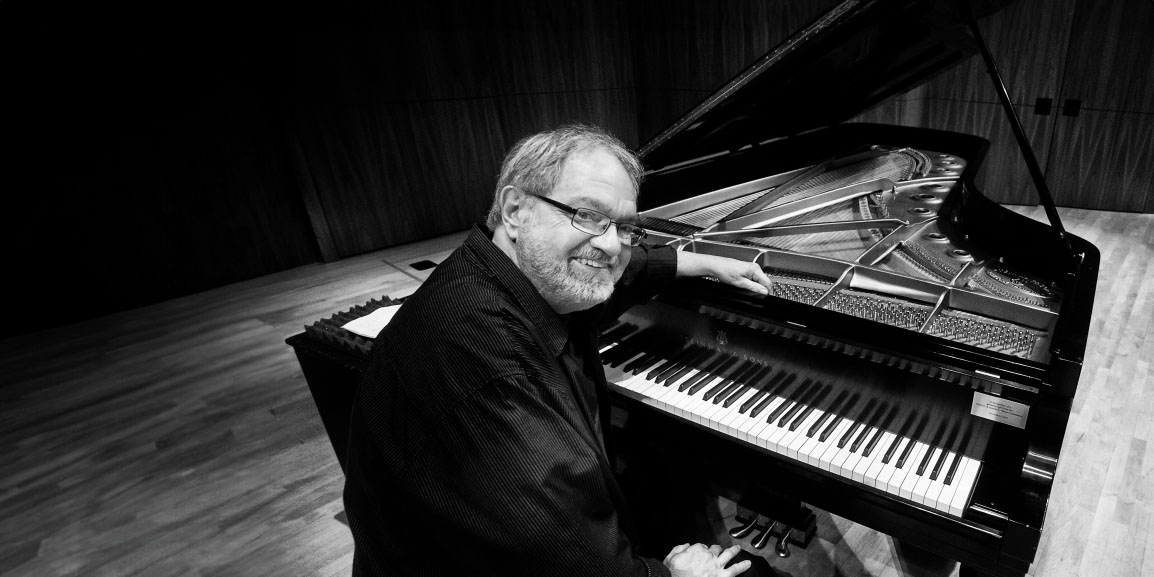
In 2024 we’re looking forward to a special event that occurs only once every four years. We don’t mean the presidential election, but a special event unique to Eastman: the Quadrennial Concert by pianist Harold Danko.
As he does every Leap Year, on February 29 Harold, a self-described “composing improviser” and Professor Emeritus of jazz studies and contemporary media, will serve up an evening of his own compositions with himself at the piano, joined by several Eastman colleagues.
This is the twelfth of Harold’s quadrennial events – or if you would like to do the math, their 44th year. The first one took place in New York City in1980, well before his arrival on the Eastman faculty. “I’d received a ‘Meet the Composer’ grant, and so I made it an evening with my quartet performing my own music,” he recalls. “The booking happened to be on February 29, so I decided to repeat the event every four years.”
Over the years, Harold got together every Leap Year with piano friends in New York “mostly as a way to get New York pianists to play my stuff.” He joined the Eastman faculty in 1998 and brought his quadrennial act to Rochester two years later, with a 2000 show at the Little Theatre Café which brought together fellow jazz faculty members and students. Harold retired from Eastman in 2020, but he’ll be back on the last day of February with more colleagues and recent music, for another chapter in what he has jokingly described as “the slowest-growing cult event of modern times.”
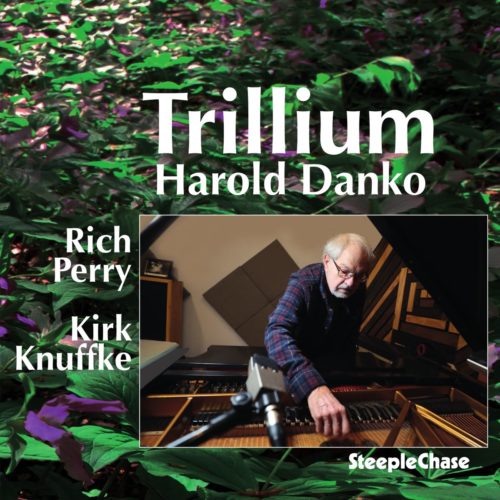
“Trillium” Album Art
Though retired, Harold continues to play and compose, calling himself “a promising septuagenarian.” Besides releasing a recent album, Trillium, he’ll return to the Rochester International Jazz Festival this spring.
The 2024 edition of the Leap Day concert will begin with a first half dedicated to Harold as piano soloist in his own music. For the second half he’ll be joined by two Eastman faculty members: trumpeter Clay Jenkins and saxophonist Charles Pillow, along with legendary local drummer Bobby Blandino and bassist Kyle Vock of Nazareth University. The music is again by Harold, with an assist from a colleague he reveres – Igor Stravinsky.
Harold has admired and studied the music of this great 20th-century composer for many years, particularly his innovative masterpiece The Rite of Spring; his last three albums have been inspired by melodies and harmonies he has found in The Rite. He describes his own jazz takes on this rich material as “vehicles for improvisation infused with Stravinsky’s musical language.”
(Stravinsky may not have minded the idea of a jazz musician encroaching on his territory. After emigrating to the United States, he wrote his Ebony Concerto for clarinetist Woody Herman. Not surprisingly, “It doesn’t sound like Woody Herman at all,” says Danko.)
The first CD, Spring Garden, uses a quartet of tenor sax, piano, bass, and drums; the second, Rite Notes, has Harold on solo piano throughout. Trillium, the latest, brings together cornet and tenor sax, with Harold at the piano in what he describes as “more of an orchestral capacity.”
“It took Stravinsky 35 minutes; it took me three CDs,” he says. “You don’t hear Stravinsky in it, but I hope I make good on his music.”
Harold Danko and Friends (including Igor Stravinsky) present a Quadrennial Leap Year concert on Thursday, February 29 at 7:30 p.m. in Kilbourn Hall. Free admission.