Messages Through Music: Donald Nally on Leading Eastman Chorale
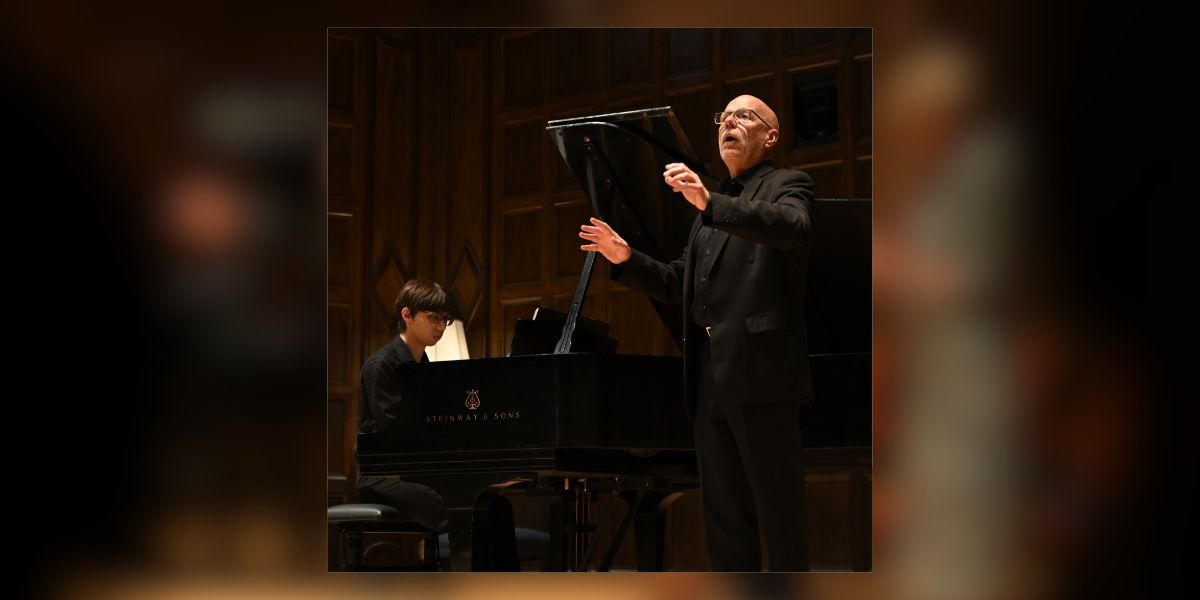
The Eastman Chorale is preparing for its second and final concert of the fall semester on Sunday, November 22. After a warmly received first concert, Shepherd, we went behind the scenes to interview Visiting Professor of Conducting & Ensembles Donald Nally about leading the ensemble and what audiences can expect in the upcoming concert.
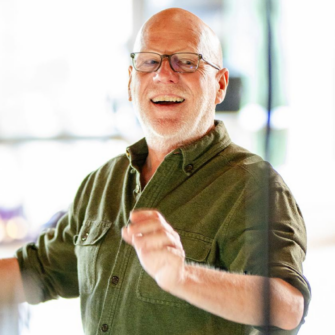
STEPPING IN: Nally joined Eastman for the 2026-27 academic year following the retirement of William Weinert.
Nally brings 45 years of conducting experience to Eastman. He is the John W. Beattie Chair of Music Emeritus at Northwestern University, and his career highlights include serving as chorus master for Lyric Opera of Chicago, Welsh National Opera, Opera Philadelphia, and Il Festival dei Due Mondi in Spoleto, Italy. He is also the conductor of The Crossing, a professional choir in Philadelphia that primarily performs works he has commissioned, addressing social justice issues such as immigration and refugeeism, wealth distribution, climate change, and gun violence. Above all, Nally is fascinated by the colors of voices singing together, what those sounds can express, and what content they hold.
Professor Nally, how has your experience at Eastman been so far?
“It’s been amazing. I started by getting to know the administration. I liked them a lot and found them to be flexible and open to new ideas. Then I met faculty members and had the same experience—very welcoming, very dedicated. Finally, I met our students, and that made everything more delightful. They are smart, talented, and eager to expand on what they know. They have already proven to be risk-takers, which is an essential part of my art.”
What’s your vision for the Eastman Chorale this semester?
“My vision for Chorale is the same as the principal goals of my conducting and teaching. First, the development of responsibility to the community. For example, you prepare the music before you come to rehearsal, not just because that’s the way the professional world is, but also so we can get to the fun stuff, the stuff that really matters, like, what’s the story, what is the composer trying to say about the story, and why do we find it moving? We need to get past notes and rhythms so we can concentrate on why we came here in the first place: we have something to say, and singing is the way we say it. I like being around artists who feel that way.
“The second is to develop a sense of listening to comprehend, not listening to respond: how we make space for each other, how we find agreements and connections within a voice part, across the choir, and, hopefully, in the world.
“Finally, there’s storytelling, which touches every level of our work. I like to introduce new ways of programming and presentation. Our first concert had a very clear arc. There were interludes, so the arc wasn’t interrupted by applause. The audience could meditate on what they had just heard, or be present in the interlude itself – whatever they chose. Add to this: technique, stylistic nuance, and historical knowledge. They’re all part of our daily bread here.”
Is there something new you’ve introduced to Chorale that’s been especially fun?
“I spend the non-academic part of my life in contemporary music, and I’m used to working on music that’s been written for me. So, it’s been a privilege to introduce contemporary pieces that I love and really believe in. In our first concert, we did three pieces by composer David Lang, who came and coached us on them. That felt like a new kind of pocket for the group to find: postminimalism—a very different approach to composition than that of the 19th century. And we did this piece called Kyiv. A couple of years ago, I went down a Ukrainian-composer rabbit hole and found this marvelous piece by Natalia Tsupryk that only existed in her electronic rendering, which featured the sounds of a cello. So I asked Natalia for permission to have it arranged for voices and cello. She agreed, we arranged it, and it’s a truly haunting work inspired by the sounds of air raids. I think the Chorale was perplexed by this piece at first. There are no words; the repetitive gestures and independent singing were new techniques to many of them. But it became one of our favorite pieces on the program. It takes you to an extraordinary place; it feels like you are describing something important. As they got to know it, they realized that the listener’s experience was very different from theirs, and that the piece was worth the investment. They sang it absolutely marvelously.”
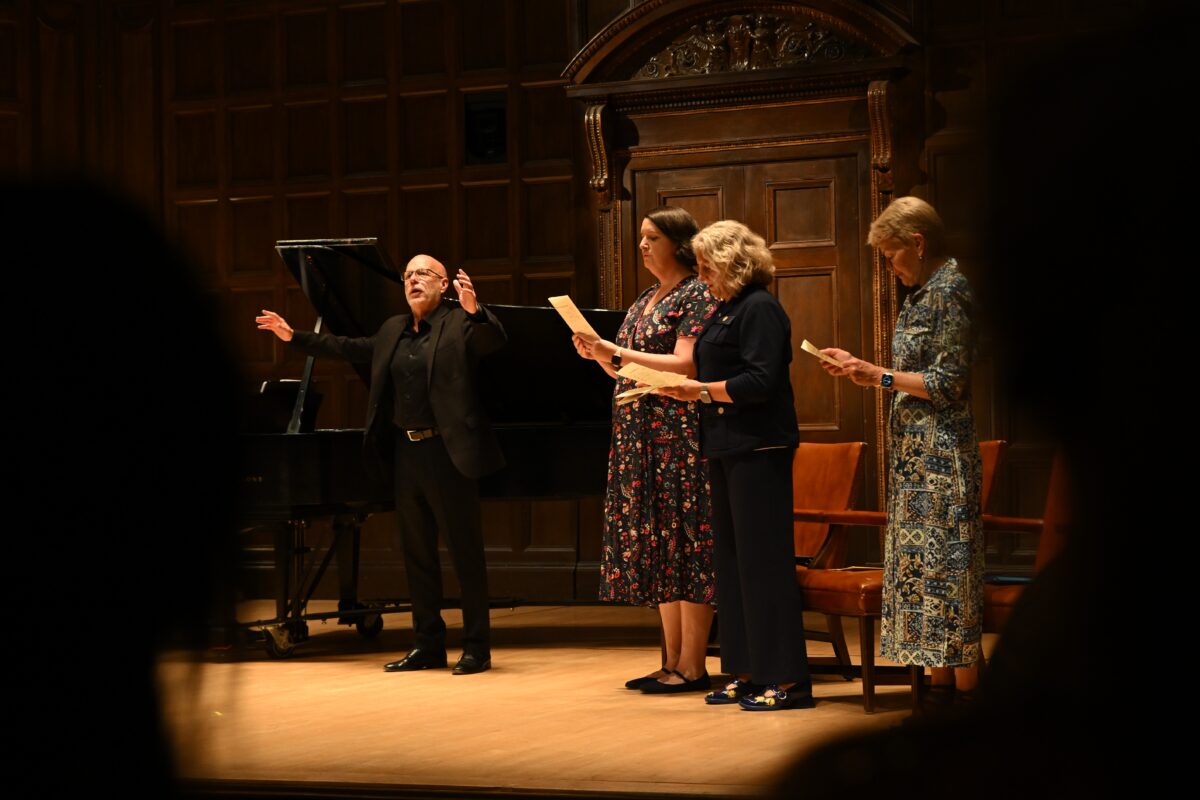
CONVOCATION: Nally joined Eastman Dean Kate Sheeran, University of Rochester President Sarah Mangelsdorf, and Provost Nicole Sampson on stage during this year’s convocation ceremony to lead Eastman students, faculty, and staff in a rendition of Samuel Barber’s ‘Sure on This Shining Night,’ accompanied by student pianist Dominic Fiacco. Photo Credit: Lauren Sageer.
What is it like working with the graduate conducting students, and what do you want to pass on to them?
“Teaching conducting is largely about eliminating issues. It’s often paring things down to the very basics, and that may initially be very technical. But being efficient and economical in gesture, in rehearsal process, in breath, and in listening also leads to a ‘point of view.’ How do we develop a point of view about any given composer or any given text? What are the questions to ask—about the compositional process, the decisions the composer made, the story, and ourselves? To be musicians is to never fully know ourselves, because we are going to be someone different and better tomorrow. I spend a lot of my time at the university level exploring these topics.
“I really like passing on what I’ve learned, and what I’m still learning. I’ve done a lot of choral work: professional opera choruses for 25 years, large symphonic choirs at the level of the Philadelphia Orchestra or the BBC Symphony, chamber choirs, Anglican church choirs, and then, of course, new music. All of that gets funneled into my teaching. And we’re fortunate at Eastman to have graduate students capable of processing a lot of information—so I try to oblige!”
What can audiences expect from the November concert for Chorale?
“The November concert is called Contradictions. I’ve paired pieces that explore human beings’ paradoxes: the good and the bad, the painful and the joyful. I wanted to open with this question: how do we respond to all the pain that’s around us all the time? Students are not immune from that in any way. At the very center is the big piece, Brahms’s Nänie, which is a broad lament. The point of Schiller’s poem is that even beauty must die—artists, civilizations, cultures—yet he concludes that it is better to die and be remembered for beauty (a contribution of some kind, for example) than to be forgotten. But there is also a sense of gratitude for, simply, living. It reminds me of Richard Dawkins’s line: ‘We are going to die, and that makes us the lucky ones.’ So, after a journey of contradictions and anxieties, the concert concludes with ‘Golden Hour,’ the last movement of Infinite Body by Ayanna Woods, written for The Crossing and me in 2023, which is about how beautiful we are—all of us. And I thought, after all of that sorrow—which every human recognizes in themselves—the message I’d like to leave us with is that we’re golden.
Eastman Chorale
Sunday, November 22, 2026
3:30 p.m. | Kilbourn Hall
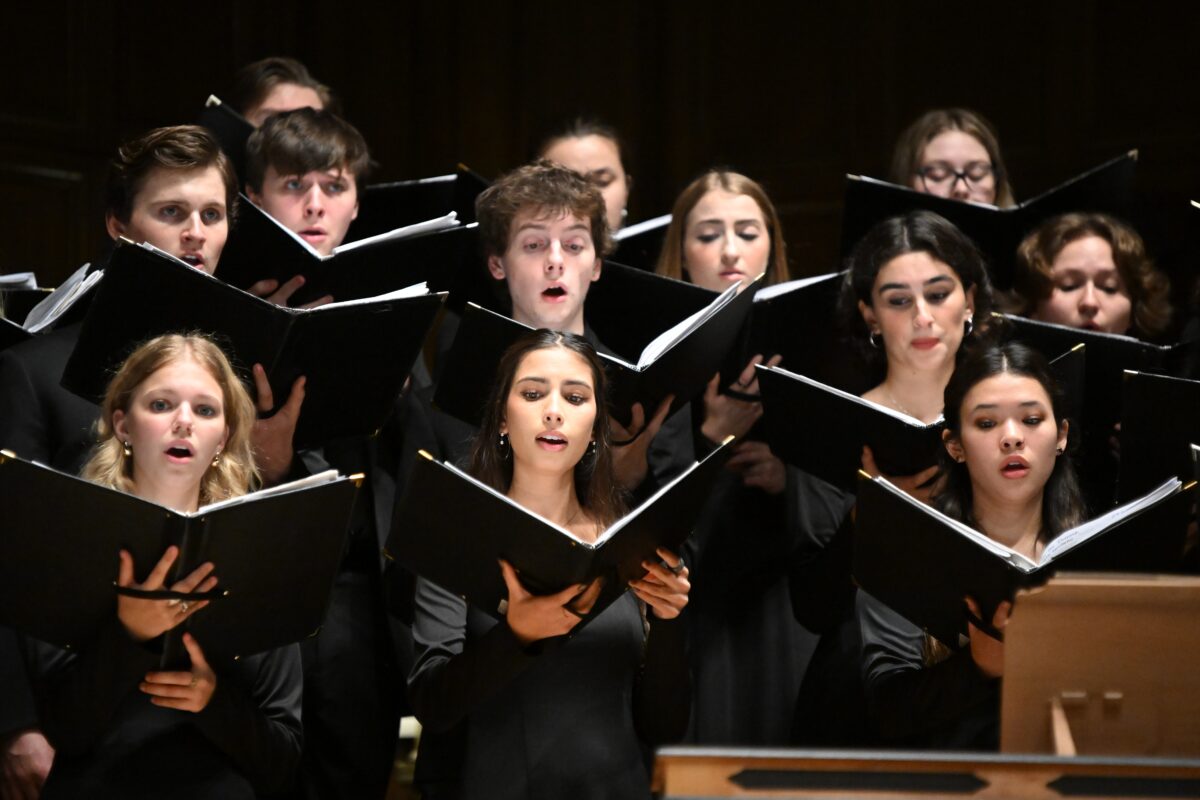
A CHORUS OF VOICES: Eastman Chorale performing in Kilbourn Hall. Photo Credit: Mint Lu.