
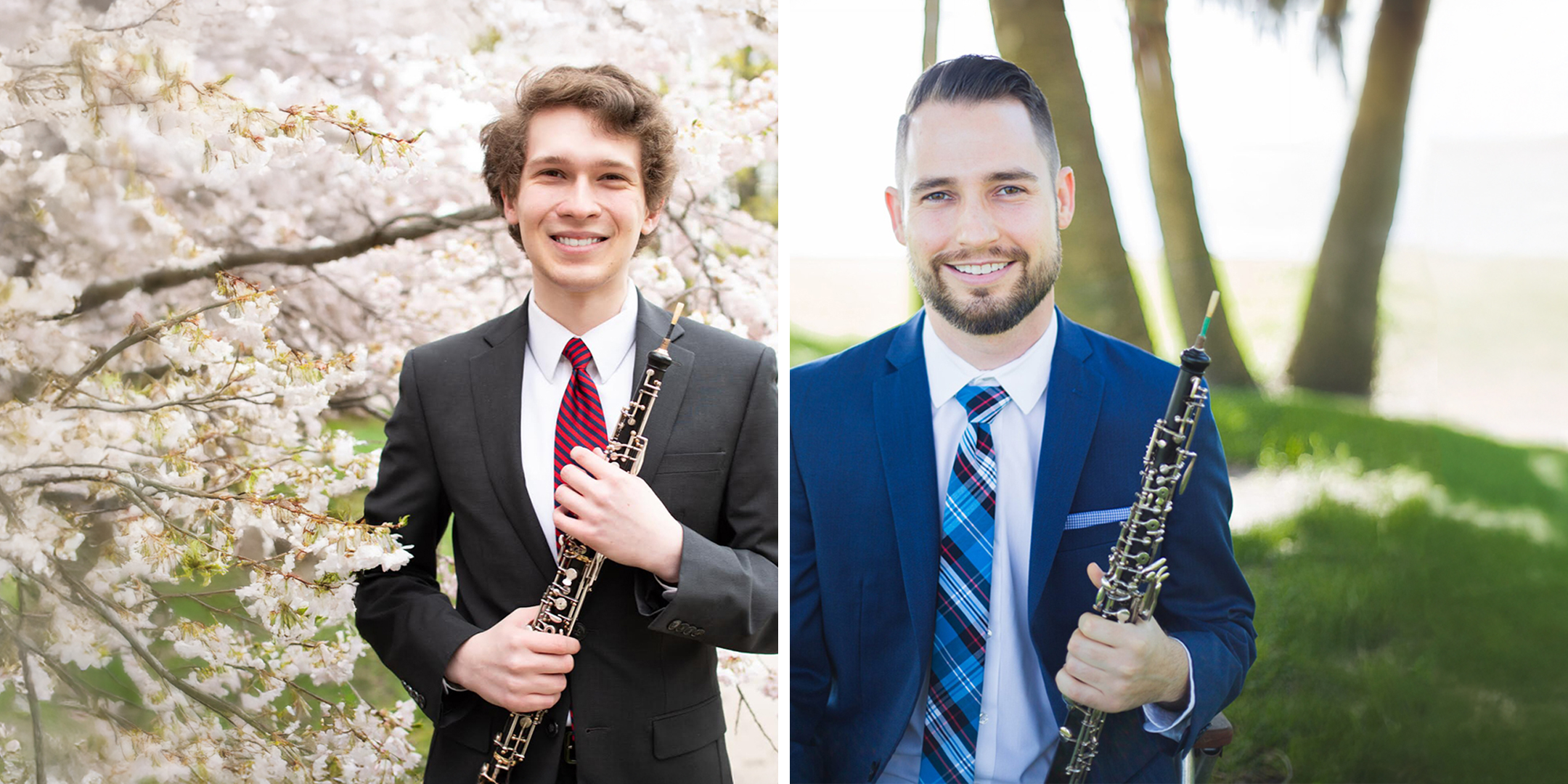
By Jonathan Heath
Few instruments possess the voice of the oboe—at once plaintive and piercing, rich with nuance and unmistakable in character. There’s a reason it often leads the orchestra with that first tuning note: a solitary A that hums with ancient authority. Its double reed gives rise to a sound that can sing, quieting a noisy orchestral pit or a fidgeting audience.
For Peter Davies ’23E, the oboe’s human-like tone is precisely what drew him in. “It’s a very vocal sound,” he says. “You really have to think about projection and vibrato and expression in a similar way to singers, which gives you a lot of really interesting expressive capabilities.”
He’s also enamored by the unique challenges the oboe presents. As a child in Dallas, TX, Davies enjoyed making and fixing things, and he brings that hobby to bear on the oboe. “Hearing that making reeds was a big part of the instrument was very interesting to me,” he recalls. “And as it turns out, that’s one of the most difficult things about the instrument, but I think it’s also something that’s very rewarding when you get it right.”
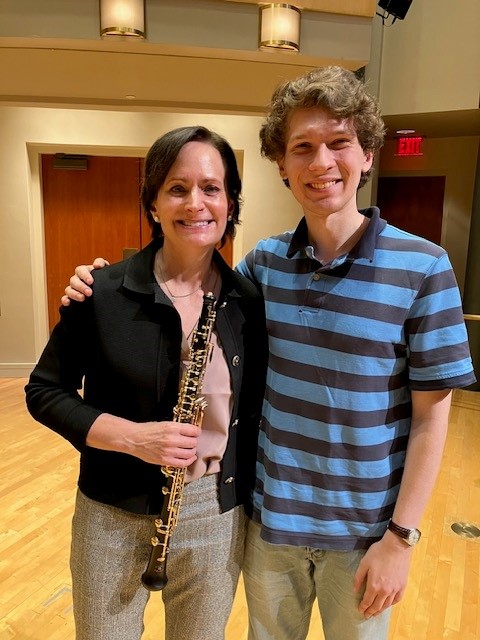
Erin Hannigan and Peter Davies at the National Orchestral Institute in Maryland on June 2, 2025. Davies was attending a master class by Hannigan.
This attention to detail has been nurtured by all of his teachers, including Eastman Professor of Oboe Richard Killmer and Davies’ high school teacher Erin Hannigan ’96E, an Eastman alumna herself and former student of Killmer. Now the principal oboist of the Dallas Symphony Orchestra, Hannigan immediately recognized his potential. “Peter was the kind of student who was always self-driven and independently curious,” she says. “I kept assigning more challenging repertoire, and he would rise to every occasion with joy and total commitment to the art. I was so happy when he decided to attend Eastman, as I knew Richard Killmer would continue to nurture the artist and the incredible young person within.”
Today, Davies continues his ascent as an oboist of great talent and dexterity. He graduated from Eastman in 2023 after studying with Killmer. It’s impossible to understate the role Killmer plays in shaping each new generation of oboists. Davies recalls a moment that sealed the deal for him. “I was very much drawn to studying with Mr. Killmer. He’s such a generous and energetic person,” Davies says. “I remember, before my Eastman audition, I had had a lesson with him a few months earlier and I was getting breakfast at Ludwig’s, right across the street from Eastman, and Mr. Killmer came in. He recognized me and wished me luck on my audition. I could tell then this was an environment and a teacher that really cares about the students and about growing you as a person.”
With his bachelor’s in hand, Davies headed to Juilliard that same year year to study with former MET principal oboist Nathan Hughes. This summer, he earned his master’s. Barely a week after commencement, Davies received the kind of news any young musician dreams of: he had won the principal oboe position with the Metropolitan Opera Orchestra. “I really didn’t expect that I could have achieved this,” Davies says. “It’s a dream job for me.”
Oddly, that dream began with a setback. The MET—one of the few orchestras in the country with two principal oboists—demands a staggering workload. With multiple performances each week, many stretching on for hours, and a rotating repertory that demands a deep musical knowledge, the orchestra shares its top chair between two players. Davies first auditioned in the summer of 2024 and didn’t advance. What followed was a year of relentless preparation. As Davies says, “You have to know a lot of music, and you have to know it very well.” He auditioned as often as possible, expanded his repertoire, and worked to be mentally ready to undertake the marathon three-day audition process again. This time, his confidence and ability shone through.
If anyone knows this process, it’s oboist John Upton ’12E.
At Eastman, the paths of students, faculty, and alumni often intersect in ways that defy logic but feel almost inevitable. As anyone who comes here knows, there is a network of lives and legacies that last long after you leave. Dive into those connections and you’ll uncover some remarkable stories. For Peter Davies and John Upton, the similarities practically jump off the page.
Upton didn’t come from a musical family. As a fifth grader growing up in Michigan, he couldn’t tell instruments apart but was eager to try something new. He chose the oboe while imagining a bassoon and was stunned when handed such a tiny case. “I remember saying, ‘Oh, there’s been a mistake, I’m playing oboe—there must be a bigger case.’ And they were like, ‘No, that’s the oboe.’” Undeterred, Upton took up the instrument and never looked back.
Like Davies, Upton’s high school years were formative ones. Internationally renowned oboist Nancy Ambrose King ’86E (MM), ’99E (DMA) helped guide his musical ambitions and prepare him for Eastman. Now professor of oboe at the University of Michigan’s School of Music, Theatre & Dance, King remembers Upton as someone with “musical awareness, intellectual curiosity, and a desire to learn everything he possibly could about the oboe and its music.”
“Working with John during that time was an absolute joy,” she recalls. “Even in those early years, his perseverance, work ethic, and dedication—combined with his endlessly positive attitude and enthusiasm—was inspiring to everyone around him.
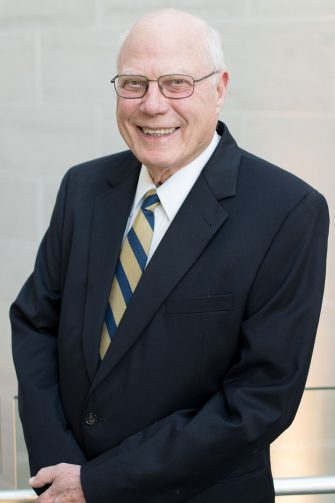
Eastman Professor of Oboe, Richard Killmer.
Another student of Professor Killmer during his undergraduate studies at Eastman, Upton was awarded the prestigious Performer’s Certificate—the school’s highest performance prize—at his 2012 commencement. He then continued his studies at Juilliard, earning his master’s under Nathan Hughes, just like Davies. From there, his career moved quickly: a fellowship with the New World Symphony in Miami, FL, which he left after a year to accept the principal oboe chair with the Florida Orchestra. After four seasons in Florida, Upton returned to New York, where he began freelancing with the MET and the New York Philharmonic, occasionally picking up the English horn, too.
For Upton, the oboe’s emotional range is part of its magic—and it doesn’t hurt that so many composers have written luminous solos for it. Today, he performs those very solos to rapt audiences at the Metropolitan Opera, where he’s served as principal oboist for the past year. (As fate would have it, Upton’s husband Evan Epifanio also plays for the MET as principal bassoonist, bringing Upton’s early memory of the bassoon full circle.)
When Upton saw that the MET was auditioning for two principal oboists, he knew there would never be a better time. “Preparation is everything for an audition,” he says, “especially an opera audition. We start learning orchestral excerpts in undergrad, but all these opera excerpts were mostly new to me. So that was a challenge—but it’s also kind of nice to see some new music.”
Upton successfully won the position in 2024. At the conclusion of his debut season, he’s thrilled to learn he’ll soon be sharing the role—and the schedule—with another Eastman alumnus. “When they announced that Peter was the winner, I couldn’t believe it,” he recalls. “I was so excited to have another Killmer/Hughes student, just like me.”
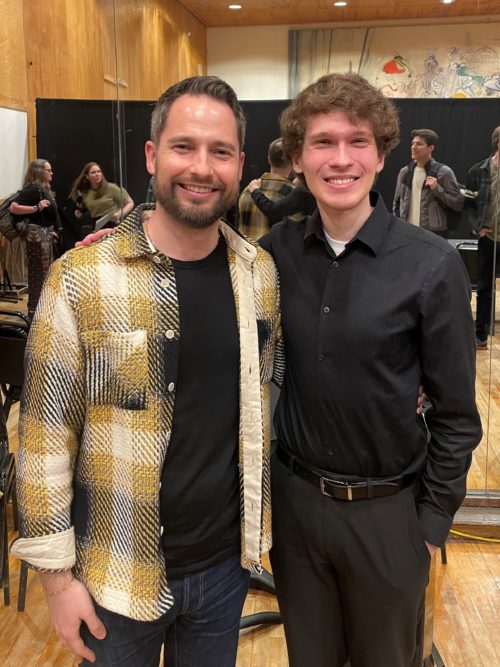
Upton (left) and Davies at the MET shortly after the announcement Davies had successfully secured the second principal oboe position.
For Davies, the respect goes both ways. “I heard the Brahms Violin Concerto at Carnegie Hall recently, which has a really wonderful, famous oboe solo in it,” he says. “And I was blown away by the way that John played that. It was just so original and striking.”
Though Upton and Davies will rarely share the stage, they’ll collaborate closely—deciding who plays what and when, balancing the demands of one of the world’s most rigorous ensembles. In the months ahead, as their professional paths grow even more intertwined, they may find that the real artistry lies not just in performance, but in partnership.
And they’ll undoubtedly discover many more commonalities. Their Eastman roots are enshrined, after all. Although the two musicians grew up on opposite sides of the country, Eastman’s legacy helped shape their talents long before either stepped onto Gibbs Street or into Kodak Hall. Through Hannigan and King—both Eastman alums and protégés of Killmer—and Professor Killmer himself, Upton and Davies bring decades of mastery to one of the world’s grandest stages.
“Having had the good fortune to also work with Peter Davies before,” Nancy King adds, “I know that he and John share the important qualities that comprise a happy and successful section. I know they will make an extraordinary team together and inspire all who hear them!”
Professor Killmer shares that optimism. “I was extremely pleased to hear the news that two Eastman graduates were chosen to fill both principal oboe positions with the Metropolitan Opera Orchestra,” he says. “While John and Peter will present their own unique oboe voices, they share an extraordinary musical talent as well as exceptional skill as oboists. In addition, their dedication to the highest artistic standards and consistent hard work is quite evident in their recent success.”
Oboists are known for their precision and endurance, shaping breath into something lyrical and alive. As John Upton and Peter Davies prepare to take on this next chapter, they do so with the guidance—and the breath—of all those at Eastman who came before them.