

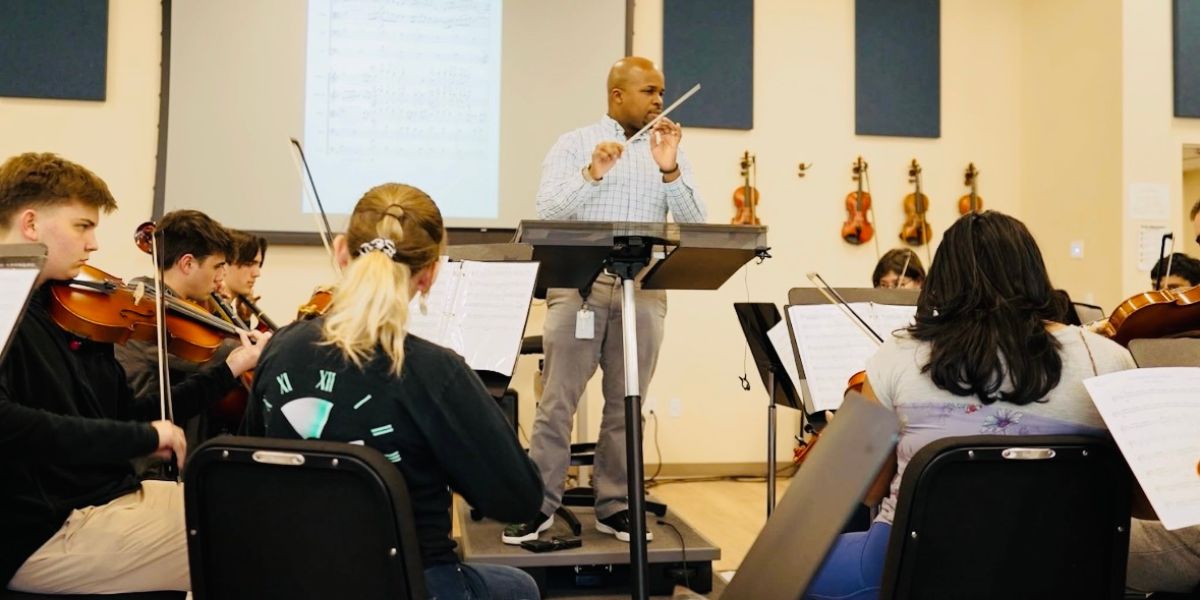
When composer and educator Adrian Gordon talks about his newest work, A Touch of Humanity, his words carry the same quiet resonance as the music itself. Commissioned through the Howard Hanson Institute for American Music, the piece will receive its premiere on December 10 by student ensembles from the Webster Central School District, marking the culmination of a collaboration that links Eastman, local teachers, and the next generation of musicians.
“The piece is about what it means to be present with one another in a world that is often filled with distractions,” Gordon says. “My hope was to pull on the heartstrings of audiences and performers alike, encouraging reflection on the connections in their lives.”
The work’s message—slow down, listen, and value genuine connection—feels especially fitting for students preparing for its first performance. Gordon, who serves as director of orchestras at Providence Day School in Charlotte, NC, approaches writing for young musicians with the same respect he gives professional ensembles. “Whether I’m writing for professionals or students, the integrity and emotional depth remain the same,” he says. “A good piece of music isn’t defined by its level of difficulty, but by how honestly it communicates emotion and tells a story in an honest and meaningful way.”
This project is more than a commission—it’s a web of collaboration that stretches from the Hanson Institute to Eastman’s department of Music Teaching and Learning (MTL) and into the classrooms of local schools. “We are thrilled to have Adrian Gordon join us,” says Associate Professor of MTL Alden Snell ’06E (MA), ’13E (PhD). “My colleague, Professor Lisa Caravan ’07E (MM), ’12E (DMA), learned of his work through her connections with the American String Teachers Association, and we were particularly excited about working with him because he’s both a composer and an in-service music educator.”

NOTE TO SELF: Adrian Gordon is an internationally performed composer, author, and seasoned music educator.
Gordon, too, relishes the special and meaningful connections that can be formed when you’re open to them, the effects of which can inspire thousands of listeners. “Partnerships like this embody the very purpose of music,” he says. “They evoke emotion and bring people together. It feels poetic that the title A Touch of Humanity also serves as the call to action—reminding us to lead with compassion and to offer the world what it needs most.”
While in Rochester, Gordon will meet with Eastman student teachers, sharing his process and perspectives on teaching creativity. He’ll also be a featured speaker at the Context Conference, where he’ll lead a session titled ‘Turning Music Makers into Music Creators’—a theme that runs through his work as both composer and educator.
At the conference, Gordon will challenge teachers to rethink how creativity fits within traditional music education. “Transformation begins with intentionally creating space for students to feel empowered to make their own music,” he explains. “They need to see that what they learn in the classroom is only the starting point. Every composer whose music they perform once reached a moment when they wanted to go beyond interpretation and create something original.”
For Gordon, composition isn’t an exclusive art form—it’s an extension of musical understanding. “Many ensemble directors may not have formal training in composition, but they already know how to read and interpret scores,” he says. “That alone allows them to guide students in structuring their ideas. The technical side of composing is often less of a barrier than it seems. This generation of students is comfortable with technology. Teachers simply need to provide encouragement, and if technology is not available, pencil and paper still work beautifully for creative exploration.”
The idea of permission is central to Gordon’s philosophy. He often tells students his personal motto is “Permission granted.” It’s both a gentle nudge and a declaration of belief in their potential. “My goal when working with students is to remind them that they already have what they need to create.”
Gordon’s professional life is a seamless blend of composing, teaching, and leading clinics around the country. Each role, he says, sharpens the others. “I’ve become a better composer because I’ve spent so many years teaching,” he reflects. “Through teaching, I’ve learned the importance of sequencing skills and writing music that is accessible to students while still letting them feel they’re creating something exciting and beautiful.”
Conversely, composing has made him a more empathetic teacher. “It pushes me to think more deeply about how students experience music and how to help them connect with it personally,” he says. “You learn a lot by turning up the empathy.”
That empathy also threads through his book Note to Self: A Music Director’s Guide for Transitioning to a New School and Building a Thriving Music Program (2022), which encourages teachers to lead with honesty and heart.
“The best thing you can offer is your true self,” Gordon says. “People of all ages can sense when someone isn’t being genuine. It’s important for young creators and composers to embrace who they are rather than trying to create something that imitates others. Not every work needs to be groundbreaking or the next great symphony. It simply needs to be honest. When music comes from a place of authenticity, listeners will always connect with it.”
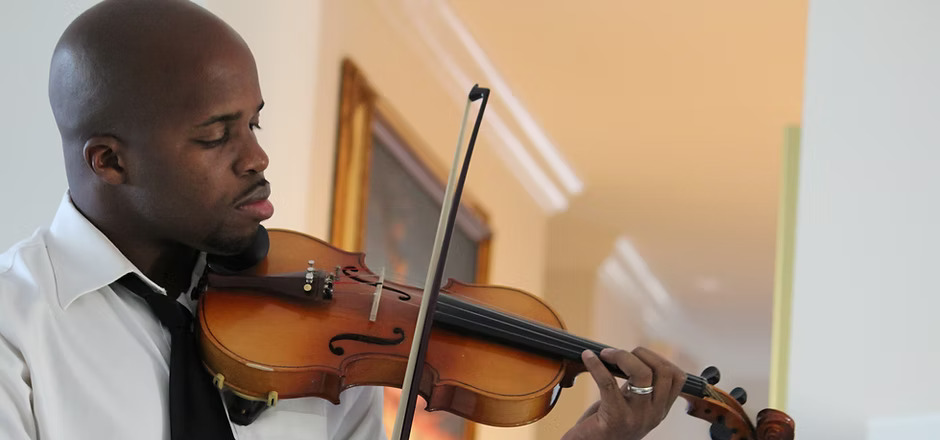
PERMISSION GRANTED: Gordon’s philosophy is to teach student’s that they already have what they need to create. All photos courtesy of Adrian Gordon.
Gordon’s path to this point was anything but linear. He only began composing around age twenty after feeling limited as a musician, discovering in the process a new sense of freedom and identity. “I didn’t start out planning to be a composer or teacher,” he says. “Composing became a way for me to rediscover my voice and connect more deeply with others.”
That sense of connection continues to guide him—whether he’s mentoring young musicians, leading a clinic, or hearing a new piece take shape for the first time. “Music is not just about notes or performance,” he says. “It’s about empathy, expression, and shared humanity. Every classroom and every ensemble is another chance to remind people that their voice matters.”
As A Touch of Humanity prepares to take the stage in Webster, that message will echo through every phrase—an invitation for performers and audiences alike to slow down, listen closely, and rediscover what it means to truly connect.