
Principal-ed Players
December 2005
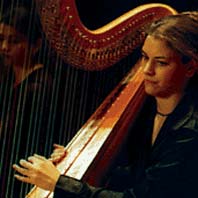 Many Eastman students dream of being first-chair players in a prominent orchestra. This year, the dream came true for quite a few, as several American orchestras — and in one case, an orchestra very far from America — hired recent Eastman graduates for first chair positions. They include:
- Erich Heckscher (BM ’94): principal bassoon with the Britt Festival Orchestra and the Houston Grand Opera Orchestra
- Randall Montgomery (BM ’95): principal tuba with the Milwaukee Symphony Orchestra
- Jennifer Rhodes (BM ’96): principal bassoon with the Memphis Symphony Orchestra
- Lori Wike (BM ’99): principal bassoon with the Utah Symphony
- Katie Buckley (BM ’02, MM ’04): principal harp with the Iceland Symphony Orchestra
- Peter Zlotnick (BM ’03): principal timpani with the Greensboro (NC) Symphony
Eastman Legends on CD
November 2005
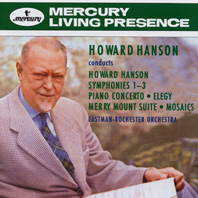 This fall’s CD releases include several that feature names (and music) familiar to Eastman alums. Howard Hanson, of course, led the School from 1924-1964 and established its national profile, while maintaining his reputation as one of America’s prominent composers. He recorded many of his works at Eastman, and many of these Mercury “Living Presence” recordings from the 1950s and 1960s are collected on a new 3-CD set (Mercury 475-6867): Hanson’s first three symphonies, the Merry Mount Suite, Lament for Beowulf, and several more pieces.
Hanson’s most popular work, his “Romantic” Symphony (1930), has a sumptuous new recording on Telarc 80649, by Erich Kunzel and the Cincinnati Pops Orchestra. Of special interest is the first recording of Hanson’=’s attractive Bold Island Suite, written in 1961 in homage to the island off the coast of Maine where Hanson spent his summer vacations.
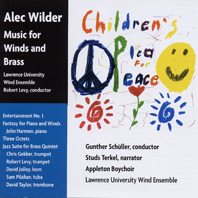
Versatile classical/jazz composer Alec Wilder (1907-1980), who studied at Eastman in the 1930s, was not a formal alumnus, but definitely qualifies as an Eastman legend. Several rarely-heard works are on a selection of Wilder’s music for winds and brass (Albany TROY 763): Children’s Plea for Peace, first performed by the Eastman Children’s Chorus in 1968; Entertainment No. 1, premiered by the Eastman Wind Ensemble and Fred Fennell in 1960; and a Fantasy for Piano and Wind Ensemble, written in 1974 for Marian McPartland. Among the performers on this CD is trumpeter Chris Gekker (BM ’76), who also wrote the booklet notes.
Disturbing Images, Exciting Sounds
October 2005
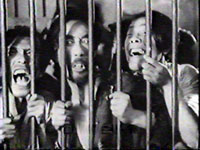 For more than 30 years, Nexus, whose founding members include Bill Cahn (BM ’68) and Rob Becker (BM ’69, MM ’71), has been one of the world’s leading percussion ensembles – and also has a history of creating and performing movie soundtracks, starting with the 1975 Oscar-winning documentary The Man Who Skied Down Everest.
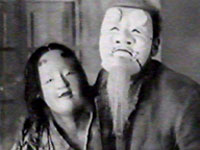
One of Nexus’ most unusual film projects is the Japanese silent film A Page of Madness, by director Teinosuke Kinugasa. Produced in 1926, it was long thought to be lost, and rediscovered in 1971. In it, a retired sailor hires on as a janitor at an insane asylum to free his wife, who has been imprisoned there after attempting to kill herself and her baby. Acted by an avant-garde theater troupe, the hour-long drama employs distorted, stylized images, flashbacks, and quick cuts, showing the world as it is seen by the insane.
All that the rediscovered film needed was a live musical score that enhanced the mystery and rhythm of the film’s bizarre images, and that’s where Bill Cahn came in. In fact, Kinugasa originally intended a percussion accompaniment for A Page of Madness; Bill’s score, performed by Nexus on percussion instruments from around the world, has been praised as a perfect parallel to the film’s unique vision.
Nexus gave the European premiere of A Page of Madness with Cahn’s music this summer at Germany’s Schleswig-Holstein Music Festival, to great acclaim. In a review headlined “Ecstatic Sound Experience,” the Hamburg Morning News praised “an impressive stock of sounds and noises…the music developed an undertow nobody could escape,” and summed up: “Never before has the tranquil balcony at Metropolis Cinema trembled with such relish.”
In Friendship
September 2005
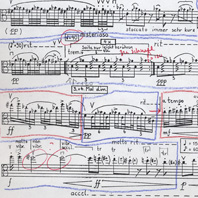
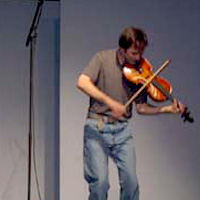 Paul Miller is currently working on a PhD in theory and a Master of Music degree in viola. His musical interests converged last month, when he premiered a viola version of In Freundschaft (In Friendship) by Karlheinz Stockhausen (1928- ). The German composer is the subject of Paul’s PhD dissertation, and he has attended the summer school devoted to Stockhausen’s music in Kürten, Germany, for several years.
This piece was originally written in 1978 for clarinet, but Stockhausen has approved many different versions of it – for bassoon, cello, saxophone and more – each signifying friendship with a different musician. The composer sent an unperformed viola version of In Freundschaft to Paul last year; he played it in Kürten in August before an audience of 200 people, including Stockhausen himself.
In this 15-minute piece, the 7 sections contrast the high and low registers of the instrument. To distinguish the different musical lines, the player must move the instrument to different heights, often very rapidly. At the end, the musical lines converge, as the performer comes to rest.
“There were no major errors and altogether it went very well!” says Paul of his August performance on his website (www.theoryofpaul.net). “Stockhausen seemed quite happy afterwards too …but I am sure the North American premiere will go better.”
That North American premiere will be at Eastman in the spring of 2006, in Paul’s MM degree recital (he is a student of John Graham). This won’t be the first time In Freundschaft will be heard in Kilbourn Hall: the first performance of the cello version was given in 1981 by Warren Stewart (BM ’81).
Keeping the Faith
August 2005
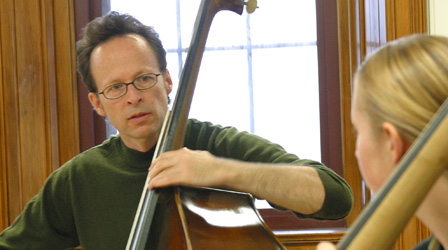 Professor of Double Bass James VanDemark demonstrated his versatility last spring in a concert at the St. Lawrence Center in Toronto. Not only did he perform in the most famous double bass piece of all, Schubert’s “Trout” Quintet, he also played in the Canadian premiere of Circle of Faith, a piece for string quintet joined by a Native narrator and a Native drum group. Van Demark commissioned and developed this work in 1992 with the late composer and Eastman alumnus Alton Clingan (BM ’93).
VanDemark has commissioned pieces from such notable composers as Gian Carlo Menotti and Joseph Schwantner, but Circle of Faith is the most unusual and moving work he has helped create. It is a setting of Chief Seattle’s melancholy 1854 speech predicting the future of First Nations peoples, and the score incorporates Native music and drumming. Since its 1992 premiere, Circle of Faith has been performed throughout the United States by indigenous drum group and narrators, and also recorded.
In Toronto, VanDemark was joined by the Gryphon Trio, violinist Scott St. John, the Whitefish Juniors Native drum group, and Native actor Gary Farmer, who appeared on The West Wing and in the movie Dead Man with Johnny Depp. The Toronto Star called Circle of Faith “one of the most emotional performances to be witnessed on a Toronto musical stage this season.”
At Eastman since 1976, VanDemark is not only one of the music world’s most famous bassists and bass teachers – he has made a mark in other areas of the arts as well. VanDemark also performed widely this year, including gigs at Eastman and at Louisiana State University, in Montreal and at the Round Top Festival in Texas. He is also a founder of Square Pegs film and TV production company, and was recently named Executive Producer of the upcoming film Constantinople.
For information on the Circle of Faith CD, visit www.dnote.com.
Broadway, Molto Vivace
August 2005
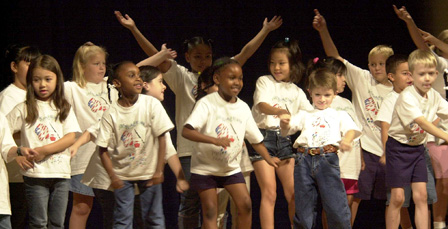 This summer, children at Japan’s Yokota Air Base got to display their abilities at everything from tap dancing to flute playing, with help from an Eastman alumna.
The Vivace Performing Arts Program, now in its fifth summer, teaches Yokota base children about drama, dance, and music. It got under way June 20 for children aged 6-8, who gathered for five afternoon sessions at Yokota West Elementary School in the program “Rising Stars” segment. Students aged 9-18 got their chance in the program’s “Shining Stars,” with a final class performance of Broadway song-and-dance numbers, Latin music, and songs of Paul Simon.
“The activities are designed to break children out of their shells, build confidence, and teach them about working as a team,” said Betsy Fitzgerald (BM ’99 – harp), Vivace’s executive director and one of the four Vivace program instructors, in a recent Stars and Stripes interview. “We do singing, dancing, and acting exercises. It’s a great way for us to keep these kids involved so later on they’ll be able to sustain the arts in America.”
Fitzgerald moved to Yokota in 2000, and started Vivace soon after encountering what she considered a bleak arts and drama picture for young people at the air base. “As an advocate, I couldn’t imagine not having these opportunities for kids,” she says.
A Singer For the World
July 2005
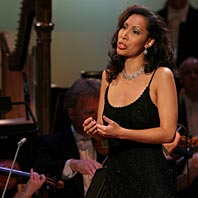 On June 19, 2005, soprano Nicole Cabell (BM ’01) won the BBC Cardiff Singer of the World Competition, one of the music world’s highest-profile, and most lucrative, competitions. The first prize consists of a cash award of 10,000 pounds (over $18,000), plus engagements with the BBC National Orchestra of Wales and the Welsh National Opera. Not to mention worldwide attention!
A native of Panorama City, California, Nicole studied at Eastman with John Maloy, and is in her third year in Chicago’s Lyric Opera Center for American Artists, where she has performed in Le Nozze di Figaro, The Pirates of Penzance, Thais, and The Cunning Little Vixen. In the final round of the competition, she sang arias by Tippett, Mozart, and Berlioz, conducted by Carlo Rizzi.
The Singer of the World Competition was first held in 1983 to celebrate the opening of St. David’s Hall in Cardiff, Wales, and is now generally regarded as the most important operatic competition in the world. Past winners include such world-famous singers as soprano Karita Mattila and baritones Dmitri Hvorostovsky and Bryn Terfel.
For video clips of the performers in the Singer of the World Competition, and many enthusiastic comments from fans about Nicole and other contestants, visit the Cardiff Singer of the World website: www.bbc.co.uk/cardiffsinger.
As Best As They Can!
June 2005
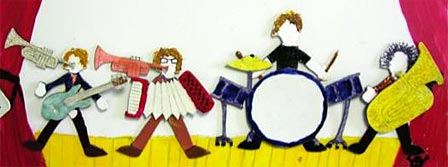 If the future of indie rock is not pronounced “SNMNMNM,” it won’t be for lack of trying. Three-fourths of this group, formed at Eastman in 1997, has a Eastman pedigree: it consists of Seamus Kenney BM ’98 (vocals, accordion, trombone), his brother Matthew (electric guitar, vocals, trumpet), Mark Dauman ’99 (amplified tuba, vocals), and Matt Vooris ’98 (drums, percussion, vocals). SNMNMNM’s songs – self-described as “libertine liberalism” – have been compared to the Beach Boys, Ben Folds Five, and They Might Be Giants, so the word “quirky” comes up a lot in press coverage of them – but so does mention of their use of an amplified tuba in place of the customary bass guitar player.
SNMNMNM formed at Eastman in 1997, and has stayed together through relocations to Los Angeles and Chapel Hill, North Carolina, as well as three albums. The most recent, As Best As We Can!, was released on February 1 and reached No. 65 on the CMJ (college radio) charts. In addition, SNMNMNM is giving many people across the country the chance to hear their music live: the group has been touring widely in 2005 to build up its fan base and in support of As Best As We Can! Along the way, SNMNMNM (and their tuba) recently picked up some potent favorable mention in Entertainment Weekly and in the New York Times.
And the name? Matt Vooris revealed the meaning in an Albuquerque Tribune interview earlier this year: S and M are the first letters of the guys’ first names; the Ns are as in rock ‘N’ roll. So now you know.
SNMNMNM is touring the south during the month of June. For more information on the group, its music, and each member, visit www.snmnmnm.com.
In the Kitchen with Mozart
May 2005
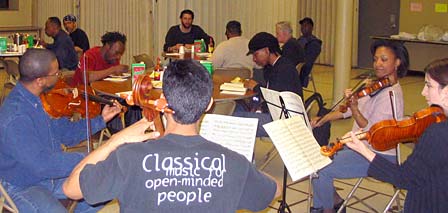 Violinist Kelly Hall-Tompkins (BM ’93) has performed in the Aurélia Trio, Orpheus Chamber Orchestra, and New York Philharmonic, and as a soloist with the Dallas Symphony. Her most recent project had an unusual, and unusually appreciative, audience. Earlier this year, Kelly founded “Music Kitchen” at her home church of Holy Trinity Lutheran Church near Lincoln Center in New York City. “My mission,” she says, “is to share the inspirational, therapeutic, evocative, and uplifting power of music with New York City’s disenfranchised homeless shelter population.”
While preparing for a series of solo concerts, Kelly explains, “my husband Joe encouraged me to play through my repertoire for the men at the shelter, rather than my usual list of colleagues and friends. Some had never heard classical music before and some were knowledgeable about it, but all seemed interested and moved by the music. It occurred to me to pursue this idea of sharing music with them regularly, with a full complement of collaborating professional musicians.”
Her first Music Kitchen performance, on March 22, at Holy Trinity (which included cellist Jeff Zeigler BM ’95), consisted of music by Brahms and Mozart. Kelly offered two more Music Kitchen performances in April (including a jazz quartet), and hopes to continue next year. For more information contact Kelly at 917.532.5547.
Prolific Mr. Puts
April 2005
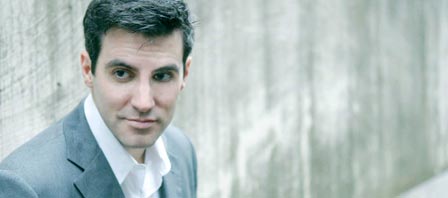 For several years, Kevin Puts (BM ’94, DMA ’99) received reviews describing him as a “promising composer” and “a young composer to watch.” But with a flurry of recent performances and prestigious commissions, Puts can now be described as one of America’s most important composers, period (he still is young, though). Currently assistant professor of composition at the University of Texas at Austin, Puts is remarkably prolific; his catalogue already includes three symphonies, several concertos, and many chamber works. His string quartet Dark Vigil, inspired by the recent rash of American high school shootings, was recently recorded by Eastman’s Ying Quartet, on their CD LifeMusic (Quartz Music).
And there is lots more to come: Puts started out the 2004-2005 season with the premiere of River’s Rush by Leonard Slatkin and the St. Louis Symphony, and next year will see the first performances of three major works: a percussion concerto for Evelyn Glennie, to be performed by her with the Pacific Symphony and the Utah Symphony; a Sinfonia Concertante for five instruments and orchestra, for the Minnesota Orchestra; and a cello concerto for Yo-Yo Ma in honor of David Zinman’s 70 th birthday, to be premiered at the Aspen Music Festival in June 2006.
For more information about Kevin Puts, and to hear excerpts from his music (including Dark Vigil), visit www.kevinputs.com.
Benefiting from Beddage
March 2005
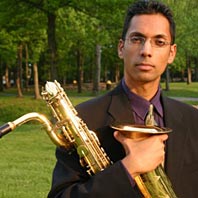 When jazz saxophonist Shirantha Beddage returned to his hometown of North Bay, Ontario, last month, he did much more than pay a visit. On February 26, Shirantha and the other Eastman graduate students in his quartet — pianist Michael Stryker, drummer Devin Kelly, and bassist Ryan Kotler — performed in a benefit concert in support of the Sri Lanka Lions Club home-building projects in tsunami-affected areas. Besides raising the roof, the concert raised $7000 from North Bay residents, enough money to pay for three new homes for families in Sri Lanka.
This is not the first tsunami relief project for Shirantha, whose sax playing has been featured on Canadian and American jazz radio, and who appears on several recent CDs. He played a fundraiser in Rochester in January, and takes part in a “Hearts for the Arts” tsunami benefit at New York’s Third Street Music School Settlement on March 13. You can read more about Shirantha’s upcoming gigs at www.shiranthabeddage.com.
Bringing American Tunes to Tunisia
January 2005
 DMA candidate Thomas Rosenkranz is already a pianist with a busy and varied schedule, but his recent trip to Tunisia may have been his most unusual gig yet. Sponsored by the U. S. State Department, Tom spent three weeks in the North African country, performing and teaching in the country’s main music schools – and was invited to stay on for a fourth by Riyadh Fehri, a virtuoso on the oud (a lute-like Arab instrument) and director of the Sidi Bou Siad Conservatory. Tom’s recitals introduced many Tunisians to piano music by Gershwin, Ives, John Adams, and other American composers, but he also tried his hand at performing traditional Tunisian music. Along with other Arab and Western musicians, Tom and Riyadh formed a group exploring the fusion of Arab, Western, and flamenco musical instruments and styles that will debut at the Theatre of Tunis on February 18.
Despite a full schedule, Tom did have some free time to explore Tunisia, including the southern desert, where he took a camel ride. He says the area looks much as it must have in biblical times. Tom found the Tunisian people kind and friendly, and he was pleased “to show Americans in a positive light in Arab countries.”
Tom writes about his Tunisian experience on his website, www.thomasrosenkranz.com, and you’ll be able to read more about his musical adventures in the June 2005 issue of Eastman Notes.