
This article first appeared in the Spring 2026 issue of NOTES, Eastman’s alumni magazine.
…
At the end of the 2025–2026 academic year, Eastman will say goodbye to more than 125 years of collective knowledge, experience, mentorship, and musicianship with the retirement of four faculty members: Professor of Piano and Director of Piano Pedagogy Studies Tony Caramia, Professor of Bassoon George Sakakeeny, Professor of Conducting & Ensembles and Director of Choral Activities William Weinert, and Professor of Double Bass James VanDemark.
Their areas of expertise span the musical map—keyboard pedagogy, orchestral woodwinds, choral artistry, and the low-string world of bass performance—but each of them speaks about Eastman with the same mixture of affection, respect, and gratitude. Taken together, their reflections form a portrait of a school that shaped them as much as they shaped it.
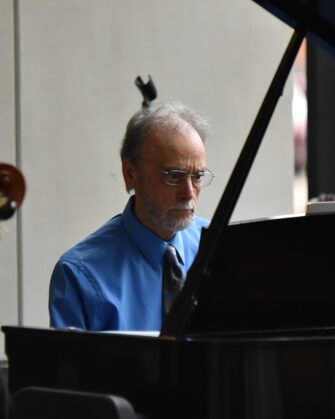
HOMETOWN HERO: Tony Caramia plays during a Context Conference lunchtime concert in Sproull Atrium in 2023. Photo Credit: Lauren Sageer.
Tony Caramia is the only Rochester native of the group, and he laughs when he remembers how people assumed his path must have started on Gibbs Street. “When people found out I was from Rochester, they’d ask me if I went to Eastman as a student,” he says. “I’d have to say, ‘No, just as a patron.’” In fact, even as he attended concerts in Kodak Hall, teaching here never crossed his mind. So, when the position opened in 1990, the idea of joining the faculty felt almost surreal. “It was like being hired by the Buffalo Bills,” he says. “I knew I’d better be really good.”
His early memories are filled with flashes of wonder—and a little disbelief. Yet even back then, he felt the warmth of colleagues who recognized the unique niche he brought to the school: a blend of classical technique, jazz fluency (seen in his affiliate faculty role in the Jazz Studies and Contemporary Media department), and a pedagogy grounded in curiosity. Over three and a half decades, Caramia became known for presenting thematic, often playful recitals, from “Evening of Études” to his exploration of obscure composers with irresistible backstories. “No one ever said, ‘You played well, but could you do some Chopin?’” he says. “Instead, they encouraged what floated my boat.”
“Telling is not teaching,” Caramia often says, preferring instead to demonstrate, ask questions, and lead by example—an approach shaped by decades in the studio and reinforced by his belief that the most lasting learning happens when students are guided to discover answers for themselves.
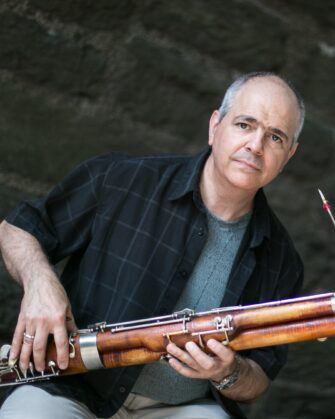
EASTMAN GRADUATE: George Sakakeeny took a sabbatical during the 2025-2026 academic year to play with the Fort Worth Symphony Orchestra.
For George Sakakeeny ’78E, returning to Eastman as a faculty member in 2016, almost four decades after he graduated, was like walking into a familiar dream. The hallways, practice rooms, and “nooks and crannies” he’d loved as a student were still there, even some of the professors. “My first and most vivid memory was performing in the opening convocation in Kilbourn Hall with Barry Snyder,” he says. “Professor Snyder was a young faculty member when I was a student, but 2016–17 would be his final year on the faculty. I felt like I was experiencing a sustained déjà vu.”
Sakakeeny has witnessed an evolving landscape in musical education over the years, and yet, the fundamental artistry required of a bassoonist is essentially unchanged since the early 20th century. The instrument still demands the same blend of craft, curiosity, and sheer patience.
When challenged to recount a highlight from his career, he resists. “There are remarkable moments being created almost daily,” he says instead. But if pressed, he mentions a few standouts: premiering a new concerto written for him in Vienna’s Musikverein, recording Villa-Lobos with Alex Klein, performing Beethoven’s Ninth under Seiji Ozawa. “See what I mean?” he adds.
More than the stages and the tours, though, Sakakeeny treasures the students themselves. “Working with students keeps you thinking young,” he says. “The bonds that are created between a teacher and their students over four years can last a lifetime. My best friends are almost all former students.”
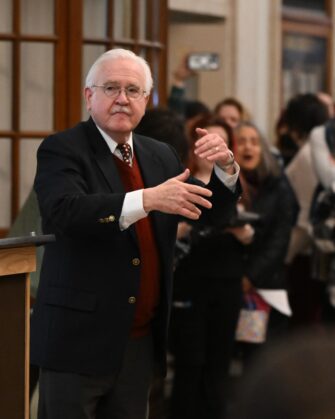
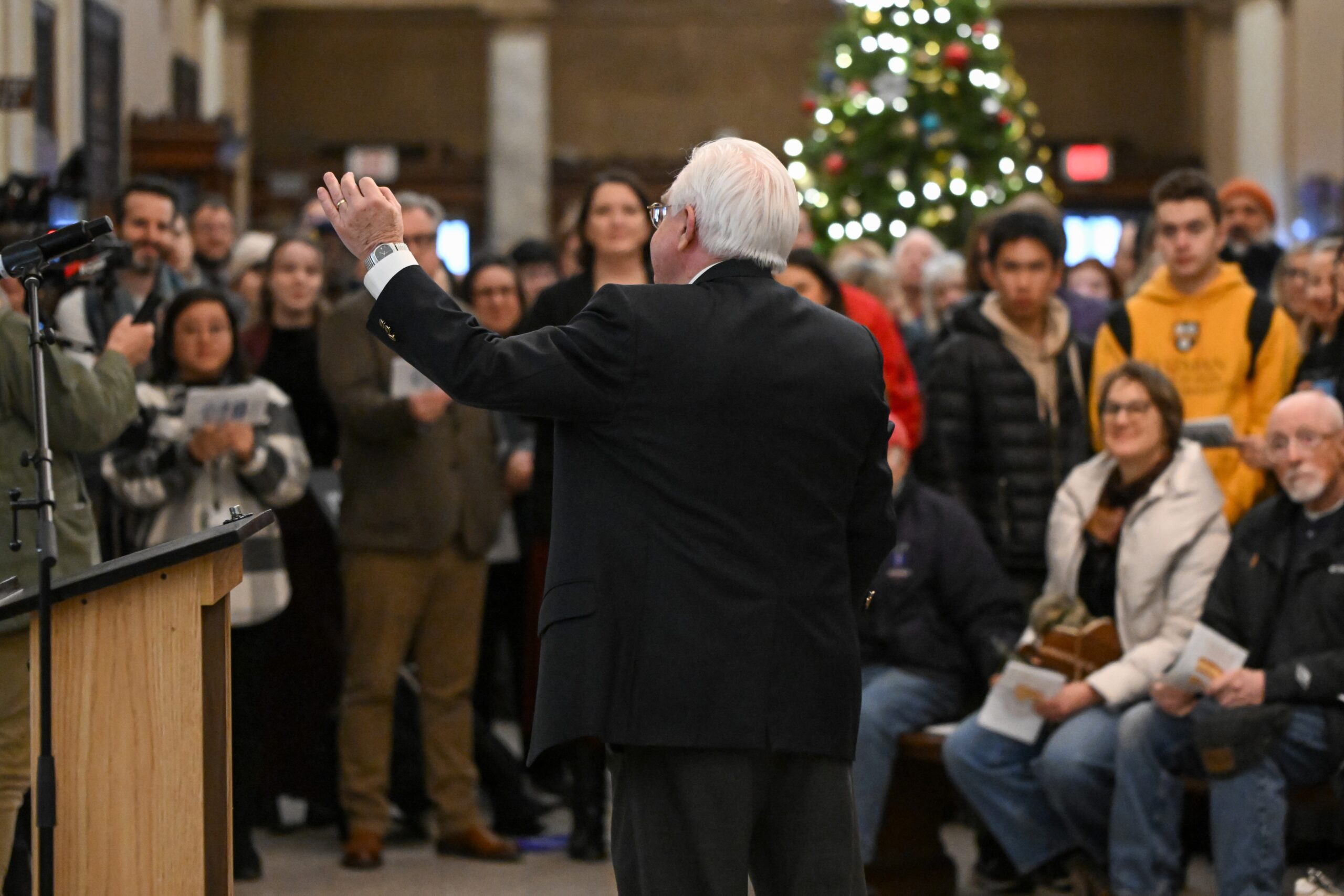
CHORAL MEMORIES: William Weinert conducts “Dona Nobis Pacem” in Lowry Hall during his final Holiday Sing in 2025. Photo Credit: Kerry Lubman.
William Weinert’s memories also begin with people—specifically the people who helped usher him into Eastman’s choral tradition when he first arrived. “I remember being struck by the incredible support from the legendary Associate Dean Jon Engberg, as well as many faculty and students,” he says. “The abundance of wonderful talent was stunning.”
For three decades, Weinert has shaped Eastman’s choral sound: its warmth, its clarity, its historic depth. And he’s watched the choral field change alongside it. “More and more students show such a strong love for choral music,” he said. “The opportunities for professional choral singing in America have grown tremendously.”
What he’ll miss most mirrors what he loves: the students’ curiosity and the way they cheer one another on with full-throated joy. “I love hearing their clear progress from year to year as they study with our wonderful voice faculty,” he says. “I also love hearing their incredible, and vocal, support for each other at recitals, masterclasses, and operas.”
Choral music is that rare gift that brings singers into contact with “absolutely the greatest masterpieces created in any artform,” Weinert says, listing off the Bach Passions and B-minor Mass, the Beethoven Missa solemnis, the Brahms Requiem, Stravinsky’s Symphony of Psalms, Handel’s Messiah, and many other works. “At the same time, it offers normal humans without expensive instruments or decades of training, or even outstanding natural vocal talent, to live inside these works by simply using their breath,” he says. As conductor, he has set the stage for so many of those rewarding experiences. “What a privilege,” he concludes.
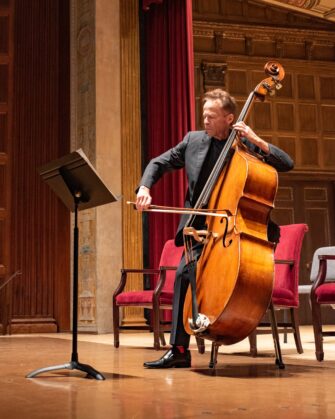
UNMISTAKABLE LEGACY: James VanDemark gives a solo performance in Kilbourn Hall during convocation in 2021.
James VanDemark’s legacy at Eastman is unmistakable—when he joined the Eastman faculty at the age of 23, he became the youngest person ever to hold such a position at a major music school. For the next 50 years he elevated the double bass as both a solo and ensemble instrument, championed student artistry, and shaped generations of musicians who now hold orchestral, chamber, and teaching positions around the world.
“Arriving as a newly minted assistant professor in September 1976 was an instant immersion into a congenial storm of energy, creativity, purpose, and imagination,” he recalls. But there were some hilarious misunderstandings along the way too, as older colleagues mistook him for a student while his own students were often his peers. But VanDemark remembers a school unified by ambition. “We cheerfully followed Director Robert Freeman as he led us to shape the school into one of the most dynamic, innovative, and esteemed institutions in America.”
Growing up in a family of pianists, VanDemark carved his own route when he became “smitten” with the double bass at a high school orchestra concert. “I was soon practicing three to four hours a day, and 18 months later made my solo debut with the Minnesota Orchestra at age 15,” he says. He has since enjoyed performances with many of the world’s greatest artists including Zubin Mehta, Pinchas Zukerman, Yehudi Menuhin, and Andre Watts.
Across their reflections, a common thread emerges: Eastman’s magic lies in its people. Caramia captures it beautifully when he recalls walking down his corridor and hearing world-class colleagues and gifted young students. “It’s a pretty good school right here,” he says with a grin. Sakakeeny calls the faculty “the unsung heroes of Eastman, the musical elites.” And Weinert echoes both sentiments: “The wealth of talent and commitment to excellence among students and faculty here continues to be unmatched.” For VanDemark, simply walking the Cominsky Promenade, where so many of his friends and heroes adorn the walls, is enough. “How lucky have I been,” he says.
As we prepare to celebrate the careers of these four remarkable musicians, their words offer not just memories, but a reminder of why Eastman has mattered to so many for more than a century. Their impact—felt in lessons, rehearsals, performances, and all the moments in between—will resound long after they take their final bows as faculty members.