
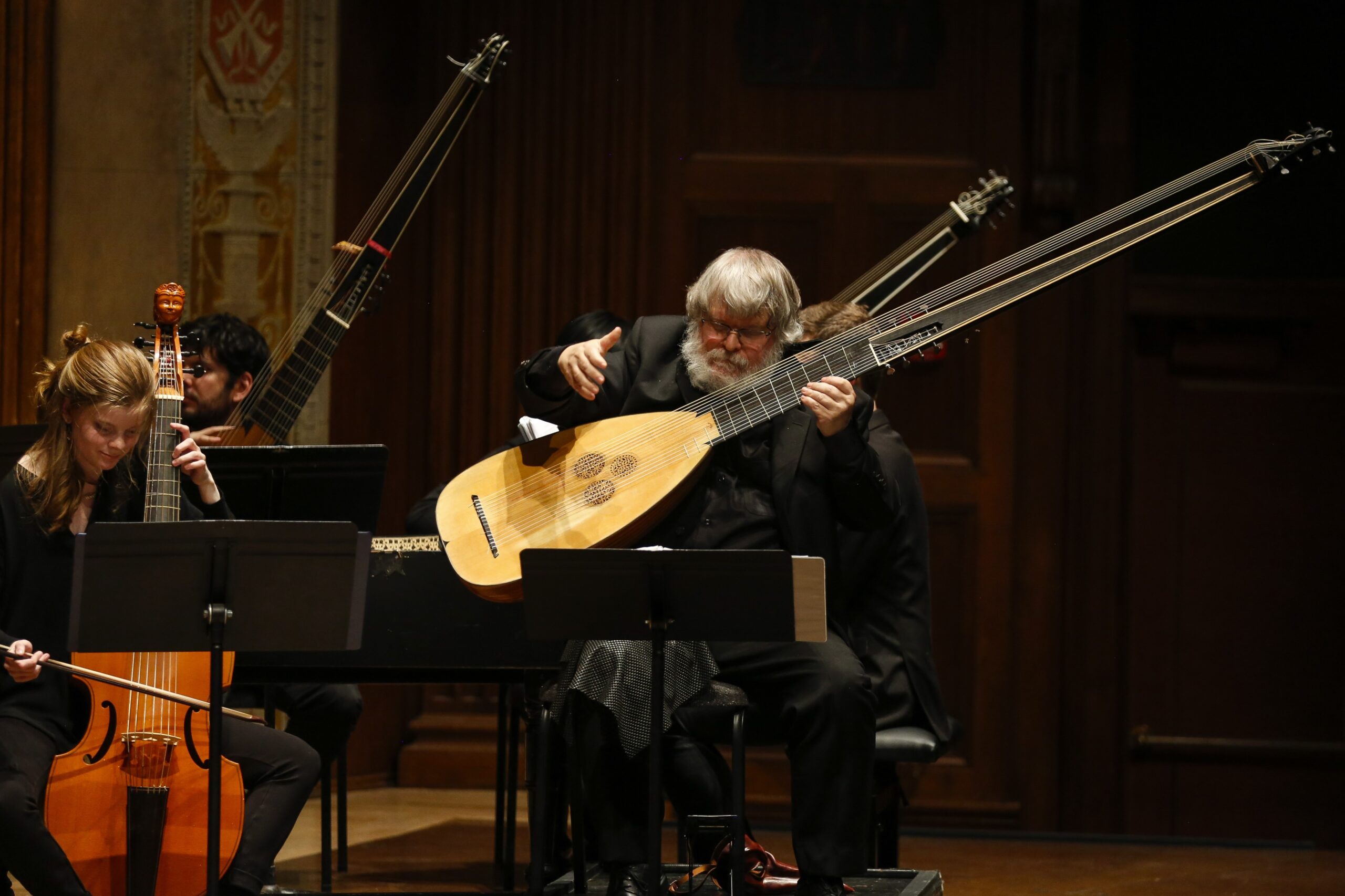
By Professor of Lute and Professor of Conducting and Ensembles Paul O’Dette
As the Collegium Musicum prepares for its April 28 concert, Paul O’Dette, who co-directs the ensemble with Assistant Professor of Conducting and Ensembles Christel Thielmann, offers an overview of the ensemble’s origins and its enduring role in the education of Eastman students.
***
In fall 1955, Director of the Eastman School of Music Howard Hanson wrote to a colleague about his long-held vision for a music literature course centered on live performance rather than recorded listening. He proposed dedicating a weekly evening to performances by Eastman ensembles, aligning repertoire with course study to enrich students’ experience.
As Eastman historian Vince Lenti ’60E, ’62E (MA) explains in his book Serving a Great and Noble Art (2009), Hanson appointed David Fetler to organize weekly Monday evening performances tied to music literature courses, followed by a social hour. While the concept drew enthusiasm, the demands of preparing regular programs—especially with limited training in historical performance—led to the 1960 creation of a formal Collegium Musicum ensemble to support the effort.
And thus, the Eastman Collegium Musicum was founded as a way for students to hear and experience firsthand the Medieval and Renaissance music they were studying in music history classes, which was not commonly available on recordings or in concert performances. The idea was to “bring music history to life.” In those early days, however, almost no one knew how to play historical instruments, and there was scant knowledge about how to perform the music. During the 60s and early 70s, the ensemble consisted mostly of musicology students, along with some local amateurs who were learning to play recorder, krummhorn, viola da gamba, etc. When Robert Freeman arrived as director of Eastman in 1973, his vision for the school was to educate well-informed musicians who could not only play their instruments at the highest levels but who were also highly knowledgeable about their art.
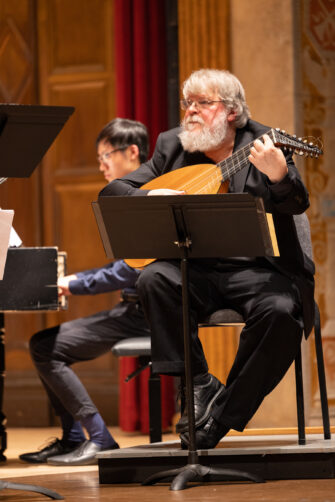
PROFESOR OF LUTE: Paul O’Dette joined the Eastman faculty in 1976. Photo credit: Kurt Brownell.
He sought to turn the Collegium into a performing ensemble and looked for a young, dynamic performer with a strong performance practice background who could combine performance with rigorous scholarship. I was hired in 1976 to design an early music program to compete with the great conservatories in Europe. At that time, I was studying at the Schola Cantorum Basiliensis, a comprehensive early music conservatory in Basel, Switzerland, specializing in Medieval, Renaissance, and Baroque music. I was a lute major, and my early professional experiences included performing Medieval and Renaissance music with Thomas Binkley and his Studio der Frühen Musik, as well as playing in all three Monteverdi operas with Nikolaus Harnoncourt at the Zürich Opera.
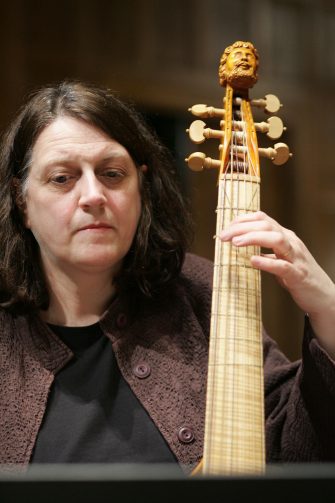
CLASSMATES: Christel Thielmann, recipient of Eastman’s prestigious Eisenhart Award for Excellence of Teaching, and O’Dette met as classmates in Switzerland.
Soon after I arrived at Eastman, we had instrumentalists of all kinds interested in joining the Collegium. This revealed a pressing need for technical expertise on early bowed strings as well as wind instruments, but fortunately, I knew the perfect person to teach that for us. Christel Thielmann and I had been classmates in Basel, and as someone who played recorder, flute, and viola da gamba, she was ideally suited to teach both types of instruments. Being both a wind and string player with deep experience on historical string and wind instruments, I knew that Thielmann could contribute significantly to raising the standards of the Collegium.
As interest spread and the standards steadily rose, many of the top students at Eastman got involved. They often commented that learning to play early instruments helped not only their technique on their modern instruments (even solving players’ injuries!) but also raised their level of musicianship and artistry. Involvement with historical performance practices gives them the opportunity to look at music-making with fresh eyes and ears.
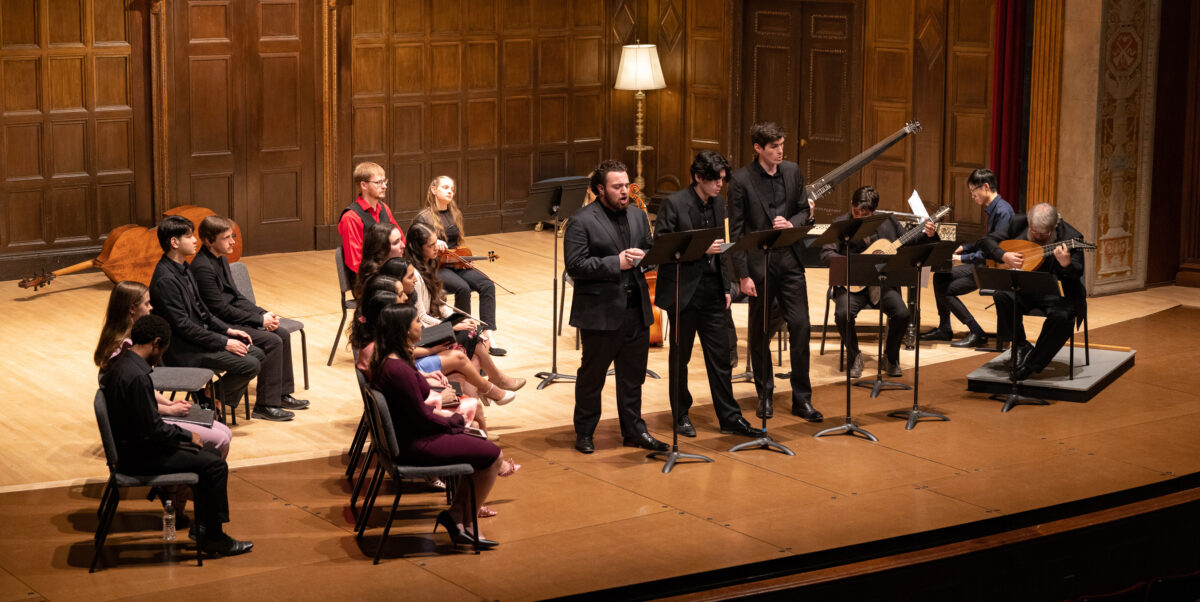
EASTMAN COLLEGIUM: The ensemble has been divided into two groups: a vocal ensemble and a Baroque orchestra. Photo credit: Kurt Brownell.
The term “Collegium Musicum” was first coined in 16th-century Germany, referring to an ensemble of mixed instruments and voices often made up of students, proficient amateurs, and professionals. The most famous Collegium Musicum was that founded by Georg Philipp Telemann in 1702 and later directed by Johann Sebastian Bach, giving regular concerts at the Café Zimmermann in Leipzig. Many of Bach’s most beloved secular works were written for that ensemble, including the Coffee Cantata. In 1909, the German musicologist Hugo Riemann formed an early music ensemble at the University of Leipzig, beginning a trend at German and American universities that led to the establishment of America’s first early music ensemble, the Yale Collegium Musicum, founded by Paul Hindemith in 1943.
While early Collegium Musicum efforts in America focused on Medieval and Renaissance music, growing interest in Baroque repertoire brought increased attention to historical instruments and performance practice. Advances in instrument setup and playing techniques, along with improved performer expertise, gradually dispelled early misconceptions that these instruments were primitive or inferior. Over time, makers and musicians demonstrated that early instruments could achieve a high level of artistry and were simply designed for different expressive purposes than their modern counterparts.
Over the past 40 years, graduates of the Eastman Collegium Musicum have contributed enormously to the worldwide revival of historically informed performance, playing major roles in internationally renowned early music ensembles. Dozens of Eastman alumni—singers and instrumentalists—perform with leading Baroque orchestras and opera companies in Europe. For current students, fluency on historical instruments and performance practices opens many future employment opportunities with Baroque orchestras and ensembles throughout North America and Europe.
As the Eastman Collegium has grown, it has been divided into two groups: a vocal ensemble with basso continuo (harpsichord, organ, lute, guitar, etc.), and a Baroque orchestra. These forces frequently join to perform large-scale works, including Baroque operas by Monteverdi, Handel, Lully, Purcell, and Luigi Rossi, as well as oratorios, cantatas, and madrigals from most major Baroque composers. Due to the abundance of sopranos in the vocal ensemble, I have specialized in discovering and editing much of the music we perform from original sources, often resulting in the first performances of these works since the 17th or 18th century. The Collegium Baroque Orchestra regularly performs concerti grossi and orchestral suites by Handel, Bach, Telemann, Vivaldi, Corelli, Locatelli, Fasch, and others. The orchestra includes Baroque violins, violas, cellos, double bass, Baroque oboes, bassoon, recorder, trumpet, timpani, harpsichord, organ, theorbo, Baroque guitar, and lute, depending on the repertoire.
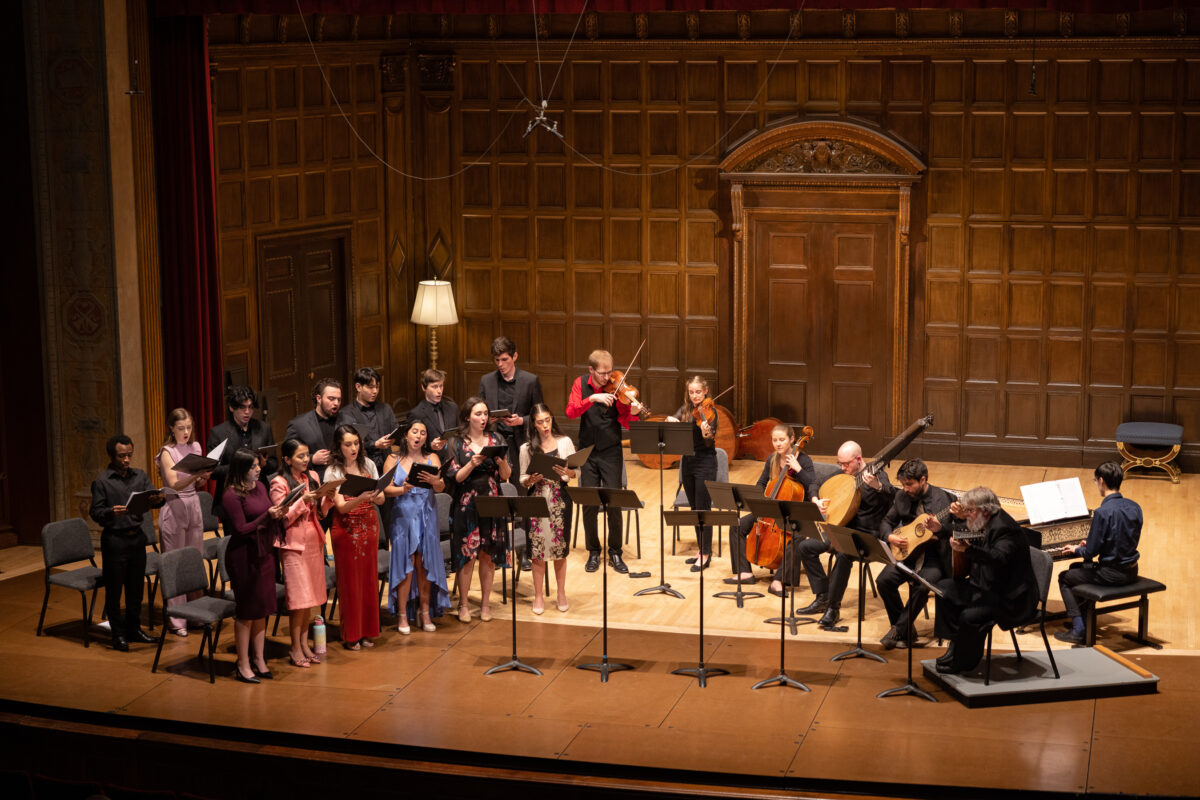
UPCOMING CONCERT: The Collegium will perform three Italian oratorios and music by Handel and Fasch. Photo credit: Kurt Brownell.
For the concert on April 28, the Collegium Vocal Ensemble will perform three 17th-century southern Italian oratorios: Cristoforo Caresana’s La Tarantella, Marco Marazzoli’s O mestissime Jesu, and Francesco Foggia’s Victoria Passionis Christi, while the Baroque Orchestra will present Handel’s Concerto Grosso No. 3 in E minor and Fasch’s Orchestral Suite in G minor for three oboes, strings, and basso continuo.
More than a reflection of its history, the Eastman Collegium Musicum remains a living, evolving part of the school’s artistic life—bringing past traditions into the present through performance, scholarship, and collaboration. As these musicians take the stage, they continue a legacy that is not only preserved, but reimagined with each new generation.
Collegium Musicum
Tuesday, April 28, 2026
7:30 p.m. | Kilbourn Hall
(This is a livestreamed 4K multi-cam concert)