
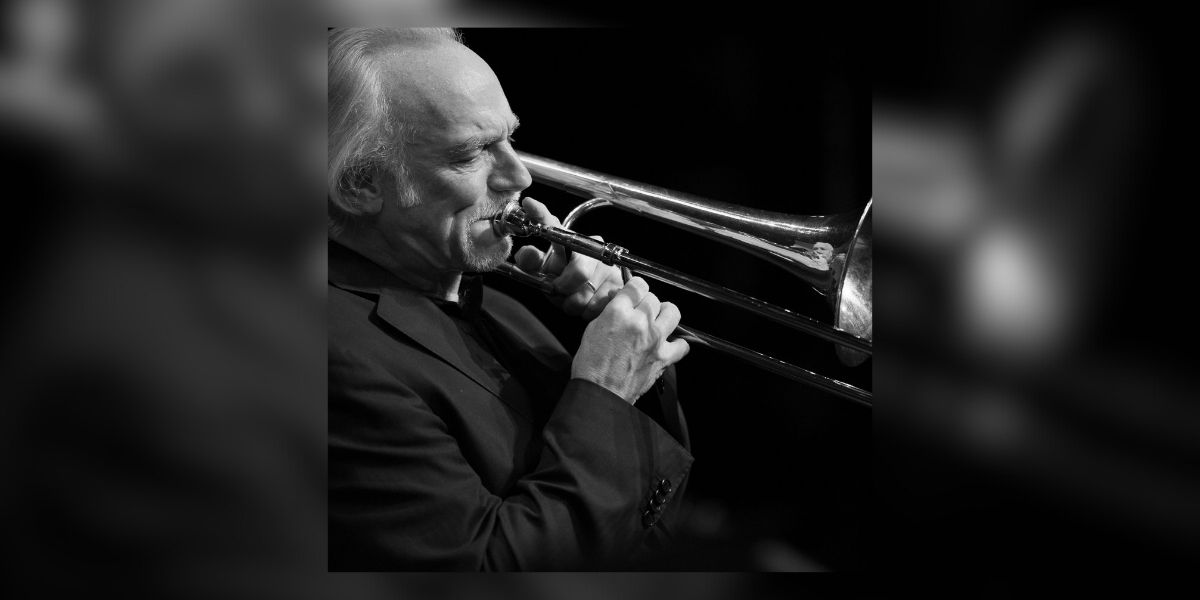
The last time composer, conductor, and trombonist Ed Neumeister came to Rochester, winter tried its best to stop him.
Flying in from Los Angeles more than 15 years ago, Neumeister was stranded in Chicago for two days as a snowstorm snarled travel across the Midwest. Eventually rerouted to Syracuse, he rented a car and drove the rest of the way through worsening weather, arriving at Eastman just in time to walk onstage. There was no rest. No rehearsals. Only instinct and experience.
This time, he’s hoping for clearer skies.
Neumeister returns to the Eastman School of Music on February 19, 2026, to conduct and perform with the Eastman Jazz Orchestra in Kodak Hall at Eastman Theatre. The concert marks a reunion with a school he describes affectionately as “tippy-top,” and a chance to share a body of work shaped by decades of playing, composing, teaching, and mindfulness.
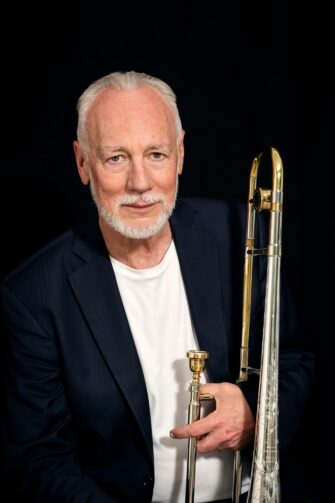
THROUGH STORMS AND ALL: Ed Neumeister has been making music for six decades. Photo credit: Katharina Gossow.
His attention to detail has been there since the beginning—even before he knew what a trombone was. Neumeister started music at age nine in a marching band in Oakland, CA, intent on playing trumpet like his father. But the band director had other plans. After inspecting a cracked front tooth, the director warned that a trumpet might damage a nerve and suggested trombone instead. Neumeister has never confirmed the medical logic behind the claim, but the practical one was clear: the band needed trombone players. “I think it was complete nonsense,” he says now, laughing. “But I stuck with the trombone.”
There were 12 trombonists in the band, and Neumeister started at the bottom of the section. Advancement came through formal challenges—musical duels, essentially—where players competed for chair placement. Within a few years, Neumeister had challenged his way to the top.
By age 12, he was playing first trombone. A year later, in 1966, he stepped to the front of the field at the newly opened Oakland Coliseum and performed J.J. Johnson’s solo from “Mack the Knife” during the halftime show of an Oakland Raiders game, playing for a crowd of more than 50,000. “I didn’t even know who J.J. Johnson was,” Neumeister recalls. “But I learned the solos. It was a great foundation, even if I didn’t fully understand it yet.”
That foundation launched a career that has moved freely between worlds: classical and jazz, performance and composition, stage and classroom. Neumeister’s formal training was classical, but his jazz education came largely from observation and immersion. He played in orchestras across California, including the San Francisco Symphony, as well as the opera and ballet, absorbing not just the music but the mechanics of leadership. “I always paid attention to the conductors,” he says. “The rehearsal technique, the orchestration. I didn’t really know why at the time, but I felt like it was important.”
During that same period, Neumeister found himself working with many notable names. At the Circle Star Theater near San Francisco, he backed up legends including Frank Sinatra, Ella Fitzgerald, and Sarah Vaughan. One night, after a Sinatra performance, Ol’ Blue Eyes himself thanked the band in his own way: a bottle of Johnnie Walker Black for each musician.
Out of the spotlight, Neumeister was equally immersed in experimental and commercial settings. By the time he left California, he might play classical repertoire one night, avant-garde jazz the next, and commercial gigs in between. In New York, writing began to play a more central role. While others relaxed during rehearsals, Neumeister studied scores, watched gestures, and filed away details. He had written horn parts for rock bands in high school, now it was arrangements for big bands in New York like the Mel Lewis Jazz Orchestra, and eventually original compositions that reflected both his classical grounding and his jazz instincts.
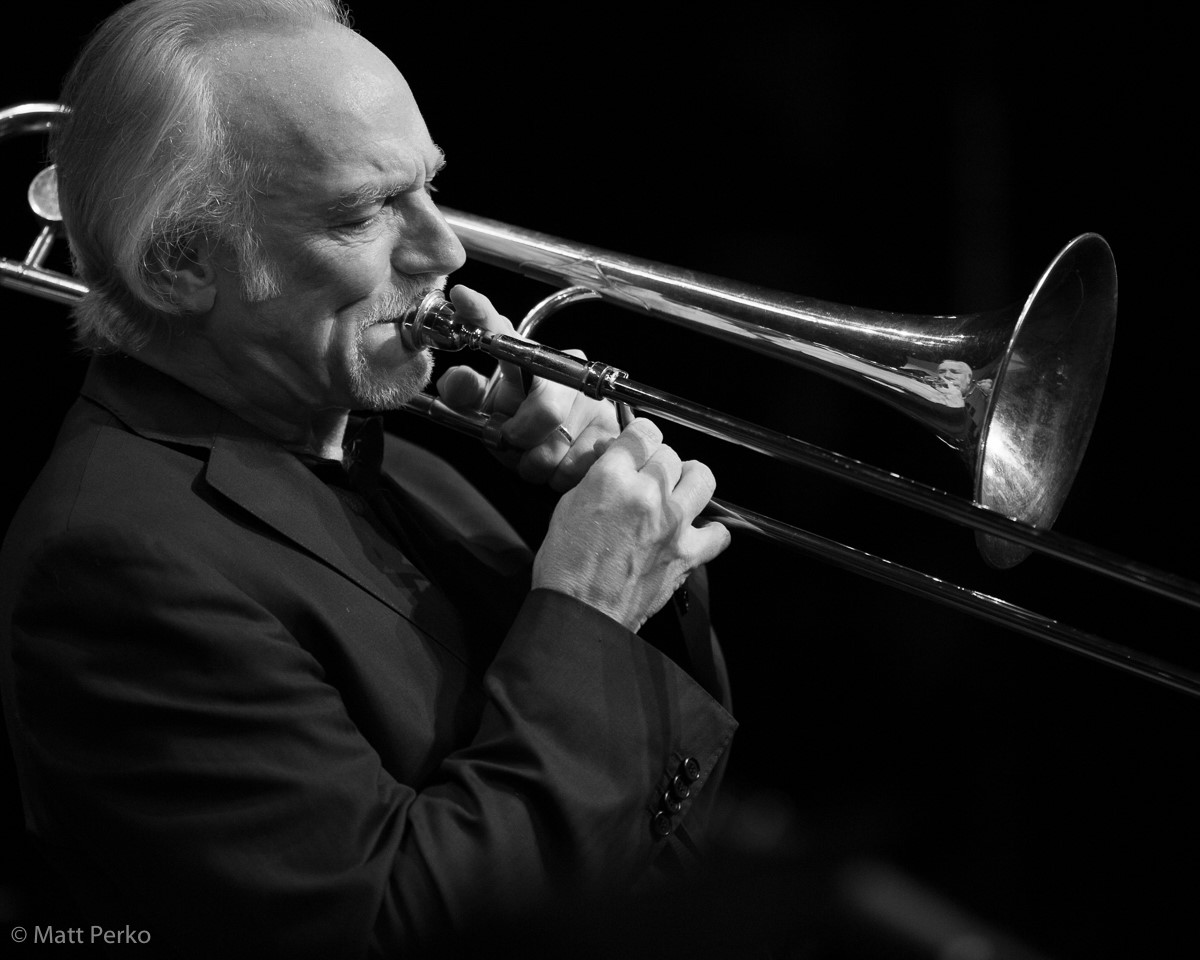
MINDFULL PRACTICE: Neumeister has built a career based on observation and immersion. Photo credit: Matt Perko.
Opportunities soon followed, especially in Europe, where he assembled his first solo tour by calling everyone he knew and announcing, confidently, that he would be there. Neumeister found himself moving from Helsinki to Amsterdam, Paris, Zurich, Vienna, and beyond. The tours became a proving ground not just for his music, but for his ability to lead.
Teaching experiences in Europe shaped how Neumeister writes for large ensembles, a philosophy that will be on display in Kodak Hall when he teams up with Eastman Jazz Orchestra director Christine Jensen. The February 19 program features mostly his original compositions, alongside “Sticks” by Jim McNeely—written specifically for Neumeister—and a reimagined arrangement of Billy Strayhorn’s 1939 standard “Take the ‘A’ Train.”
Neumeister consulted with Jensen about the orchestra’s strengths and limitations. Her response was reassuring. “Whatever you want, they got it,” she told him.
One distinctive feature of the program will be the use of two rhythm sections onstage, a practice Neumeister developed during his years teaching university jazz orchestras in Europe. Rather than rotating players in and out, he prefers to keep everyone engaged. “I never want anybody sitting around,” he says. “I want everybody involved all the time.”
During his visit, Neumeister will also lead a masterclass, which he approaches much like his music: loosely structured, responsive, and grounded in the moment. “I rarely plan,” he says. “I just show up and start riffing. I like watching people’s faces. When people are playing and I’m responding, that’s easy. I go with the flow.”
“We are so excited to have Ed come and share his vision in music with us as a composer, bandleader, improviser, and trombonist,” Christine Jensen says. “He is an all-encompassing jazz master with a process that includes fusing jazz improvisation with contemporary composition techniques. I am certain it will be an exceptional concert, as the students are buzzing with excitement after every rehearsal.”
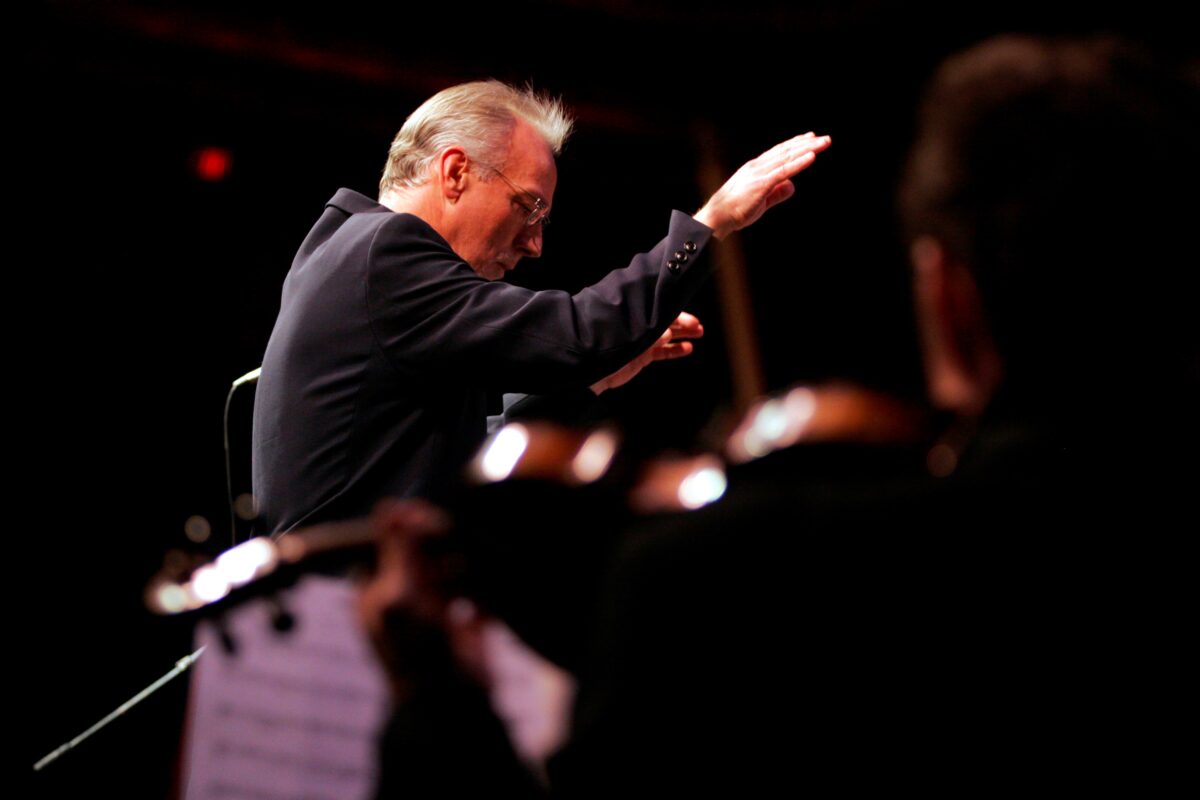
EVERYONE’S ENGAGED: Neumeister will keep both rhythm sections busy during his concert with the Eastman Jazz Orchestra.
Neumeister’s connection to Eastman runs deep, even if his physical visits have been few. He has worked alongside and taught many Eastman alumni, and he speaks with particular reverence about the school’s trombone lineage, tracing it back to Emory Remington, who taught at Eastman from 1922 to 1971. Meanwhile, Marshall Gilkes, Eastman’s new associate professor of jazz trombone, is a former student of Neumeister’s from William Paterson University.
As he prepares to return—hopefully without a snowstorm—Neumeister continues to follow a personal rule he set long ago: compose every day, practice every day, and move his body, often through tai chi. “I’m not always successful,” he admits. “But that’s the goal.”
On February 19, that lifelong discipline, curiosity, and adaptability will converge again at Eastman—this time, with rehearsals, a full night’s rest and a little less weather drama.
The Ray Coniff Jazz Ensemble Series presents
Eastman Jazz Orchestra featuring Ed Neumeister
Thursday, February 19, 2026
7:30 p.m. | Kodak Hall at Eastman Theatre