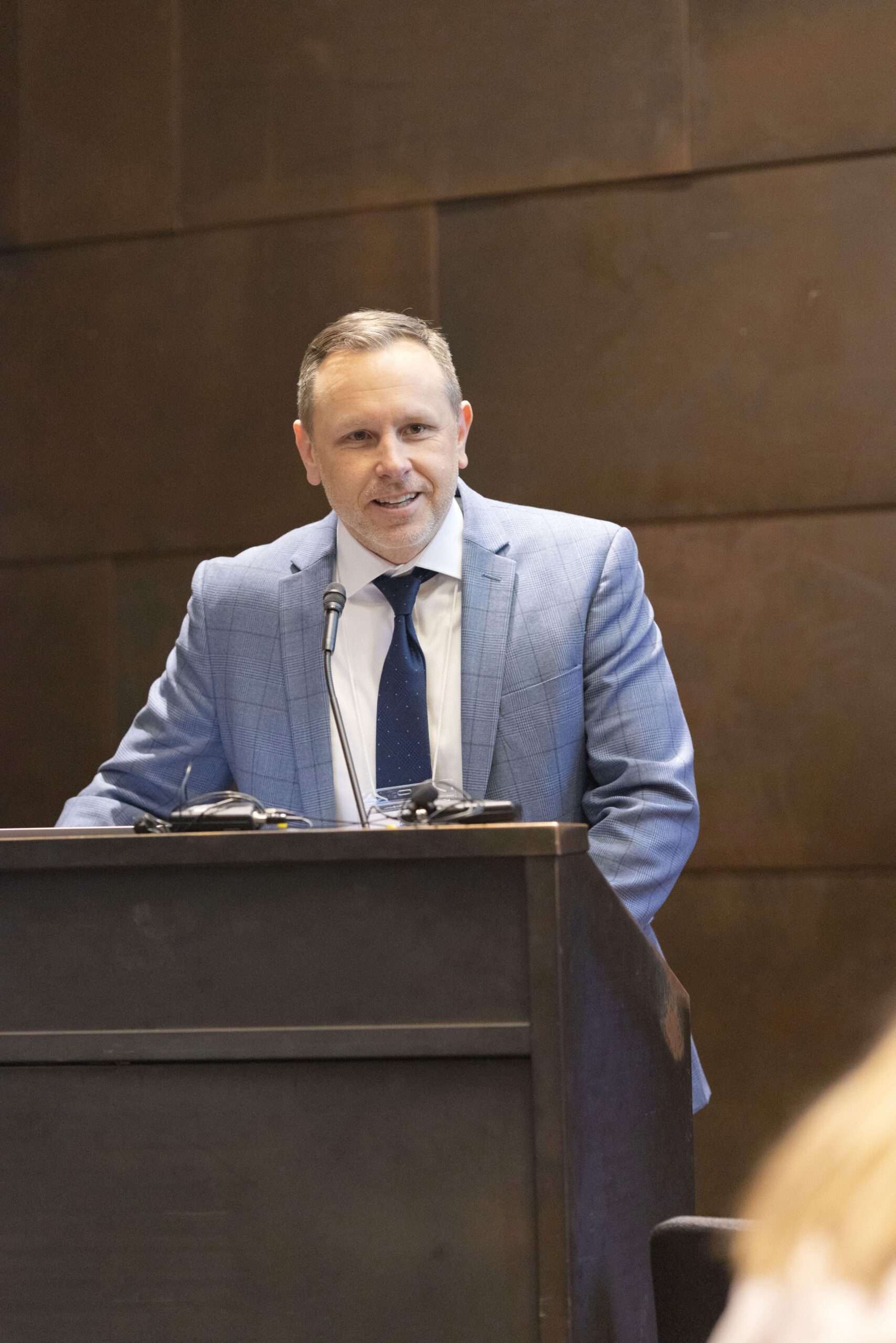
Michael Alan Anderson
Professor of Musicology
Faculty Associate, Susan B. Anthony Institute
Faculty Affiliate, Humanities Center, University of Rochester
Founder and Program Director, ENCORE Chorus
BIOGRAPHY
Michael Alan Anderson is an award-winning scholar of late medieval and Renaissance sacred music, and a musical leader whose work joins historical inquiry, artistic performance, and community life. He is artistic director of Schola Antiqua and founder and program director of Eastman’s ENCORE Chorus, a singing community for people living with dementia and their care partners. Across these roles, Anderson explores how music creates meaning, whether in devotional cultures, through historically informed performance, or in communities facing the challenges of aging and caregiving.
Anderson specializes in sacred music from the fourteenth through sixteenth centuries, illuminating the intersections of devotion and social identity in the late Middle Ages and Renaissance. He is the author of Music and Performance in the Book of Hours (Routledge Press, 2022) and St. Anne in Renaissance Music: Devotion and Politics (Cambridge University Press, 2014). Articles have appeared in various peer-reviewed journals, and he is a two-time winner of ASCAP’s Deems Taylor Award for outstanding writing about music, for articles published in Early Music History (2011) and in the Journal of the American Musicological Society (2013). Anderson’s scholarship and creative work have also been recognized by the American Musicological Society’s Noah Greenberg Award, a National Endowment for the Humanities Summer Stipend, the AMS Alvin H. Johnson Dissertation-Year Fellowship, and the Medieval Academy of America’s Grace Frank Grant. At the University of Rochester, multidisciplinary and humanities awards have supported projects joining scholarship, technology, visual art, and performance, including first recordings for the Memorial Art Gallery’s medieval collection, a symposium on machine-reading medieval music manuscripts, and musical programming created in conjunction with an exhibit on stained glass.
At Eastman, Anderson teaches courses in medieval and Renaissance music, 19th-century music in the United States, and musical cities and cultural encounter. His editorial work has included two widely used histories of Western music published by W.W. Norton. Broader interest in musical institutions and collective identity also informed The Singing Irish: A History of the Notre Dame Glee Club (University of Notre Dame Press), in which Anderson chronicled the history of one of the oldest American choruses on the occasion of its centennial.
Committed to bringing historical sources of music to audible reality, Anderson has served since 2008 as artistic director of Schola Antiqua, a Chicago-based professional ensemble specializing in medieval plainchant and Renaissance polyphony. The group maintains an artistic residency at the Lumen Christi Institute in Chicago and has collaborated with the Metropolitan Museum of Art and museums around the country. These partnerships have shown performance to be a mode of historical interpretation, earning Anderson Chorus America’s 2016 Louis Botto Award for Innovative Action and Entrepreneurial Zeal. Schola Antiqua’s recordings have been released on the Naxos and Discantus labels and have been heard on nationally syndicated broadcasts including With Heart and Voice, Millennium of Music, and Harmonia.
As managing editor of the Eastman Case Studies series, Anderson authored more than twenty case studies and oversaw ten volumes of essays addressing leadership and ethics in contemporary musical life. A 2019 University of Rochester Bridging Fellowship at the Simon Business School supported this work. His case study of The Phoenix Symphony’s participation in clinical research with Alzheimer’s patients led him to found the ENCORE Chorus at the Eastman Community Music School.
Founded in 2024, ENCORE brings people living with dementia and their care partners together with an intergenerational community of volunteers for weekly music-making and social connection. Through singing, storytelling, light movement, and shared conversation, the program creates opportunities for artistic expression and connection within the caregiving relationship. Working at the intersection of community music-making, dementia support, and aging research, ENCORE is supported by the University of Rochester Aging Institute and Eastman Performing Arts Medicine Center and works with allies in the School of Nursing, Memory Care, Geriatrics, Psychiatry, and Health Humanities.
As program director, Anderson guides ENCORE’s artistic, community, and research development, cultivates institutional partnerships, and works to expand access to dementia-inclusive music-making across Rochester. He also serves on the National Advisory Council of the Giving Voice Initiative, a national leader in the development of choruses for people living with dementia and their care partners.
WORKS AND PUBLICATIONS
Books
Music and Performance in the Book of Hours. Routledge Press, 2022. (Introduction and Chapter 2 available through Open Access)
- Winner of the Newberry Weiss-Brown Publication Subvention (2021), which subsidizes the publication of a scholarly book on European civilization before 1700 in the areas of music, theater, cultural studies, or French or Italian literature. (April 2021)
- Subvention award from the Claire and Barry Brook Fund and Margarita M. Hanson Fund of the American Musicological Society, supported in part by the National Endowment for the Humanities and the Andrew W. Mellon Foundation. (July 2022)
- Multiple grants in support of the publication from the Eastman School of Music, Professional Development Funds (February, May 2022)
St. Anne in Renaissance Music: Devotion and Politics. Cambridge University Press, 2014. Chapter 1 – sample • Review in Speculum • Review in Plainsong & Medieval Music • Review in Music & Letters • Review from Renaissance Quarterly • Review in Notes • Appendix B and Errata
- Publication subvention from the Martin Picker Endowment of the American Musicological Society, funded in part by the National Endowment for the Humanities and the Andrew W. Mellon Foundation. (December 2013)
- Subventions from the University of Rochester, Office of the Provost (July 2013) and the Eastman School of Music, Professional Development Funds (June 2013)
The Singing Irish: A History of the Notre Dame Glee Club. University of Notre Dame Press, 2015. Chapter 4 – sample
Articles
“The One Who Comes After Me: John the Baptist, Christian Time, and Symbolic Musical Techniques,” Journal of the American Musicological Society 66 (2013): 639-708. Full text
“Cantus Firmus,” in Oxford Bibliographies in Music. Ed. Kate van Orden. New York: Oxford University Press, 2019 with co-author: C. Aaron James
“The Palatini Partbooks Revisited,” Journal of the Alamire Foundation (2019), 85-96.
“Root, Branch, and Flower: Lineage and Fecundity in the Versified Offices for St. Anne,” in The Book of Nature and Humanity in Medieval and Early Modern Europe, ed. David Hawkes and Richard G. Newhauser, Arizona Studies in the Middle Ages and the Renaissance 29 (Turnhout: Brepols, 2013), 105-129.
“Fire, Foliage, and Fury: Vestiges of Midsummer Ritual in Motets for John the Baptist,” Early Music History 30 (2011): 1-54. Full text
“‘His Name will be Called John’: Reception and Symbolism in Obrecht’s Missa de Sancto Johanne Baptista,” Early Music 39 (2011): 547-61. Full text
“Enhancing the Ave Maria in the Ars Antiqua,” Plainsong and Medieval Music 19 (2010): 35-65. Full Text
“Magnificat – Christianity – Medieval Times and Reformation Era,” in the Encyclopedia of the Bible and Its Reception, 30 vols. (Berlin: Walter de Gruyter), vol. 17, forthcoming.
“The Organization and Complexes of the Q 15 Hymn Cycle,” Studi musicali 35 (2006): 327-62.
“Can Music Heal Our National Divisions?” The Washington Post. Op-ed in Perspective: Made by History. June 18, 2019. (link)
“An Interview with New York Polyphony,” American Choral Review 58 (2020): 20-24, with co-author Laura Lynch.
Reviews
Review of Medieval Music, Legend, and the Cult of St. Martin: Local Foundations of a Universal Saint, by Yossi Maurey, in Plainsong & Medieval Music 24 (2015), 234-40.
Review of The Flower of Paradise: Marian Devotion and Secular Song in Medieval and Renaissance Music, by David J. Rothenberg, in Speculum: A Journal of Medieval Studies 89 (2014), 236-7.
Review of Anne Smith, The Performance of 16th-Century Music: Listening to the Theorists. Oxford University Press, 2011, in American Choral Review 55 (2013): 12-13. Full text
Review of Christopher Page, The Christian West and its Singers: The First Thousand Years. New Haven: Yale University Press, 2009, in American Choral Review 53 (2011): 9-11. Full text
Case Studies
Written for the Eastman Case Studies series (each includes Teaching Notes)
- “Tonality: Unity through Diversity” (Rochester: Institute of Music Leadership, 2021)
- “Gamelan Dharma Swara” (Rochester: Institute of Music Leadership, 2021)
- “Bridging Cultures with the South Dakota Symphony” (Rochester: Institute of Music Leadership, 2020)
- “Fifth House Ensemble and Agent Relationships” (Rochester: Institute of Music Leadership, 2020)
- “The Nashville Symphony” (Rochester: Institute of Music Leadership, 2020)
- “Bridging the Gap: Accountability at the San Francisco Symphony” (Rochester: Institute of Music Leadership, 2020)
- “The Crossing at a Crossroads” (Rochester: Institute of Music Leadership, 2020)
- “Stress, Science, Saliva, and a Symphony” (Rochester: Institute of Music Leadership, 2019)
- “Refugees and Cultural Humility at Buffalo String Works” (Rochester: Institute of Music Leadership, 2019)
- “Chanticleer, Youth, and the Choral Art” (Rochester: Institute of Music Leadership, 2019)
- “Lara Downes: Artist, Activist” (Rochester: Institute of Music Leadership, 2019)
- “Kinnara Ensemble: A Project-Based Choir” (Rochester: Institute of Music Leadership, 2019)
- “Name Calling: The Rebranding of Artis–Naples” (Rochester: Institute of Music Leadership, 2018)
- “Succession Planning at Art of Elan” (Rochester: Institute of Music Leadership, 2018)
- “The Sphinx Organization and the Diversity Marketplace” (Rochester: Institute of Music Leadership, 2018)
- “Composer Marc Mellits” (Rochester: Institute of Music Leadership, 2018)
- “After Monetization: The New Recording Landscape for Artists” (Rochester: Institute of Music Leadership, 2017)
- “My House is Your House: Groupmuse’s Revival of Chamber Music” (Rochester: Institute of Music Leadership, 2017)
- “Building on Trust at the New World Symphony” (Rochester: Institute of Music Leadership, 2017)
- “No Place Like Home: The Industry at a Crossroads” (Rochester: Institute of Music Leadership, 2017)
- “Taking up Residence with Eighth Blackbird” (Rochester: Institute of Music Leadership, 2016)
- “At the Core: Contract Negotiations at the Hartford Symphony Orchestra” (Rochester: Institute of Music Leadership, 2016)
Recordings with Schola Antiqua
- Notker Balbulus: Liber ymnorum (Naxos of America, 2025), Artistic Director (reviews)
- Missa Conceptio tua: Medieval and Renaissance Music for Advent. Includes the first recording of Pierre de la Rue’s Missa Conceptio tua. (Naxos of America, 2014), Artistic Director and liner notes (reviews)
- The Kings of Tharsis: Medieval and Renaissance Music for Epiphany (Discantus Recordings, October 2011); includes first recordings of works by Leonin, Du Fay, Victoria, and Guerrero. Artistic Director and liner notes.
- West Meets East: Sacred Music of the Torino Codex (Discantus Recordings, October 2010); includes first recordings of music from the first three fascicles of this important fifteenth-century manuscript. Artistic Director and liner notes.
- Long Joy Brief Languor (Discantus Recordings, May 2009); features the only known recording of one of the earliest English cyclic masses Missa Quem malignus spiritus. Performer; liner notes.
MEDIA
Schola Antiqua sings “Alla battaglia” (Heinrich Isaac)
Video for the Louis Botto Award for Innovative Action and Entrepreneurial Zeal (Chorus America)
Video explaining the ENCORE Chorus for people with dementia and their caregivers.
MUSICOLOGY