
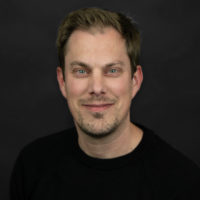
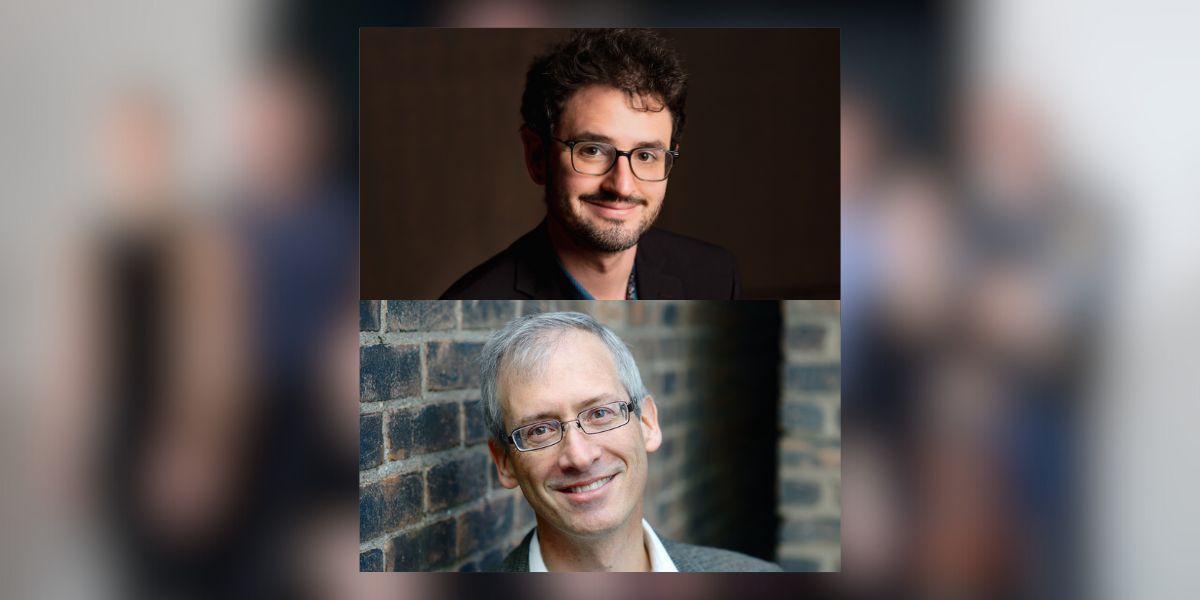
On October 20, the Eastman School of Music presents Songbook, a Faculty Artist Series concert that blurs the boundaries between premiere and revision, collaboration and friendship. The program in Hatch Recital Hall brings together Professor of Composition Ricardo Zohn-Muldoon and Assistant Professor of Composition Daniel Pesca ’05E, ’16E (DMA) with soprano Leah Brzyski, guest composers John Liberatore ’09E (MM), ’14E (PhD) and Ania Vu ’17E, and the Zohn Collective for an evening that explores devotion, memory, and transformation through poetry and sound.
The project, aptly titled Songbook, is far more than a recital. It is the culmination of a yearlong project that included performances, workshops, and collaborative sessions—an ongoing conversation among composers, performers, and poets whose works reflect the complexity and tenderness of the human voice in contemporary life. That sense of alliance is vital for Zohn-Muldoon. “Many of the composers in tonight’s program have long collaborative relationships,” he says. “The composition of these works carries a special component of shared experience, friendship, and trust that is joyful and nurturing to all concerned.”

UNITED BY VOICE: Grammy Award-nominated soprano Leah Brzyski inspired many of the works featured in ‘Songbook.’
“Daniel Pesca’s A few lilies and my work Gypsum were written for Leah Brzyski,” says Zohn-Muldoon. “So, her singing was central to the idea of this project from the start.” The program’s design grew organically from these relationships, expanding to include new works by John Liberatore, Ania Vu, and Eastman’s Professor Emeritus of Composition David Liptak ’75E (MM), ’76E (DMA)—all written or adapted for Brzyski and members of the Zohn Collective. “This is what ultimately binds the works in the program,” Zohn-Muldoon continues. “The musical imagination and interpretive sensitivity of Leah and the performers are as important an inspiration as the poetry itself.”
That sense of shared artistry defines the evening, with each piece finding its center in language—its rhythms, textures, and histories. Ania Vu’s Jak gdyby nigdy nic (“As if nothing had happened”) bends time through the sound of whispered Polish syllables, while John Liberatore’s Night After Night—set to a poem written by Kuwaiti poet Mona Kareem at age 14—unfolds in dreamlike flashes of moons, palms, and quiet grief. David Liptak’s The Locust Tree, receiving its world premiere, turns outward to the natural world, tracing the resilience of the black locust.
Two song cycles serve as the program’s emotional anchors. Zohn-Muldoon’s Gypsum, setting texts by artist Deidre Huckabay, drifts between humor and tenderness as it revisits childhood memories through surreal fragments about a stuffed bear. “Deidre’s texts elicited a playful attitude in my musical imagination,” Zohn-Muldoon notes, recalling echoes of his grandfather’s cuckoo clock and melodies from his youth. Daniel Pesca’s A few lilies, meanwhile, offers a more contemplative vision, drawing on the poetry of Gerard Manley Hopkins and George Herbert to reveal how simplicity can give rise to radiance.
Across these works runs a thread of human connection: composers writing for friends, texts that bridge centuries, languages that reshape sound itself. “Languages certainly evoke different sound worlds,” Zohn-Muldoon reflects. “But what also fascinates me are the historical eras and contexts in which the poetry was written—texts by contemporary women with very different life experiences alongside men from centuries past. This elicits musical responses that treat the ensemble and singer in very different ways.”
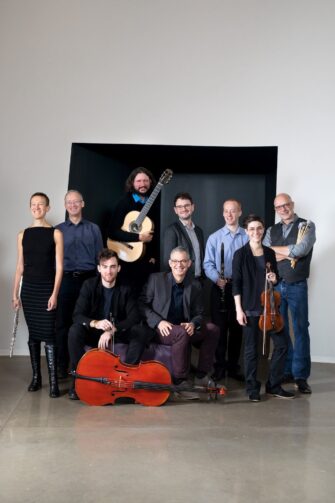
THE ZOHN COLLECTIVE: Regarded as one of the finest chamber music ensembles in the country, the group is dedicated to the performance of contemporary art music.
That balance—between eras and voices—gives Songbook its distinctive shape. Liptak’s instrumental duet sits, as Zohn-Muldoon puts it, at the “fulcrum” of the program, connecting the vocal cycles that precede and follow it. “While the composers in the program bring distinctly diverse musical sensibilities and poetic affinities,” he says, “we all composed or revised our works for the specific musicians performing this evening. That’s what binds it together.”
For the Zohn Collective—a flexible chamber ensemble co-directed by Zohn-Muldoon and Pesca—this spirit of exchange is foundational. The group’s work often unfolds across media and borders, pairing new music with dance, puppetry, and visual art. “Self-generated projects tend to be the most rewarding musical experiences,” says Zohn-Muldoon. “They allow us to work with collaborators we value deeply—as musicians and as friends.”
Bringing such works to life requires more than artistry alone. Grants from the Humanities Center at the University of Rochester, Eastman’s Institute for Music Leadership, New Music USA, and the Ditson Fund provided crucial support for this project, enabling the ensemble to commission new works and share them with the community.
The result is a concert that mirrors Eastman’s evolving role in contemporary music—a place where experimentation is inseparable from collaboration. “Eastman’s composition program fosters an open community in which students and faculty can chart creative paths that respect their individual expressive needs,” says Zohn-Muldoon. “At the same time, we all value musical skill, self-reflection, and creative intelligence. This program clearly reflects that.”
Faculty Artist Series: Ricardo Zohn-Muldoon and Daniel Pesca – “Songbook”
Monday, October 20, 2025
7:30 p.m. | Hatch Recital Hall
Tickets for Eastman’s Faculty Artist Series are $10 for the general public (unless otherwise noted) and free to University of Rochester ID holders. General Admission tickets will be available for purchase at each concert. Visit EastmanTheatre.org for more information.
If you can’t attend this event in person, Songbook will be livestreamed using Eastman’s new 4K camera system. Click on the link above to access the livestream.