

This article first appeared in the Fall 2025 issue of NOTES, Eastman’s alumni magazine.
…
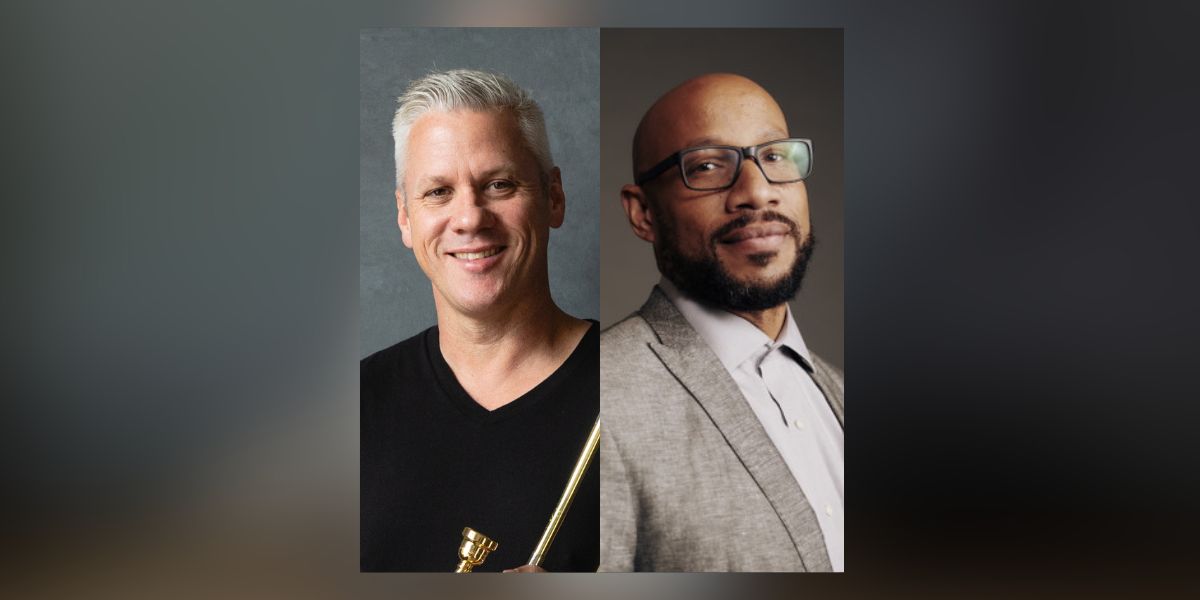
This fall, the Jazz Studies & Contemporary Media department welcomed two new faculty members whose careers span Grammy nominations, international tours, and deep roots in jazz education.
Otis Brown III, a native of Hackensack, NJ, assumed the role of Assistant Professor of Jazz Drum Set, while Marshall Gilkes, originally from Camp Springs, MD, joined as Associate Professor of Jazz Trombone. Though they both hail from the east coast, Brown and Gilkes share more than geography. Each was raised in a musical household, absorbing the sounds, values, and discipline of the craft from an early age. That legacy, paired with their years on the circuit and in the studio, now informs their teaching philosophies at Eastman. We caught up with both new faculty members to talk about early influences, musical mentorship, and what students can expect in the years ahead.
Marshall, what sparked your passion for music, and how has that evolved throughout your career?
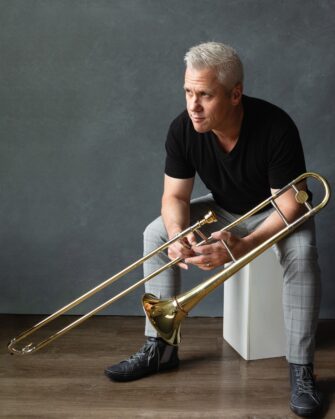
AN EASTMAN LEGACY: Gilkes is drawn to the excitement and unpredictability of improvisation. Photo courtesy of Marshall Gilkes.
“Music has always been a part of my life. Both of my parents were musicians—my father studied trombone at Eastman in the 60s and later became a conductor in the Air Force Band, while my mother was a singer and taught piano and voice lessons from home. I grew up attending my dad’s concerts, which eventually led me to discover jazz through the big band that was part of his group. From the beginning, I was drawn to the excitement and unpredictability of improvisation. That thrill is still with me today, and I remain just as passionate about music and the endless possibilities of creative expression. I’m always seeking new ideas and concepts to explore.”
Can you share a highlight from your career that shaped your perspective as a musician?
“That’s a tough question because there have been so many meaningful moments. However, I’d say my recent work with the WDR Big Band in Germany stands out. Over the past 10 years, I’ve had the privilege of being a composer, arranger, soloist, and conductor with the band, and that experience has significantly shaped my current perspective as a musician. The three albums I’ve made with them have given me the opportunity to explore all the aspects of music I love— playing, writing, recording, and conducting.”
How would you describe your teaching style, and what do you hope students take away from their time in your classroom?
“I’d describe my teaching style as straightforward and engaging. I’ve always appreciated teachers who are direct and honest, so I aim to be the same. At the same time, I try to make the learning experience fun and inject humor into my lessons. I want students to leave feeling motivated and inspired, so I spend a lot of time playing during lessons—whether it’s trading choruses over a standard or playing a duet together. I also bring in music I’m preparing for my outside performances, giving students a real-world glimpse into the life of a professional musician. My goal is to show them what they need to develop to play the same gigs and work in the industry. While we primarily focus on jazz and improvisation, I want my students to graduate with the skills needed to excel in any musical setting they may encounter.”
Otis, what sparked your passion for music and how has that evolved throughout your career?
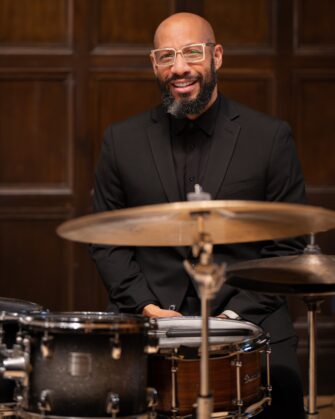
ENDLESS POSSIBILITIES: Brown’s teaching philosophy is rooted in meeting students where they are. Photo credit: Lauren Sageer
“I think my passion for music was sparked by my parents—they were both music educators. My dad’s a drummer, and my mom played piano, taught, and led choirs. The church I grew up in, back in Hackensack, NJ, was also hugely influential. Hearing music there was formative, and it’s the same church I still attend and play at today. I was involved in school bands starting in elementary school, and while I always knew I wanted to do something in music, I originally thought I’d become a music educator. But once I discovered performance as a path, it really piqued my interest. I wanted to be on stage playing shows, connecting with people. Music has this ability to move people, and I love being part of that. That connection, that emotional spark, is what drew me in, and it’s also how my relationship with music has grown. But education has always been at the heart of it—because of my parents—and coming here to Eastman feels like a continuation of what I’ve always been meant to do.”
Can you share a highlight from your career that shaped your perspective as a musician?
“I’ve had a lot of incredible experiences—like playing with Herbie Hancock, Terence Blanchard, and Wayne Shorter—but one that truly shaped my career was meeting jazz trumpeter Donald Byrd. During my last two years at Delaware State University, he came on as artist-in-residence, and everything changed. Byrd opened my mind to new possibilities. I didn’t really know what I was going to do after college until he suggested that I had the talent and ability to pursue music as a career—performing, recording, making it my life. He planted that idea in me. Just being near him was a turning point. He became a mentor. Even after I graduated, I’d call him for advice, go visit. Donald Byrd was such an icon, a true legend in jazz and beyond. I was incredibly fortunate to be around him. I always tell people: he changed my life. Hearing someone of his caliber say I could do this too—that gave me the confidence to go for it.”
How would you describe your teaching style? And what do you hope that students will take away from their time in your classroom?
“My teaching philosophy is rooted in meeting students where they are. I want them to understand that the possibilities are endless—especially in jazz. While there are foundational skills that absolutely need to be learned, this genre is a melting pot. If something is used musically and with intention, it’s acceptable to me. I often tell students that the level of your mastery is directly tied to the depth of your study. There’s no shortcut, but there is always a path. I want them to leave my classroom believing that whatever direction they want to pursue—and whatever level they’re aiming for—is within reach, as long as they’re willing to put in the work.”