
This article first appeared in the Fall 2024 issue of NOTES, Eastman’s alumni magazine.
…
By Anna Reguero
When Howard Hanson Recital Hall was first dedicated on Thursday, February 19, 1976, Howard Hanson, who directed the school from 1924 to his retirement in 1964, stood before an audience of luminaries such as Eastman Director Robert Freeman, Professor of Chamber Music John Celentano, and Professor David Craighead as he marveled at how the drab classroom of room 406 was imaginatively and magically transformed into what he called “a beautiful architectural fantasy.”
Expressing gratitude for the dedication, he told the audience that “this lovely little hall with its hundreds, and eventually thousands of recitals by gifted young performers, is bound to become the very heart and soul of our institution.”
While Howard Hanson Recital Hall has been an important space for smaller recitals, studio and master classes, and as additional classroom space, its original design has posed challenges, especially for the changing needs of a contemporary music school. The stage was cramped and inaccessible, the blue fabric seats had become worn and uncomfortable, the acoustics were inflexible and ineffective, and there were limited ways for performers and instructors to use the space. Almost 50 years after it was first dedicated, the recital hall needed updates to make the space more functional for the twenty-first century.
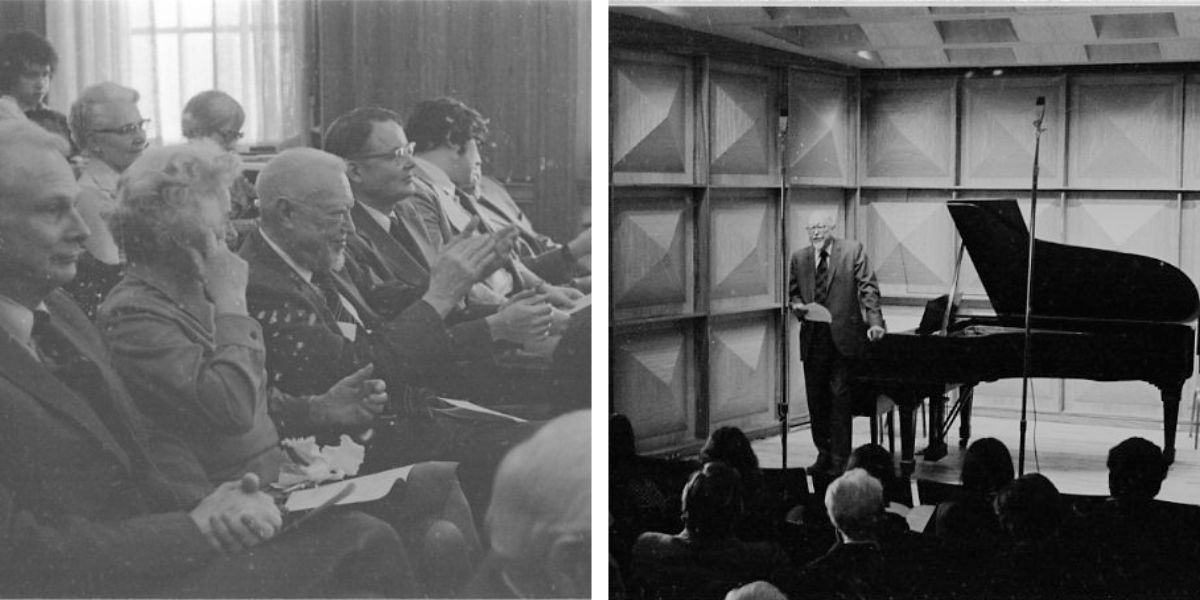
Left: The audience at the Howard Hanson Recital Hall dedication concert. Center row, L-R: University Chancellor W. Allen Wallis, Mrs. Hanson, Dr. Hanson, University President Sproull, Eastman Director Robert Freeman, and Professor of Chamber Music John Celentano. Right: Howard Hanson speaking at the Howard Hanson Recital Hall dedication in 1976. Photo credits: Louis Ouzer.
To bring the hall up-to-date and cement its multi-use functionality, Eastman’s prior dean, Jamal J. Rossi, prioritized Howard Hanson Recital Hall as his final renovation project. Over two years, the Howard Hanson hall was redesigned, fully gutted, renovated, and debuted anew in January 2024. The only original details that remain are wall paneling on the far wall of the hall as well as the auditorium ceiling and floor, which was refinished. (The floor and ceiling of the stage were renovated). Also remaining is a steel beam behind the walls that was signed from 1975, during the original renovations. In this renovation, the hall received a complete facelift—from the stage to the walls, seats, and even greenroom—and many technological enhancements. Now, Howard Hanson Recital Hall is the school’s most coveted small performance hall, classroom, recording space, and virtual meeting room. It has the most technologically advanced capabilities of any other room in the school.
“The complete renovation of Howard Hanson Recital Hall complements the recent renovations of Eastman’s other performance venues—Kodak Hall at Eastman Theatre, Kilbourn Hall, and the Hatch Recital Hall,” said Rossi. “As one of the most state-of-the-art locations on the Eastman campus, Hanson Hall is now a multi-use space that integrates highly advanced technology into an acoustically and aesthetically pleasing hall. It also houses a beautifully restored 1906 Steinway piano. I am grateful to the many craftspeople, technicians, and Eastman colleagues who brought this project to fruition.”
The hall is extremely compact: With 57 seats (down a few seats with this renovation), the hall measures just under 1,100 square feet, which includes the greenroom. Despite the challenges of such a small space, Eastman’s facilities team packed in the hall’s capabilities to ensure the space would benefit performers, professors, scholars, and administrators. Every detail was thought through with the help of Rochester-based CJS Architects, who designed a modern space that retained room’s historical elements, and Building Services Group contractors, who carried out the design despite any behind-the-wall surprises of a century-old building. All hired contractors on the project were local to Rochester.
“The concept was a top to bottom renovation with really great technical accoutrements,” remarked Kevin Gibson, Executive Director of Operations, who brought his experience on the Kodak Hall and East Wing renovations to this project. “We wanted it to be cosmetically beautiful and wanted to bring it up to date with current needs.”
Paul Spaulding, Director of Facilities and Auxiliary Operations, who managed the day-to-day aspects of the renovation project, says that the facilities team worked hard to understand and implement details that would make the space functional for the various stakeholders who use it. He joked that multipurpose spaces tend to serve no one function well. But, he assured, “we’ve tried to come really close.”
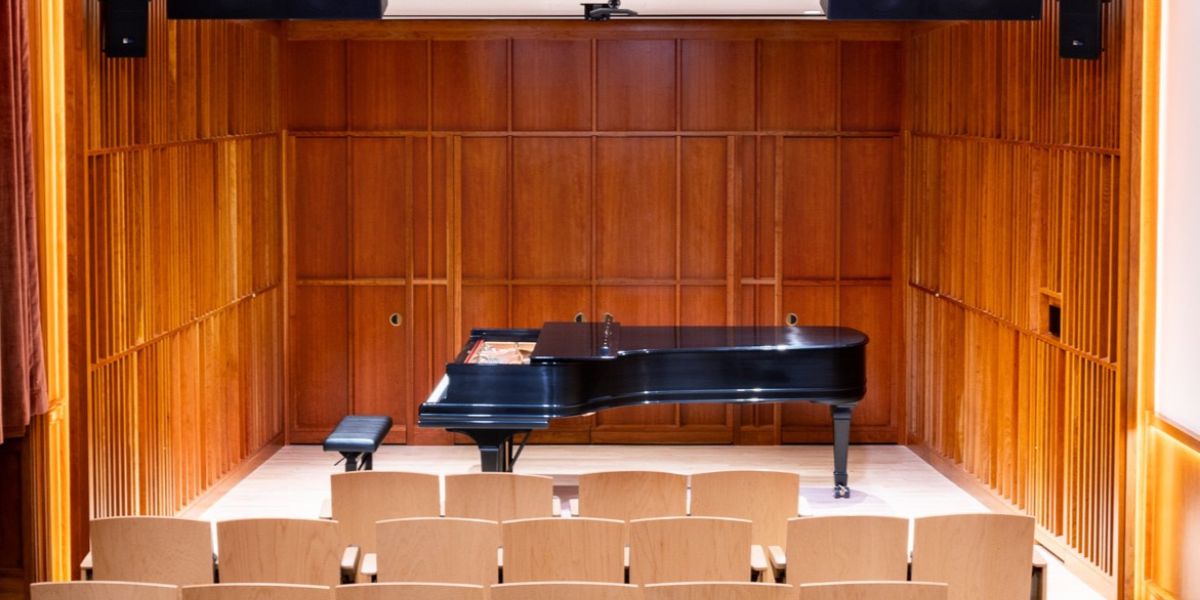
The hall received a complete facelift. The paneling on the far wall (with the window) is original and provided the color palette for the updates. Photo credit: Kurt Brownell.
The previously raised stage was removed and rebuilt to audience level with matching maple floors and a band of red cherry wood to delineate the stage from the seating area. The stage walls are designed from wooden ribs, each individually milled at unique angles beneficial to projecting sound. All around the stage walls are hidden doors that keep cables and connectors neatly out of view and contain an all-important touchscreen control panel that controls all the room’s brand-new technologies.
For performances, the touchscreen panel helps users control new stage and house lighting, fully dimmable, that comes with several preset options for concerts and events, including color mood lighting. It additionally controls curtains and blackout shades on the far wall of the auditorium, where two layers of window treatments were added to prevent noise infiltration from the street. For acoustic tuning, a new curtain hidden behind the ribs of the back wall can be adjusted to help liven or dampen the sound as needed, also controlled also by the stage panel.
Performers can newly self-record audio and video from the control panel, eliminating the need to bring in personal recording equipment. Two 4k cameras positioned on the back wall of the hall are controlled from the panel, allowing for multiple angles to be captured, including one specifically to zoom in on piano hands. A high-quality stereo microphone hangs from the stage ceiling. Recordings are transferred overnight to a hard drive that students can access at the school’s media lab, where they can self-edit the file.
“That’s never been available before to Eastman students,” explained Mark Wazowicz, Director of Technology and Media Production, who helped plan the hall’s new technological capabilities. It’s a feature he hopes to bring to other performance halls in the school in the future.
A moveable and height-adjustable lectern with a fully connected PC computer and nearly every type of connector transforms the stage into a presentation area for classes, meetings, and other major events. It can broadcast to a drop-down screen that is ensconced within the ceiling of the stage when not in use, keeping it out of sight for concerts. A long-arm document camera is connected to the lectern, which functions as a chalkboard replacement: scores and other documents placed on the lectern table are magnified on the screen projector, allowing for close-up, real-time annotations.

Left: The new ADA-compliant lectern features a networked computer and a long arm document camera that projects to a drop-down screen. Photo credit: Kurt Brownell. Right: The room is controlled through a touchscreen panel, the same type and interface as in classrooms across the University. Photo credit: Kerry Lubman.
The hall’s new connectivity includes a Poly device that can hook in and allow for highspeed conferencing to other Poly devices around the world, making virtual meetings with other institutions a breeze. A special round microphone is positioned on the stage ceiling to effortlessly pick up voices. Zoom and other video conferencing works too, thanks to a new wireless connection point for the hall.
A 5.1 surround sound system of Meyer Sound speakers means not only that recorded music can be listened to in high definition but that it will be an especially friendly space for electronic sound experimentations. The lectern also has a slide-out table to hook up equipment like turntables; similarly, there are hidden connectors at the back of the hall to hook in additional equipment for sound mixing.
Of the technology, Wazowicz said, “We have created a lot of options for how people can use the room. But we also tried to keep it as simple as possible so that you don’t have to be a tech person. You can just walk-in, touch a couple of buttons on the touch panel, and hopefully be off and running.”
An effort to standardize the University of Rochester’s technology, the control panel in Howard Hanson Recital Hall matches those in other renovated classroom spaces across the University. At Eastman now for two years, Wazowicz brought his previous experience in the Event Classroom Management department at the University, where he was responsible for updates to its 300 plus classroom and meeting spaces, upgrading speakers, connectivity, and other technologies around the campus.
In another major change to Howard Hanson Recital Hall, the back of the stage now fully opens into a sound insulated greenroom, which now has ample space to house the hall’s lectern and its rebuilt 1906 Steinway piano out of stage view. The greenroom is also home to what they call “the brains,” a tall tower with endless wires that runs all the technological connections for the hall, and which patches the hall into the audiovisual control centers in the school’s basement, where concerts and events can be recorded and livestreamed by the school’s audiovisual pros.
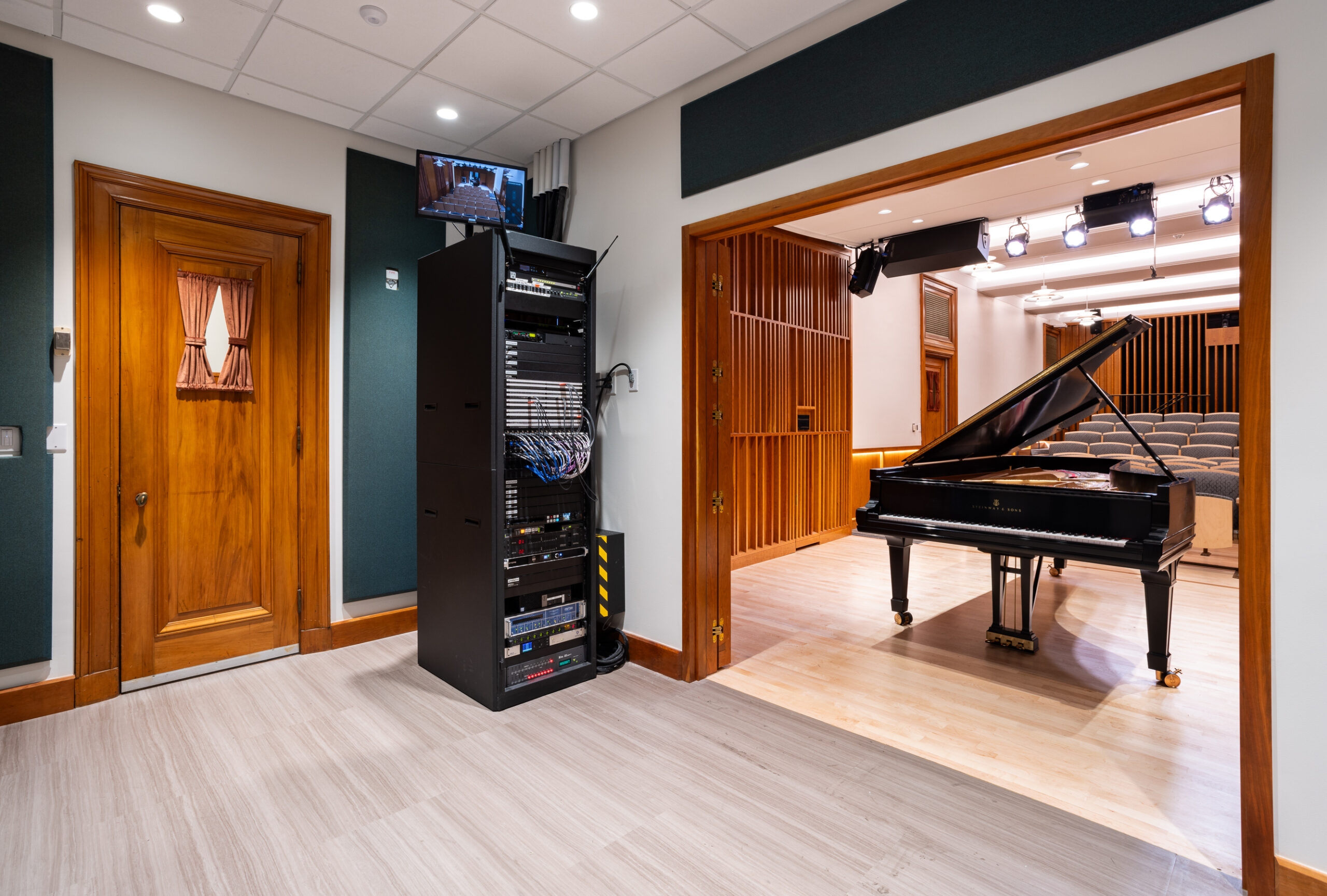
The back of the stage now opens to a greenroom. It can house the hall’s piano and lectern, and also contains “the brains” of the hall. Photo credit: Kurt Brownell.
Audiences will also benefit from enhanced comfort. More supportive seating with tablet armchairs were built and installed, with a formal grey fabric and wood accents to match the hall’s floor. Ugly florescent lights were replaced with cove lighting and additional fixtures by Scandinavian designer Louis Poulsen, all with energy-efficient LEDs for maximum control. All materials were chosen to complement the color tones of the original wood paneling of the hall.
Accessibility was a significant concern throughout the auditorium: while the stairs up the sides and back of the hall remain, new brass bannisters were added as well as security lighting. The front two rows of seats are on skids so they can be removed for handicapped access. And the now floor-level stage provides yet another point of accessibility compared to the prior stage, which required a step up. The hall’s height-adjustable lectern is also Americans with Disabilities Act compliant.
Facilities continues to tweak the space as the Eastman community breaks in the hall. But the result? “I consider it a great success,” concluded Gibson, who oversees all facilities projects.
Spaulding reflected, “We’re spoiled, those who get to build things like this, because we leave a legacy for years. It’s not like writing a paper or punching a form and passing it on, where there’s not much of a record for perpetuity. This will last for 50 years. And if we do it right, we’re remembered for that. There’s a huge amount of pride in being able to do something like this.”
There are several facilities projects in the works next: replacing hot water tanks and boilers, updates to basement practice rooms, installing new awnings, and more. And with the slew of retirements and new faculty recently hired—12 new faculty joined the school last year, and another five this academic year—the facilities staff has kept busy on faculty studio upgrades.
But it’s the less glamourous projects that need attention: the infrastructure of the 100-year-old school, critical systems that keep the heat, water, and lights on. The school’s audiovisual control rooms also need upgrades to be able to better produce high quality recordings and livestreams. Spaulding and his team hope that funders will understand the necessity of projects that aren’t as forward facing as concert halls.
Spaulding shared, “If I’ve got 10 to 12 years left, I’d like to replace those systems during that window, so when I walk out the door, we can say we left it in good stead for the next group.”